
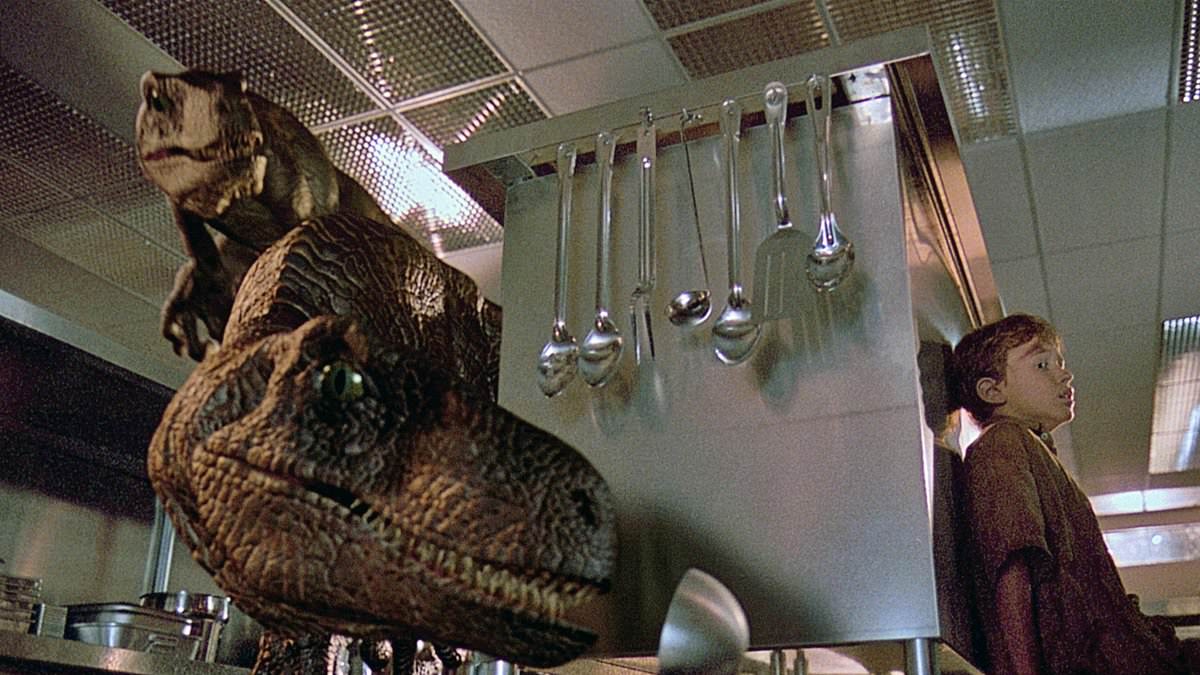
If watching Jurassic Park was the start of a childhood fascination with the Stegosaurus, Velociraptor, or T.rex, scientists say you are far from alone.In fact, a new study shows that the 1993 blockbuster had such a lasting impact that people only care about a dinosaur species if it appeared in the movie franchise.Researchers analysed 3.5 billion Wikipedia page views from 2015 to 2025 to see which dinosaur species still captivate the public imagination.This revealed that an appearance in the Jurassic Park franchise was the strongest predictor of modern public interest.Besides their film appearances, the public were more interested in large, meat-eating dinosaurs.But even the biggest, scariest predators barely get any attention if they haven't secured some screen time. Dinosaurs only get attention from the general public if they have been featured in the Jurassic Park franchise, with other factors like time period and size having a much smaller effect A new study shows that the 1993 blockbuster had such a lasting impact that people only care about a dinosaur species if it appeared in the movie franchiseAs the researchers point out, dinosaurs occupy an almost bizarrely prominent place in our imaginations.Despite the last dino having died off 66 million years ago, these prehistoric beasts can still be found in video games, movies, children's toys and T-shirts around the world.The Natural History Museum, home to the UK's biggest collection of dinosaur fossils, attracted over 7.1 million visitors last year.Meanwhile, Steven Spielberg's Netflix Documentary, The Dinosaurs, drew 10.4 million views in the first week of its release.However, while scientists have discovered over 700 dinosaur species, public attention is focused on only a handful of prehistoric giants.In the past, experts had thought that size and diet would be the biggest factors that determine public attention, with giant predators dominating our interest.However, in their paper, published in the journal Biology Letters, the researchers show that biological factors are not what gives a dinosaur star power.Lead author Dr Pamela Lima, of the Federal University of Alagoas, told the Daily Mail: 'While being large and fierce naturally attracts human attention, media exposure is the ultimate driver.'Our models reveal that appearance in the Jurassic Park movie franchise is the strongest predictor of contemporary public interest, surpassing biological traits such as size or whether the dinosaur was a carnivore.' Researchers found that appearance in the Jurassic Park movie franchise (pictured) was the strongest predictor of public interest in a dinosaur species Larger, meat-eating dinosaurs were more popular than their smaller, plant-eating counterparts, but dinosaurs with screen time got much more attention Smaller dinosaurs and plant eaters are still at a biological disadvantage in the competition for our attention, but Dr Lima and her co-authors believe the 'blockbuster effect' can overcome these issues.That allows herbivores, like the triceratops, and smaller dinosaurs like frilled Dilophosaurus to become just as popular as big predators.Additionally, the franchise doesn't just show these animals; it continuously updates and reinforces their relevance for new generations through sequels and spin-offs.Co-author Dr Ricardo Correia, Associate Professor in Biodiversity and Sustainable Futures at the University of Turku, told the Daily Mail: 'The Jurassic Park franchise, including the books and the movies, has helped to both raise awareness of certain dinosaurs and contribute to materialising in our collective imagination how these extinct creatures might have looked and behaved.'I think this increased attention towards dinosaurs is positive because it can represent a first step for people to engage with and become more interested in the natural world.'For example, it can contribute towards increased visitation of natural history museums or paleontological sites.'However, the researchers aren't just interested in what makes one type of dinosaur a superstar. The scientists say movie appearances overcome biological disadvantages like size, making even quite small species like the Dilophosaurus (pictured) more popular Since no one has ever actually seen a dinosaur, they are a perfect 'natural experiment' to help understand what makes the public care about particular species.This is important because many species face what scientists call 'society extinction', meaning they fade from human memory before going extinct in the wild.While top predators like sharks and big cats hold a tight grip on public attention, less exciting species are at risk of being overlooked and underprotected.But if the blockbuster effect can get people talking about a long-extinct lizard, it could also help conservationists raise the profile of Earth's most vulnerable species.Dr Lima says: 'It proves a great point: we can manufacture cultural visibility through compelling storytelling.'By understanding how a movie made people obsessed with animals that have been dead for 66 million years, conservationists can use that same narrative-driven storytelling playbook to generate cultural visibility and save the living species we still share the planet with.'HOW THE DINOSAURS BECAME EXTINCT AROUND 66MILLION YEARS AGODinosaurs ruled the Earth around 66million years ago, but suddenly disappeared in what is known as the Cretaceous-Tertiary extinction.It was believed for many years that the changing climate destroyed the food chain of the huge reptiles. However, in the 1980s paleontologists discovered a layer of iridium - an element that is rare on Earth but found in vast quantities in space. When this was dated, it coincided precisely with when the dinosaurs disappeared from the fossil record. A decade later, scientists uncovered the massive Chicxulub Crater at the tip of Mexico’s Yucatán Peninsula, which dates to the period in question. Scientific consensus now says that these two factors are linked and they were both probably caused by an enormous asteroid crashing to Earth.With the projected size and impact velocity, the collision would have caused an enormous shock wave and is likely to have triggered seismic activity. The fallout would have created plumes of ash thought to have covered the whole planet, making it impossible for dinosaurs to survive. Other animals and plant species had a shorter time-span between generations which allowed them to survive.There are several other theories as to what caused the demise of the dinos. One early theory was that small mammals ate dinosaur eggs and another proposes that toxic angiosperms (flowering plants) killed them off.
The Jurassic Park effect: People only care about dinosaurs if the species was featured in the movie franchise, study finds
Full Article
Original Source
Read the full article at Dailymail →KhanList aggregates and links to publicly available news content. We do not host full articles from third-party sources. Always verify important information with original sources.