
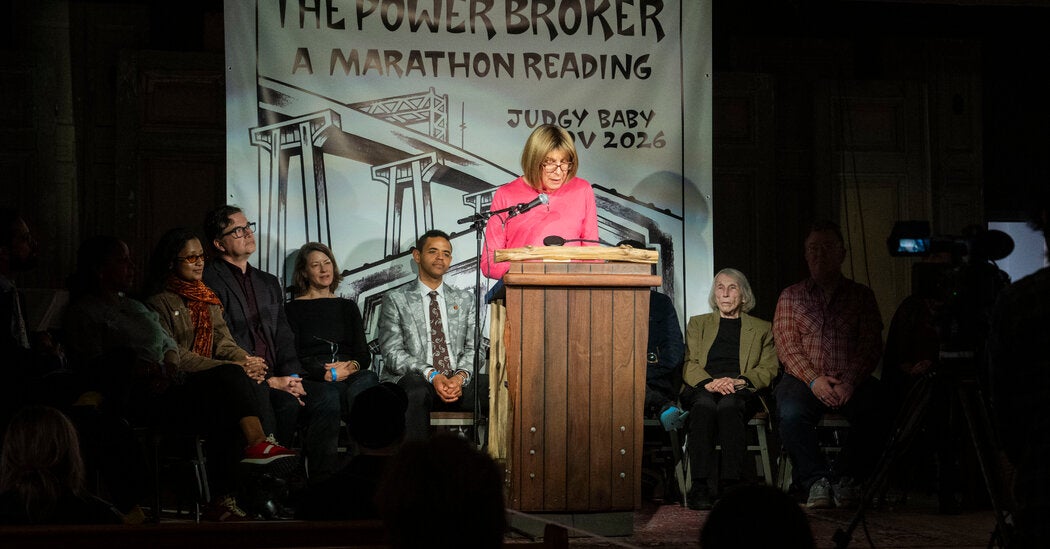
AdvertisementSKIP ADVERTISEMENTNew Yorkers read the 1,162-page book around the clock for four days, reflecting on the legacy of Robert Moses and celebrating its author, Robert Caro, who read the final pages.Bernie Wagenblast, widely known as the voice behind New York City subway announcements, was among hundreds of people who read portions of Robert Caro’s “The Power Broker” at a marathon event in Brooklyn.Credit...Hiroko Masuike/The New York TimesEmma G. FitzsimmonsEmma G. Fitzsimmons first read “The Power Broker” in 2016 when she covered New York City’s transit system.Nov. 15, 2026, 7:25 p.m. ETThere was a union organizer who had spent the day meeting with biology researchers in Manhattan. There was a biographer of Albert Einstein who had just returned from a reporting trip to New Mexico. There was a “street librarian” from the Bronx who arrived in Brooklyn by subway and Uber after 1 a.m.There was a descendant of a Depression-era mayor, several current government officials, a few college professors and the voice of the subway announcements.Each climbed to the third floor of a cavernous space in an old brick building that was once a paint factory to read about 1,300 words of what has been celebrated as one of the best American nonfiction books: Robert Caro’s “The Power Broker.”Over 66 hours, hundreds of people took turns onstage reading aloud from the monumental 1974 book chronicling the life and projects of Robert Moses, the polarizing great builder who is responsible for much of modern New York City.At 9 p.m. on Thursday, there was wine and a picked-over charcuterie board as readers recited passages about Mr. Moses’s childhood. At midnight the next night, there were scenes about his penchant for retribution and the 255 playgrounds he built in the 1930s.And all throughout, there was Mr. Caro’s rhythmic and mesmerizing prose and the torrent of vivid details uncovered by his obsessive reporting.ImageBrad Vogel, left, organized the event with a group of volunteers. Asad Dandia, center, the Brooklyn borough historian, read a section of the book on Thursday night, calling it “a grand narrative.”Credit...Hiroko Masuike/The New York TimesImageMr. Caro, 91, did not appear in person, but made a video of himself reading the book’s final pages.Credit...Michelle V. Agins/The New York TimesThe event ended on Sunday afternoon — after 402 readers and 1,162 pages — with a video of the author reading the final two pages. Mr. Caro, 91, described how an aging Mr. Moses was “forgotten — to live out his years in bitterness and rage,” unable to understand his fall from power.“Couldn’t people see what he had done?” he read. “Why weren’t they grateful?”Unlike Mr. Moses, Mr. Caro is spending the twilight of his career as a beloved figure whose book is being embraced by new generations.More than 1,700 people applied for a 10-minute reading slot at the marathon event at Judgy Baby, a new arts venue in an industrial stretch of the Gowanus neighborhood overlooking the Brooklyn-Queens Expressway, a crumbling highway that Mr. Moses built.Among them were notable figures — a great-granddaughter of Mayor Fiorello H. La Guardia; Mr. Caro’s editor Kathy Hourigan; the subway announcer Bernie Wagenblast — and ordinary fans. Two of the final readers were Henry and Elias Jones, ages 13 and 16.Some fans were disappointed that they did not secure a reading spot, including Marc Molinaro, a former Republican congressman who said he had read the book twice. I joined the reading late Friday, starting on page 502 with a tale about Mr. Moses’s war with a Long Island newspaper publisher who opposed one of his highway projects.ImageKathy Hourigan, a former vice president and managing editor of Knopf Doubleday who worked with Mr. Caro, joined the readers at Judgy Baby, an event space in Gowanus.Credit...Hiroko Masuike/The New York TimesHundreds of visitors dropped in to sit in pews and listen to Mr. Moses’s many contributions to New York’s landscape: 416 miles of parkways, 11 swimming pools, 17 miles of beach, 1,000 public housing buildings.They also heard about the damage he oversaw: the nearly half a million people who were displaced by his projects; the overpasses he built low over Long Island parkways to keep out buses full of poorer city dwellers; the asthma rates in the neighborhoods he carved up; the rail projects that were never built because he preferred car travel.Ujji Bathla, the union organizer, read a passage on Thursday about Mr. Moses’s gilded childhood, in which Mr. Caro remarks on the builder’s “high cheekbones and slim, almost aquiline nose.” Mr. Bathla, 22, lives near Washington Square Park in Manhattan and said he was thinking about how community opposition had stopped Mr. Moses from building a highway through the park. He also simply enjoys the writing.“For a piece of journalism, it reads almost like a novel,” he said.The city has seen other marathon readings over the years, but this one was perhaps the most ambitious. A reading of Sylvia Plath’s “The Bell Jar” in the East Village last month lasted nearly eight hours. A reading of Gertrude Stein’s “The Making of Americans,” held many times since the 1970s, lasted 52 hours in 2024.Ujji Bathla, a union organizer, and Christina Greer, a political science professor, said they were reflecting on how Mr. Moses had shaped the city.Credit...Hiroko Masuike/The New York TimesThe event was organized by Brad Vogel, an environmentalist known for canoeing in the contaminated Gowanus Canal. He and a merry band of volunteers selected the readers, who represented a variety of backgrounds and ZIP codes, and set a nap schedule to make sure that “someone has their hand on the tiller,” Mr. Vogel said.Late on Friday, they were fading. A volunteer dozed off on a giant bean bag. Mr. Vogel fought to stay awake to ring a bell at midnight.“I got 2.5 hours of sleep last night and then I had a 10-minute cat nap,” he said. “People keep buying me pizza, which I really appreciate.”Mr. Caro, a former Newsday reporter who lives on the Upper West Side of Manhattan, is revered for his meticulous research and accessible writing. He is currently working on the long-awaited fifth and final volume of his biography of Lyndon B. Johnson. “The Power Broker,” his first book, is still regarded as a masterpiece, a way for New Yorkers to understand why the city is the way it is.The book received renewed attention during the pandemic, when it became a status symbol in the background of countless video calls. Mayor Zohran Mamdani recently used the book as a prop in a video announcing his plan to fix the Brooklyn-Queens Expressway, though he has acknowledged that, like many New Yorkers, he owns a copy and has not read it.ImageMr. Caro has also written a biography of Lyndon B. Johnson, published in several volumes over decades, with the final installment yet to be completed.Credit...James Estrin/The New York TimesMr. Caro said in a recent podcast interview that he often wondered whether the city needed someone like Mr. Moses now.“I certainly don’t want someone who is ruthless and disregarding public opinion as a Robert Moses,” he said. “But at the same time, you need someone who’s going to find a way to get things built.”Christina Greer, a political science professor at Fordham University who read at the event on Thursday, said she often found herself thinking of Mr. Moses and all the lives he affected — the Puerto Rican neighbors who lived near Fordham’s Manhattan campus in the 1950s and were evicted to make way for Lincoln Center, and the people who couldn’t access his beautiful parkways.“No matter where you live and what neighborhood you’re in, it has somehow been touched by Robert Moses,” she said, “whether it’s your ability to move freely about the city or your inability to move freely about the city.”The Einstein biographer, Laurie Gwen Shapiro, read about Mr. Moses’s mother on the first night. The library evangelist, Brandon Montes, had a slot Saturday at 1:40 a.m. that covered the 6,800,000 pounds of steel used to cover rail tracks and build Riverside Park in Manhattan.The gathering was a chance for New York history buffs to find community in person. It was also an opportunity to debate Mr. Moses’s legacy and the efforts underway to counteract its most damaging effects, including by building more housing and transit.ImageInterest in “The Power Broker” was revived during the pandemic and around the 50th anniversary of the book’s release, in 2024.Credit...Hiroko Masuike/The New York TimesAnd there was room for dissent over the book’s flaws. Asad Dandia, the official Brooklyn borough historian, pointed out on social media recently that there had been more than 50 years of scholarship on urban planning since the book was published. “With the greatest respect to Robert Caro,” he wrote, “our public discourse has to evolve.”Still, Mr. Dandia came to read on Thursday and said he admired the book. It resonates in part, he said, because Mr. Caro framed it around “one titan, a Caesar.”“People are hungry for grand narratives,” he said, adding, “They allow us to coalesce around something, whether it’s supporting or opposing, and Caro offers a grand narrative for New Yorkers.”Emma G. Fitzsimmons is a public policy correspondent for The Times, covering New York City.Related ContentAdvertisementSKIP ADVERTISEMENT
The Joyful Nerdiness of a 66-Hour, Nonstop Reading of ‘The Power Broker’
Full Article
Original Source
Read the full article at Nytimes →KhanList aggregates and links to publicly available news content. We do not host full articles from third-party sources. Always verify important information with original sources.