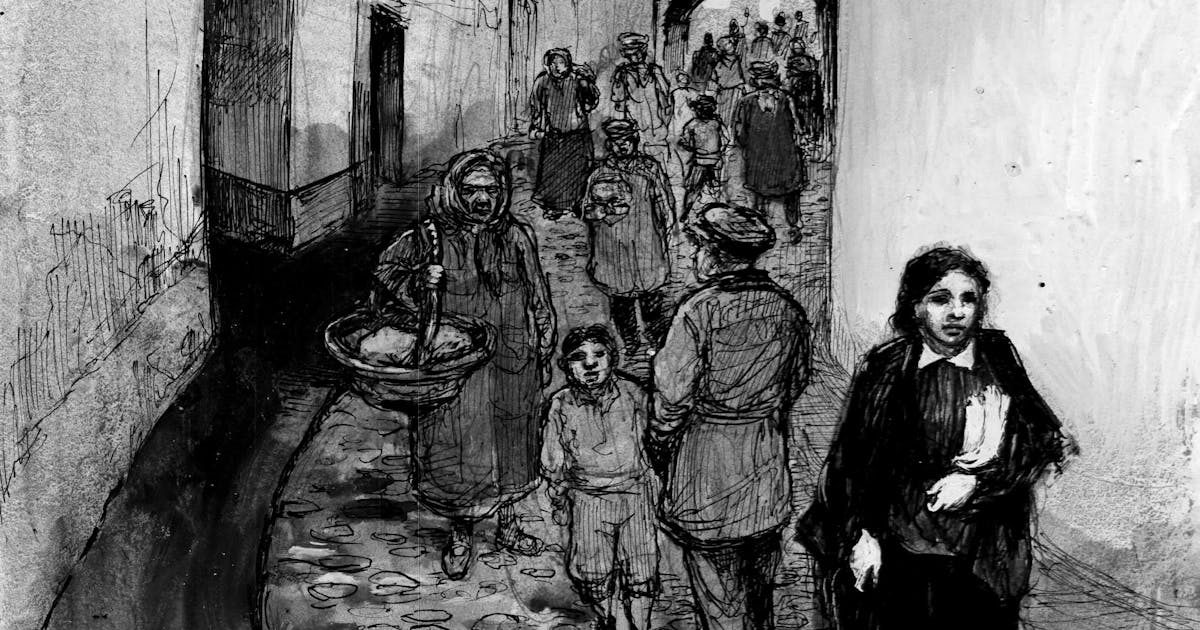
History forgets most activists, but future generations can benefit from exhuming their ideas. Take the Jewish Labor Bund, the lefty, anti-Zionist liberation party that agitated for worldwide socialism while defending its members against the scourge of antisemitism. Formed in 1897, the Bund was the largest insurgent group in the Russian Empire at the time of the 1905 revolution. After the Tsar fell, the Bund reached a new peak in the newly formed Second Polish Republic. And then it all but died, targeted for murder along with most of its members by the Holocaust. Surviving Bundists and their descendants came together in other socialist organizations, and so perhaps it shouldn’t surprise that the tremors of a party formed in the nineteenth century resonate with today’s left. As Zionism gained traction in cities and shtetls, the Bund condemned the oppression of Arabs in Palestine, lamenting that “Zionists have built all their hopes on stripping away the political rights of Palestine’s existing Arab population, who constitute the oppressed majority … and on forcing them from all positions of power.” The Bund published Palestinian voices in its newspapers and denounced the Pandora’s box of chauvinism that Zionism had pried open. Women were equal participants in Bundist affairs during an era when gender parity was vanishingly rare, even if they were subject to the condescension of male comrades. Bundists and their fellow travelers in the United States organized against anti-Black racism: After the 1908 race riots in Springfield, Illinois, Yiddish newspapers called for demonstrations and pooled money for victims; meanwhile, Black newspapers, such as The New York Age, committed extensive coverage to the anti-Jewish pogroms erupting across the Russian Empire. The Bund supported liberation movements throughout the world, resisting a rising tide of fascist governments, land wars, bigotry, and apartheid.Here Where We Live Is Our Country: The Story of the Jewish BundOne World, 480 pp., $32.00While the Bund was primarily active in pre-1945 Europe, the wails of its epoch haunt the present in Molly Crabapple’s new history, Here Where We Live Is Our Country: A Story of the Jewish Bund. Crabapple begins her inquiry with her great-grandfather, the teenage Bundist Sam Rothbort, who may have been involved in the shooting of a plunderous police officer in his native Volkovysk and transformed from a scrappy rebel to a mournful painter and sculptor after he passed through Ellis Island. Though he died before she was born, Crabapple takes the buried past as “a guide for our contemporary moment, in all its horror and possibility, in all its repression, courage, and loss.”Crabapple is perhaps best known as a visual artist, the creator of striking illustrations and lithographs from the Occupy Wall Street protests. She’s also a dogged reporter who has worked in combat zones. She sees a precedent for today’s progressive firebrands in the example of Jewish freedom fighters who opposed prejudice, tyranny, and class stratification in their home countries, without seeking solutions in nationalism and the colonization of distant lands. Anyone, anywhere, she suggests, can tune themselves to the wavelength of revolution.From its early days, the Bund put principle before power. As factory strikes roiled turn-of-the-century Russia, the Russian Social Democratic Labour Party attempted to gather Marxist revolutionaries into a cohesive bloc. Their Second Congress, held in 1903 between Brussels and London, was pivotal—Lenin consolidated control, and the Bolsheviks, who wanted immediate revolution, split from the more gradual Mensheviks. But this summit sidelined another group: the Bund, which, in spite of having 30,000 members at the time (compared to a few thousand Bolsheviks and Mensheviks combined), received just five delegates out of 51. And so they walked out, a decision that did not give them much of a say in the future of Russian politics, Crabapple admits. Yet it’s evidence of a faction that rejected bad compromises and was willing to organize outside of the electoral system. And organize they did. By 1906, when Russia tempered the long-standing absolutism of its monarchy with a parliament, the number of Bundists in the empire had swelled, by some accounts, to 40,000—as the Bolsheviks and Mensheviks grew at even faster rates. Membership in the Bund plummeted in the early 1910s, and, after the Bolsheviks assassinated the royal family, they liquidated the Russian Bund, suppressing the political activities of its members unless they joined the Jewish Section of the Communist Party. Yet with the restoration of Polish independence in 1918, the Bund became a social force in Poland. They printed their own Yiddish-language publication, the Folkstsaytung. They opened the Medem Sanitorium in Warsaw to treat needy children for tuberculosis—an institution that offered kids a chance to edit their own newspaper and elect representatives from their ranks to participate in self-governance; corporal punishment, too, was outlawed in this facility, during a period in which much of Europe treated flagellation as an ordinary aspect of child-rearing. Women founded an organization, YAF, that pushed for equal wages and free childcare, established day-care centers, and circulated information about birth control. Among the tenets of the Bund was a commitment to improving the political situation in their home countries—whether in Central and Eastern Europe or new havens in the United States and even Palestine—instead of seeking to establish a Jewish state. They were neither assimilationist, religious, nor supremacist; they believed in secular Jewish culture and in ending a legacy of persecution without inflicting the same subjugation on others. The problem with Zionism, the Bund believed, was not necessarily Jewish emigration to Palestine—if you must go there, why not just try and live alongside Arabs?—but the desire for Jews to reign over others. “The most important condition for a peaceful life together, for the entire population of Palestine, is the renunciation of the Zionist plan to rule the land against the will of the majority,” the Bund declared in a 1929 resolution. Meanwhile, it was becoming harder for Jews to imagine living anywhere: Many fled to Palestine because the United States effectively stopped the flow of Jewish immigrants with the Johnson-Reed Act in 1924.The Bundists predicted that Zionism would perpetuate a cycle of imperial brutality: “Zionism drew its vital juices from defeats and catastrophes,” wrote the Bundist Emanuel Nowogrodski in his history of the Polish Bund, written before his 1967 death and published posthumously in 2001. Nowogrodski was a general secretary for the Bund’s Central Committee until World War II, a position he relinquished because he was visiting New York when Hitler invaded Poland. (His wife, Sonia, stuck in Warsaw, became a leader of the underground until she was murdered in Treblinka.) For Crabapple, the fiery, foreshortened life of Sonia Nowogrodska is an inspiration, not just a tragedy: She ran a soup kitchen out of the Bund’s headquarters until it was bombed, when she restarted operations around the corner. Here Where We Live Is Our Country denies any narrative defined by victimhood, particularly one that suggests hopelessness as an essential theme of Jewish existence. This feels more surprising than it should. Crabapple proceeds from a refreshing assumption that Jews were agents of history and not mere casualties of its worst tendencies, that the footprint of anti-Zionists in the twentieth century was robust and central to Jewish history at large, and that exclusionary notions of Jewish identity were already outdated a century ago. In her book, Jewish forbears are models for anti-colonial fervor and action: staunch souls who, while fending off starvation, disease, overcrowding, and lethal violence in the Warsaw Ghetto, found space and energy to support Gandhi and the cause of Indian independence. Isolated from the world, the Bundists sent telegrams praising Gandhi’s Quit India campaign, a push for Indian self-determination that was sparked by the martial law that Britain instituted to maintain order while it fought the Nazis. No matter that the Brits, like the Bund, were battling Hitler—the Bundists knew that their allies were the colonized, marginal, and exploited.In the interwar period, the Bund had made a place for itself in the civic fabric of Poland, teaming up with the Polish Socialist Party, with whom in 1926 they reluctantly supported a coup by socialist leader Jozéf Piłsudski, who had dreams of a pan-ethnic Poland yet ended up being a vindictive authoritarian—Piłsudski even dissolved Parliament in 1930, jailing his political opponents. The Bund and the Polish Socialist Party grew closer in the subsequent months, their fates bound by a shared enemy. The Polish Socialist Party also understood antisemitism as a serious threat, even as its members became more embattled and, after the 1939 Nazi invasion, increasingly unable to aid Jewish compatriots.The Jews were confined to ghettos, most famously the Warsaw Ghetto, which Crabapple describes with devastating eloquence:People slept everywhere, in corners, hallways, cellars, curbs. The streets were so crowded it took an hour to walk five blocks. You shoved through peddlers, scammers, and feral skeletons who would snatch the bread out of your hands and eat it even while the crowd showered them in blows. The horses had all been slaughtered, so former professionals yoked themselves to rickshaws. Crabapple builds grand, gritty set pieces for the dozens of pages she devotes to the Warsaw Ghetto Uprising, the largest Jewish revolt against the Nazis during World War II. She compares the effectiveness of the Jews to the success of so many guerilla combatants who use their superior knowledge of terrain to humiliate foreign armies. When the Nazis tried to burn the ghetto, the Jewish Combat Organization burned Nazi factories. They donned stolen German uniforms and cloaked their footsteps at night with rags fastened to their feet. Crabapple digs into the fates of the Bundists who helped helm the rebellion, their extraordinary efforts to cling to life, hiding beneath floorboards and fleeing through sewers, and their self-sacrificing deaths.She also chronicles Zionist atrocities toward Jews in Palestine who strayed from the party line. Crabapple writes of Labor Zionists under the British mandate who kidnapped and sexually abused Jewish women if they had romantic relationships with Palestinian men. She explains how, in March 1948, after David Ben-Gurion called for a draft of Jewish refugees in Europe (people who had no formal connection to Israel, a country that would not exist for two more months), officials in displaced persons camps fined, blacklisted, and denied rations to refugees if they refused to enlist in the Haganah, a pre–Israel Defense Forces military. Crabapple tells of a refugee camp in Ulm, Germany, where residents beat the elderly parents of Jews who wouldn’t sign up for the draft. The Bundist newspaper Unzer Shtime expressed shock “that Jews, the standard victims of Fascism and terrorism, would be capable of the kinds of violence Zionists in the camps exercise toward their Bundist and other non-Zionist political rivals.” Chaim Weitzmann, later the first president of Israel, described Zionism’s biggest enemy, back in 1903: This indomitable foe was not the Cossacks carrying out pogroms or the ethnonationalists scapegoating Jews or the empires that pit minorities against one another; it was the Bund.In the United States, the Bund was never at the center of Jewish life. In certain ways, this reflects the group’s guiding ethos. Instead of mapping the same vision they had in Eastern Europe onto the U.S., they coordinated their own experience as Jewish Socialists with the melting pot of a country that was hardly free of antisemitism but also did not target Jewish immigrants for mass butchery. Bundists were a major presence in the Workmen’s Circle, a social justice organization that provided mutual aid—including health insurance and elder care—to socialists across the U.S. and Canada. Bundists headed major unions, such as the International Ladies Garment Workers Union, became leaders in the Socialist Party of America, and helped collect donations for Jews back in Europe. One of the Bund’s major American fundraisers, Meyer London, became a congressman who represented New York’s Lower East Side. Crabapple offers an overview of the Bundists who fled Europe, but there are more detailed surveys of the Bund outside of Europe, such as David Slucki’s The International Jewish Labor Bund After 1945: Toward a Global History. Crabapple’s main interests are the threads that link her back to the old country, where the Bund experienced both its glory days and its gravest challenges.What she does astonishingly well is reframe a decisive, often misconstrued period of European Jewish life, restoring a sense of diversity and complexity to the conversation. Bundist Marek Edelman, a leader of the Warsaw Ghetto Uprising, wrote an invaluable book about the resistance in 1945, which was not sold in Israel or published in Hebrew until 2001. It’s no mystery why: The nation furnished a narrative that such a monumental insurrection was enacted nearly exclusively by Zionist youth militias. Crabapple reorients this tale toward the truth, gifting her readers a compass for their exploration of the past, and a rallying cry for battling the oppressors of now.
The Jewish Radicals Who Wanted Equality for All
Full Article
Original Source
Read the full article at Newrepublic →KhanList aggregates and links to publicly available news content. We do not host full articles from third-party sources. Always verify important information with original sources.