
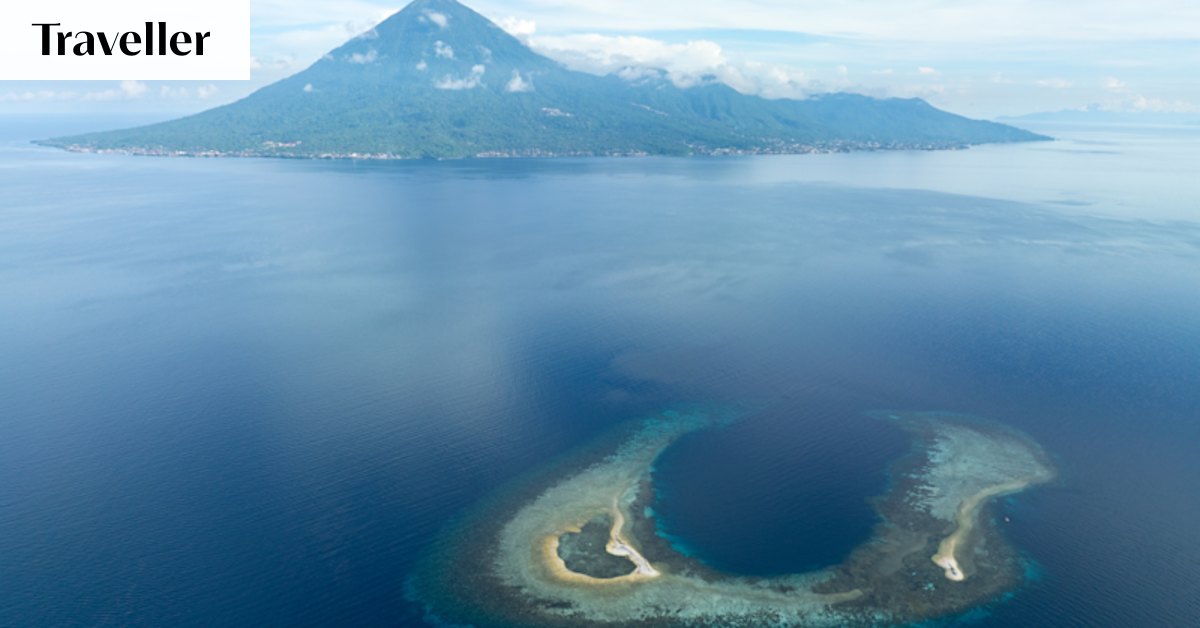
From above, Ternate is a mere pinprick in the more than 1000-island strong Indonesian archipelago of Maluku. But, in its own way, this place has helped shape the world as we know it today.The aroma of nutmeg and cloves here has been largely replaced by the exhaust fumes of countless motor scooters, but the precious spices still grow in the island’s forests – spices that enticed Arab, Persian and Indian traders to this remote part of the world more than a thousand years ago.Mount Gamalama rises above Ternate, in Indonesia’s Maluku islands. Getty ImagesFive hundred years later, the Portuguese, Spanish and Dutch would fight for control of the archipelago, though today the only real disturbances on Ternate come from Mount Gamalama, the volcano towering above the island which still lends it an impossibly exotic air.“Is it alive?” I’d ask a local soon after my arrival. “It smokes in the morning and at night,” he says, putting two fingers to his mouth to mime a drag on a cigarette. That evening a wisp of smoke curled up from Gamalama’s lip.I find myself in Ternate, 3347 kilometres east of Jakarta, as a guest aboard a 14-day, 13-night adventure cruise dubbed “Maluku & Sulawesi: Rare Species, Cultures & Corals”. Operated by On Water Expeditions, a division of the Australian-based World Expeditions group, I’m sailing aboard Ombak Putih, a 42-metre twin-masted schooner or phinisi, as the traditional coastal traders of seafaring Sulawesi, Indonesia’s fourth-largest island, are known. The vessel comfortably accommodates 24 passengers in 12 en-suite cabins, all of which are, thankfully, equipped with air-conditioning.Sign up for the Traveller Deals newsletterGet exclusive travel deals delivered straight to your inbox. Sign up now.Back on the island, an abundance of spices isn’t this region’s only claim to notoriety. There are those who believe that the greatest single idea ever to have fizzed into a human mind was first described in a little house on a side street of Ternate, the island’s small but seething eponymous city.It was in 1858, inside a building that today houses a pet shop, that Alfred Russel Wallace, a self-taught Welsh naturalist, wrote his famous 1858 essay on evolution by natural selection. Wallace laid out his theory that earthly species evolved into their glorious variety via a competitive mechanism he called the “natural means of selection”.The Ombak Putih, a traditional phinisi schooner, takes passengers through the Indonesian archipelago. AlamyHe was at the time four years into an eight-year scientific expedition across the waters in which the Ombak Putih is sailing. Of course, the same theory had occurred to Charles Darwin 20 years earlier, after his celebrated voyage on HMS Beagle. But Darwin – doubtless concerned he may have inadvertently challenged the existence of a god responsible for the creation of all creatures great and small – had conveyed his theory only to trusted confidants, consigning his notes to a desk drawer.Still intending to publish, Darwin was appalled to receive what became known as the “Letter from Ternate” from Wallace, detailing the same theory in startling detail. Nonetheless, Darwin bundled Wallace’s essay with sections of his own treatise and had the papers published together, effectively rendering the pair co-discoverers. What was at first known as the Darwin-Wallace theory of evolution drew little attention for a time, but it would come to upend the world’s understanding of science and nature, botany and biology, of philosophy and religion.The Ombak Putih’s passengers are treated to an esteemed guest lecturer, namely Dr George Beccaloni, a former curator at London’s Natural History Museum and one of the world’s leading authorities on Wallace. Our two-week voyage around the Molucca Sea will include visits to the islands that shaped Wallace’s work. We meet outside the building in Ternate in which Wallace is said to have written his essay, before visiting a 16th-century Portuguese fort and touring the palace of the Sultan of Ternate, dating to the early 19th century.Fort Tolukko, a small fortification on the east coast of Ternate.Getty ImagesMy fellow passengers skew adventurous by demeanour and older by years. We come to know each other well over communal meals of curries, fresh fish and fruit on deck over the coming days. It doesn’t take long for those days to take on a grand sort of rhythm. The longer stretches of the cruise are made overnight, with guests waking on most mornings over new reefs to explore.Remarkably, and especially by comparison to the sections of our own Great Barrier Reef which I have visited over recent years, the coral here is in spectacular health. And while the reefs at first blur, one into another, after enough time in the water you realise each is different. One afternoon we swim a half-moon formation around a tiny island where all I see is thriving life, but Dr George – whose greatest enthusiasm beyond Wallace is Indonesia’s reefs – points out sections cloaked in algal growth.This is evidence, he explains, that the fish that would normally clean it have fallen in number. It’s then that I notice that the shoals we swim among are numerous but tiny. Anything big enough to make a meal has already been eaten.One day we roll off the side of the rigid inflatable boats (RIBs) into a sanctuary for giant clams, their great fat lips spilling vivid blue and green over metre-long shells. Our tour leaders, Dion Luas and Tinae Ringo, constantly patrol for creatures that might delight. One will find, say, a seahorse or a moray eel and a yell will rise from the water and we’ll all form an earnest aquatic huddle.A hornbill photographed in the Indonesian jungle. A few mornings later and in the darkness a little after 4am, half our ship’s party bundle into the RIBs and head to shore, the passengers locked into a tired silence as the faces of the boat pilots glow red from the essential navigation lights. The plan is to trek into the foothills of the Sibela Mountains in time to see birds of paradise perform their courting ritual at dawn. These birds were important to Wallace. He noted they existed on the eastern side of what we know today as the “Wallace Line” – the boundary he first identified in 1859 that divides the flora and fauna of Australasia and Asia.To the east you find tree kangaroos, cockatoos and birds of paradise; to the west, tigers and primates. Something, he realised, had caused life to evolve differently on either side of the divide. He could not have known this was the product of the ancient collision of two tectonic plates, but he was the first to note the effect. It would not be until the 1960s that the cause – continental drift – was properly understood.Wallace was also the first European to witness birds of paradise dance their courting displays, performing upon “leks” – carefully selected branches plucked clear of foliage high up in rainforest trees. Birds of paradise were, he wrote, “the most perfectly lovely of the many lovely productions of nature”. They were also “dry, tasteless, and very tough – to be eaten only in necessity”.In the dark we troop through a coconut plantation, then start up a narrow twisting path. I’m vaguely aware of dense forest to my left, a steep gully to my right, but soon I can focus only on keeping pace, pausing only to gasp for breath and to wring the sweat from my shirt.At one point on the dark steep slope I turn back to share the exhaustion with the man behind me. It’s a member of the kitchen crew. He is smoking a cigarette and has a large esky full of soft drinks perched jauntily on a shoulder.At dawn the lek emerges out of the night sky. We wait in silence. And wait some more. Even though the birds don’t appear, the trek down is magical. We weave between banyan trees and figs and see drongos and hornbills. We pick cloves and nutmeg.After enough time in the water you realise each reef is different.It’s on the second-last night of the cruise that we make the longest passage across open water and few on board sleep well. It is not just the rolling swell, but excitment at the prospect of swimming with whale sharks in the morning.Back aboard the RIBs, we head towards the busiest beach we’ve seen in a fortnight. There is something like a circus playing out on the water.Dinghies arrive from dive charters and the nearby village and churn about beyond a rope line established to protect snorkelers. Some feed the sharks with fish meal. Local radio blares from tinny speakers.Stick your head beneath the water and the turmoil vanishes abruptly, you are a visitor to an alien world, silent and beautiful. The whale sharks emerge out of the deep blue, slowly, and then all of a sudden.First you see their weird wide mouths, then their vast spotted flanks, each as distinctive as a fingerprint, as big as a minivan.Soon there are nine of them, juveniles we are later told. Swimming alongside one you need to take care not to glide into the path of the next. Occasionally, one will sink away into the blue depths, only to reemerge later on the edge of your vision.Above the water the circus continues. An influencer – she must be an influencer – lies back in a clear perspex canoe grinning absurdly up at the sky rather than down at the great creatures beneath her. She’s making cutesy v-signs by her cheeks with both hands.It takes a moment to put it all together. She’s performing for a pair of drones above, piloted from the nearby beach. They are, in turn, filming her and her canoe, which rests upon the back of a whale shark, which is being fed by a guide, who is towing the canoe, in order to keep the animal, the canoe and the influencer all in place for her whining airborne cameras.It’s quite a feat.The sharks make slow circuits, all precision and grace and utter indifference to the nonsense above.Once you get their pace you can swim in tandem, tack along the inside of the long arcs they describe. They are mesmerising. Time slows. Wallace would surely have been stunned, but unlike modern visitors, he never got to see what lay beneath the water.THE DETAILSCRUISEOn Water Expeditions’ 14-day, 13-night “Maluku & Sulawesi: Rare Species, Cultures & Corals” adventure cruise includes airport transfers, all meals, park entrance fees and activities including optional snorkelling, kayaking and guided hikes. See onwaterexpeditions.com; worldexpeditions.comBOOKTwin-share cabins aboard Ombak Putih start from $16,660 a person, flights not included. The next departure date for the annual “Maluku & Sulawesi: Rare Species, Cultures & Corals” adventure cruise with Dr George Beccaloni again scheduled as special guest leader, is February 23, 2027.FLYFly to Jakarta from Sydney or Melbourne and connect to Ternate, where the cruise departs, on a three-hour and 50-minute flight. The cruise ends in Bitung where flights to Jakarta from nearby Manado take three hours and 20 minutes. See garuda-indonesia.comMORESee indonesia.travelThe writer travelled to Indonesia as a guest of On Water Expeditions, a division of the World Expeditions Group.
The island that changed the world is on Australia’s doorstep
Full Article
Original Source
Read the full article at Smh →KhanList aggregates and links to publicly available news content. We do not host full articles from third-party sources. Always verify important information with original sources.