
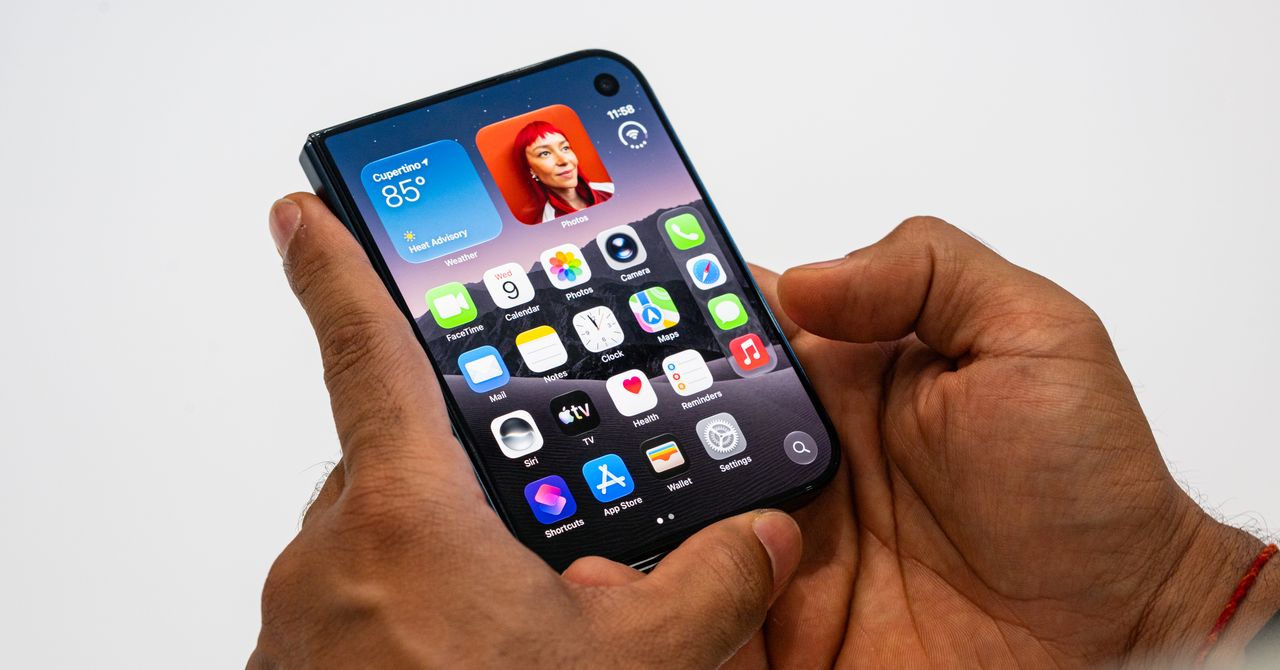
Originally launching only with Touch ID, Apple's folding phone now borrows a feature from the new HomeView and can recognize your mug, but it's likely not as secure as Face ID.Photograph: Julian ChokkattuApple's most expensive smartphone—the iPhone Duo—lacks one of the company's hallmark features: Face ID. The folding phone is already jam-packed with a hinge and multiple display layers, leaving no room for the TrueDepth sensor required for biometric face authentication. The Duo relies on Touch ID instead.That's changing now in a software update. On Monday, Apple announced that it's bringing facial recognition to the iPhone Duo as part of the iOS 27.3 update. But since it can't rely on the tried-and-true Face ID system without those crucial components, it's borrowing the feature from the company's recently launched smart display, the HomeView.The HomeView personalizes the display content for up to six people in a household, with its camera recognizing people who step in front of it (it also uses voice data for recognition when someone asks Siri a command). This “person recognition” technology is protected by the Secure Exclave—different from the Secure Enclave chip that houses Face ID data—a memory-protected space in Apple's A20 Pro processor. As WIRED's Lily Hay Newman writes, it's still not as comprehensive as Face ID, and could be more susceptible to attacks.At launch, the iPhone Duo relied on Touch ID for biometric authentication. Photograph: Julian ChokkattuRumors abound that Apple is racing to add proper Face ID to the second-generation iPhone Duo. Still, tight development cycles might mean the feature may not arrive until the third generation in 2028. That also points to limitations in the Duo's new facial recognition tech.You cannot use it to authenticate payments or unlock sensitive content, like your banking app. You'll still need your thumbprint or passcode to approve Apple Wallet purchases. Instead, it's designed to unlock the foldable without tapping a finger on the Touch ID sensor. There is also a time-based limitation. For face recognition to work, it needs a recent Touch ID or passcode authentication within a 45-minute window. This capability is also restricted to the front screen and camera—it doesn't work if the iPhone Duo is unfolded. Also in iOS 27.3, Apple has a new toggle that lets you lock your iPhone Duo when you close it.Google's newer Pixel folding phones are the only ones on the US market with secure facial authentication, though it's not as effective in the dark as Apple's Face ID. Samsung's facial biometrics on its Galaxy phones aren't strong enough to protect sensitive content and are largely used to unlock the device.Apple’s willingness to roll out a watered-down version of Face ID is a rare compromise for the company—and shows just how much of a friction point Touch ID has become for Duo owners.big story: cool kids write in all lowercase—does that make you mad?Julian Chokkattu is Senior Editor, Gear at WIRED, overseeing personal technology, gadgets, and gizmos. He has been reviewing consumer products for a decade, specializing in mobile—from smartphones, tablets, and smartwatches to smart glasses and virtual reality. This is his sixth year at WIRED. Previously, he was the mobile and wearables ... Read MoreWired Coupons
The iPhone Duo Is Getting a Limited Version of Face ID
Full Article
Original Source
Read the full article at Wired →KhanList aggregates and links to publicly available news content. We do not host full articles from third-party sources. Always verify important information with original sources.