
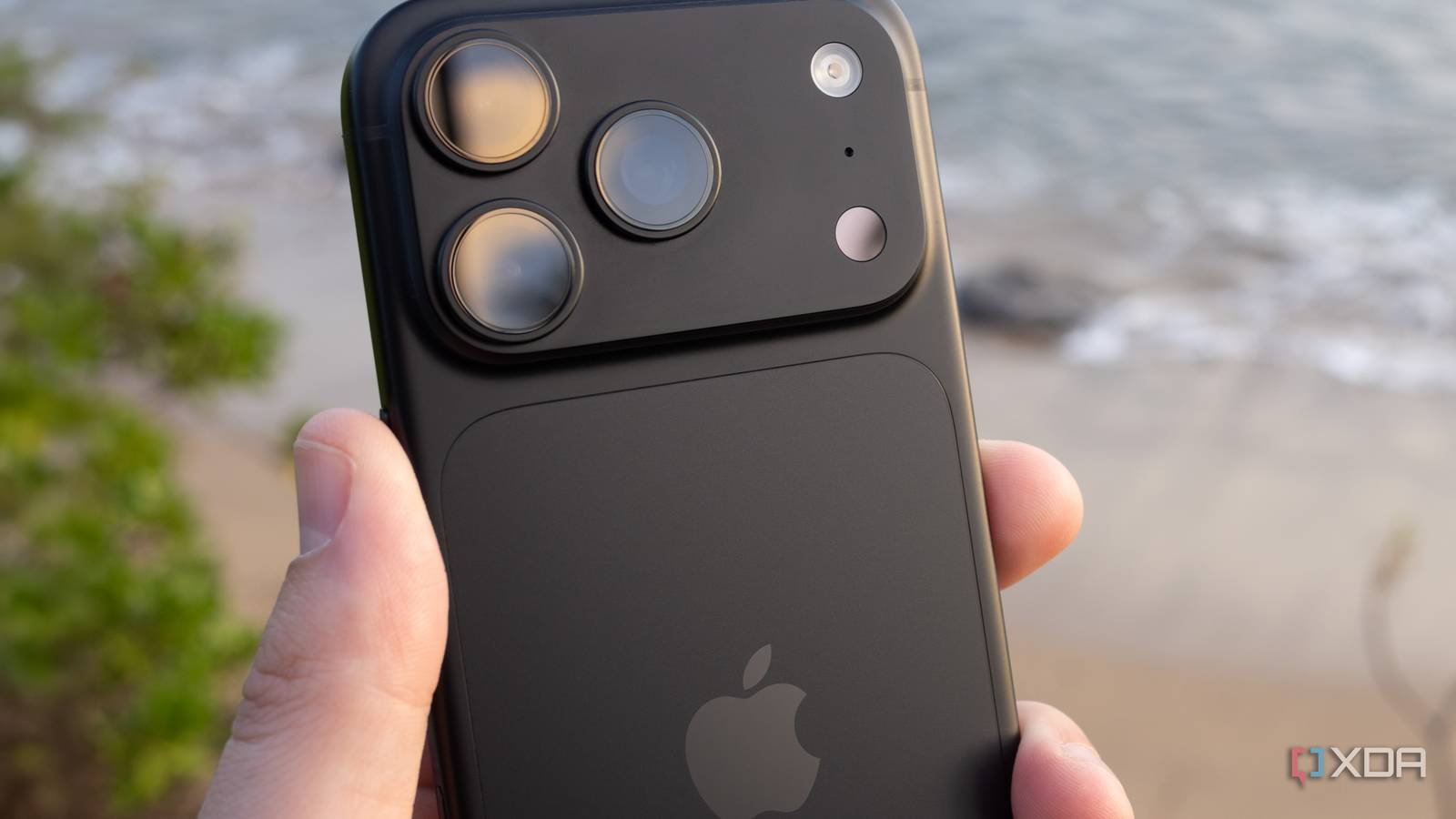
Published Oct 10, 2026, 9:00 AM EDT Unless you're really into smartphone photography, there isn't a lot new with this year's iPhone. Last year's iPhone 17 Pro featured a substantial change to its look. In fact, I even described the design as "daring" at the time. Whether it was the new panel-shaped camera bump, the two-tone rear, or the all-aluminum build, Apple clearly took a chance on the smartphone's aesthetic, and while some people loved it, there was a lot of hate for the design, too. That hasn't changed with the iPhone 18 Pro. If you set the iPhone 17 Pro and the iPhone 18 Pro side by side, both devices look pretty much identical. That similarity extends to the internal hardware, too, though some of this year's upgrades will appeal to photography-focused iPhone users, including the clever variable aperture, alongside the faster A20 Pro chip. Still, to throw things back to Apple's iPhone "S" era, this is definitely a "tock" year compared to last year's "tick." That doesn't make the iPhone 18 Pro a bad device; it just means that upgrading from the iPhone 17 Pro makes almost no sense (no one should be upgrading their iPhone every year anyway). Apple sent XDA the iPhone 18 Pro for review. It did not have any input on the contents of this article. iPhone 18 Pro 8/10 Brand Apple SoC A20 Pro Display 6.3-inch Super Retina XDR display Storage 256GB, 512GB, 1TB, or 2TB Rear camera f/1.5-4.0 48-megapixel 24mm (wide), f/2.8 48-megapixel 100mm (periscope telephoto), 4x optical zoom, f/2.2 48-Megapixel, f/2.2 13mm, 120˚ (ultrawide) Front camera f1/.9 18-megapixel selfie camera Battery Up to 45 hours Charge speed 25W wireless MagSafe/Qi2, 50% in 30 min Dimensions 5.91 x 2.83 x 0.35-inches (150 x 71.9 x 8.8mm) Colors Burgundy, Glacier, Silver, Black Display resolution 2622x1206 pixel resolution Wi-Fi connectivity Wi-Fi 7 Pros & Cons Great-looking design Very powerful Variable aperture is cool, but very subtle Not much of an upgrade over the iPhone 17 Pro iPhone 18 Pro pricing, specs, and availability Apple's iPhone 18 Pro features an LTPO Super Retina XDR OLED 120Hz screen with a 6.3-inch 1206x2622 pixel resolution (460) ppi. Dimensions come in at 5.91 x 2.83 x 0.35-inches (150 x 71.9 x 8.8mm) with a 7.44 oz (211g) weight. This year's chip is the A20 Pro. Storage options include 256GB, 512GB, 1TB, and 2TB. On the camera front, the iPhone 18 Pro features a f/1.5-4.0 48-megapixel 24mm (wide) shooter, making this the first time the iPhone has included a variable aperture, a f/2.8 48-megapixel 100mm telephoto lens, and an f/2.2 48-megapixel ultrawide. The front selfie camera is f/1.9 18-megapixels. The phone starts at $1,200. This review is focused on the iPhone 18 Pro. The iPhone 18 Pro Max features the same specs as the iPhone 18 Pro, only with a larger 6.9-inch screen and a larger battery. iPhone 18 Pro Brand Apple SoC A20 Pro Display 6.3-inch Super Retina XDR display Storage 256GB, 512GB, 1TB, or 2TB Rear camera f/1.5-4.0 48-megapixel 24mm (wide), f/2.8 48-megapixel 100mm (periscope telephoto), 4x optical zoom, f/2.2 48-Megapixel, f/2.2 13mm, 120˚ (ultrawide) Front camera f1/.9 18-megapixel selfie camera Battery Up to 45 hours Charge speed 25W wireless MagSafe/Qi2, 50% in 30 min Dimensions 5.91 x 2.83 x 0.35-inches (150 x 71.9 x 8.8mm) Colors Burgundy, Glacier, Silver, Black Display resolution 2622x1206 pixel resolution Wi-Fi connectivity Wi-Fi 7 This year's iPhone looks a lot like last year's You've seen this phone before. First off, right down to the millimeter, Apple's iPhone 18 Pro is identical to the iPhone 17 Pro. That means it features the same sprawling rear-facing camera island (Apple still calls it a "plateau") and a two-tone rear with an aluminum unibody frame and Ceramic Shield glass. The aluminum and rear glass are more closely color-matched now, which I'm not a fan of and feels like a cop-out in a way. I really liked the starker color contrast on the rear of the iPhone 17 Pro, so this is a disappointing move by Apple. On the color front, there's Silver, Apple's long-standing staple; Glacier, a sort of sky-blue hue; the return of Black; and this year's flagship color, Burgundy. Glacier is my personal favorite, but Burgundy is also pretty stunning under certain light. At the same time, I also appreciate the return of the very stark Black. The rounded corners, squared-off sides and sprawling camera bump return, too. There's also the Action Button, which I rarely use, and the finicky Camera Control button (I still find myself constantly accidentally changing Photographic Styles with it), and the standard volume buttons. If you've used a recent iPhone, you'll know what to expect here with the iPhone 18 Pro's design. One design change I immediately noticed the first time I picked up the phone for the first time was the smaller Dynamic Island, thanks to the iPhone 18 Pro's Face ID components and infrared camera being shifted underneath the OLED display. As a result, Apple has slightly reduced the cutout around the selfie camera. It also now allows three Live Activities to appear on the Dynamic Island instead of two. I haven't seen this happen yet, and I can't even think of a situation where I'd have three Live Activities running simultaneously, but the revamped Dynamic Island is useful in other ways. For example, during a recent flight, my seat showed up in the big section of the Dynamic Island, while the music I was listening to on Spotify shifted to the right. I like the cleaner look and the way the new Dynamic Island clearly separates the content. It's admittedly a subtle change, but I've grown to appreciate it. The key takeaway here is that if you don't like the look of the iPhone 17 Pro, you won't like the iPhone 18 Pro's aesthetic either. So what's actually new on the inside? It turns out there are a few key upgrades Beyond the camera hardware and software changes I'll get into later, there are a few other key upgrades worth unpacking. First, this year's iPhone 18 Pro features the A20 Pro chip. Like pretty much every iPhone chip from the past few years, the A20 Pro is an absolute beast. Over my past few weeks with Apple's flagship phone, I haven't encountered a single instance of slowdown or lag, except for the first hour or so after initially setting up the iPhone 18 Pro. If you care about benchmarks, the A20 Pro hits 4,678 for single-core and 12,583 for multi-core performance in Geekbench 6. To put that score in perspective, that is leagues faster than the 2,728 single-core and 7,411 multi-core scores the Pixel 11 Pro and its Tensor G6 chip hit in my tests. But have I run into performance issues with the Pixel 11 Pro? Not at all. With this in mind, just like in years past, the iPhone 18 Pro's power is absolutely overkill. Regardless, you'll get a smooth smartphone experience with Apple's latest flagship. The iPhone 18 Pro also runs surprisingly cool, which is a welcome improvement over the oven-like iPhone 17 Pro. Even when playing a game like Pokémon Go for a long time, the phone only got a little warm thanks to its improved vapor chamber cooling. Other upgrades include Apple's new C2 cellular modem. It seems to perform fine and, beyond the fact that I have awful signal in my neighborhood with every smartphone, I haven't encountered any reception issues with the iPhone 18 Pro. The A20's efficiency gains have also delivered impressively long battery life. Seriously, it feels like I never have to plug the phone in. I easily get a full day from the phone, even when pushing it to its limits over the past few days with a lot of doom-scrolling on social media, snapping photos, and playing games. I can't put an exact number on it, but it definitely feels like at least a 1-2 hour improvement over the iPhone 17 Pro's battery life. Lastly, wired charging has jumped to 60W with a compatible adapter, with MagSafe and Qi2 wireless charging at 25W. Faster charging is a welcome improvement, but I haven't really felt the speed change during my time with the phone so far. This is the first iPhone to feature a variable aperture Most of the upgrades are on the camera side Nearly all the iPhone 18 Pro's most interesting upgrades are on the camera side. First off, the f/2.8 48-megapixel 100mm telephoto lens, f/2.2 48-megapixel ultrawide, and f/1.9 18-megapixel selfie shooter are the same as last year. The main 48-megapixel wide shooter is where things get interesting. The lens features a variable aperture that can shift between f/1.48, f/1.8, f/2.8, and f/4.0. First, it's worth noting this isn't new in the smartphone space. For example, back in 2018, Samsung's Galaxy S9/S9+ featured a f/1.5 to f/2.4 Dual Aperture before dropping the feature a few years later with the Galaxy S20 series. Even now, Chinese phone makers like Huawei and Xiaomi still offer variable apertures. Still, it's new in the context of Apple's iPhone. With that out of the way, do I see a substantial difference in depth of field between photos shot at f/1.48 and f/4.0? Not really. It's there, but it's subtle, and some people likely won't even notice it and will still prefer Portrait Mode's more dramatic software-powered bokeh. The iPhone 18 Pro's camera sensor is too small for the shifting aperture to really change things that much (this is likely why Samsung eventually ditched it from its S series phones). On the other hand, as someone who shoots a lot with a DSLR, I really appreciate the variable aperture because it gives me far more control over the photos I'm snapping, which goes hand-in-hand with the new manual camera controls (more on this later). What surprises me most is how useful the wider f/1.48 aperture is for low-light and night shooting. It's a substantial jump over last year's f/1.8 that Apple claims offers "50 percent better low-light performance." In my experience, that seems to be the case, especially while shooting in auto, where the phone typically opens its aperture all the way to f/1.48 and sometimes f/1.8. It's nice to rely less on using the iPhone's Night mode, even though it is slightly faster with the iPhone 18 Pro. Speaking of photography controls, Apple has finally relented and added manual "Pro" controls, including shutter speed, white balance, a histogram, and even focus. They're a little difficult to use since the icons are so small, and oddly, the Camera Control button can't access any of them, but I'm glad they're finally here. Sure, you could always download a third-party app to change more granular photography settings like this, but Apple's implementation feels more polished, even if it's a bit harder to access, and because of that, I find myself using it way more. The more true-to-life take on photography Apple has been rolling with for the last few years is back with the iPhone 18 Pro, but if you want to customize the look yourself more, Photographic Styles are back with new features that let you add extra texture and grain to images. I'm not cool enough to appreciate photos that look like they were shot on an ISO 3200 with a film camera, so like last year, I've stuck with the very understated Natural look. It offers cooler colors that still have a bit of vibrancy to them. Photographic Styles remain one of my favorite iPhone photography features (I'm glad Google copied it with the Pixel 11 Pro this year with Camera Looks). Should you buy the iPhone 18 Pro You should buy the iPhone 18 Pro if: You have an older iPhone and you're looking to upgrade If you're really into smartphone photography You should not buy the iPhone 18 Pro if: If you already own the iPhone 17 Pro If you are expecting this year's iPhone to offer a substantial upgrade Overall, the iPhone 18 Pro is a very solid smartphone, and I've had a great experience with it over the past few weeks. But like the Pixel 11 Pro over the Pixel 10 Pro, it's just not much of an upgrade over the iPhone 17 Pro. With this in mind, if you're the type of person who upgrades their iPhone every year, you can sit this one out (you should also just stop upgrading your iPhone every year). On the other hand, if you're using an iPhone 14, iPhone 15, or iPhone 16, this is a great year to pull the trigger on a new device. You just need to keep your expectations in check to some extent, because as much as I enjoy the iPhone 18 Pro's marquee variable aperture feature, only pixel-peeping smartphone photography nerds (like me) will really appreciate the update. iPhone 18 Pro 8/10 Brand Apple SoC A20 Pro Display 6.3-inch Super Retina XDR display Storage 256GB, 512GB, 1TB, or 2TB
The iPhone 18 Pro is great, but it feels like Apple brought back the ‘S’ year
Full Article
Original Source
Read the full article at Xda-developers →KhanList aggregates and links to publicly available news content. We do not host full articles from third-party sources. Always verify important information with original sources.