
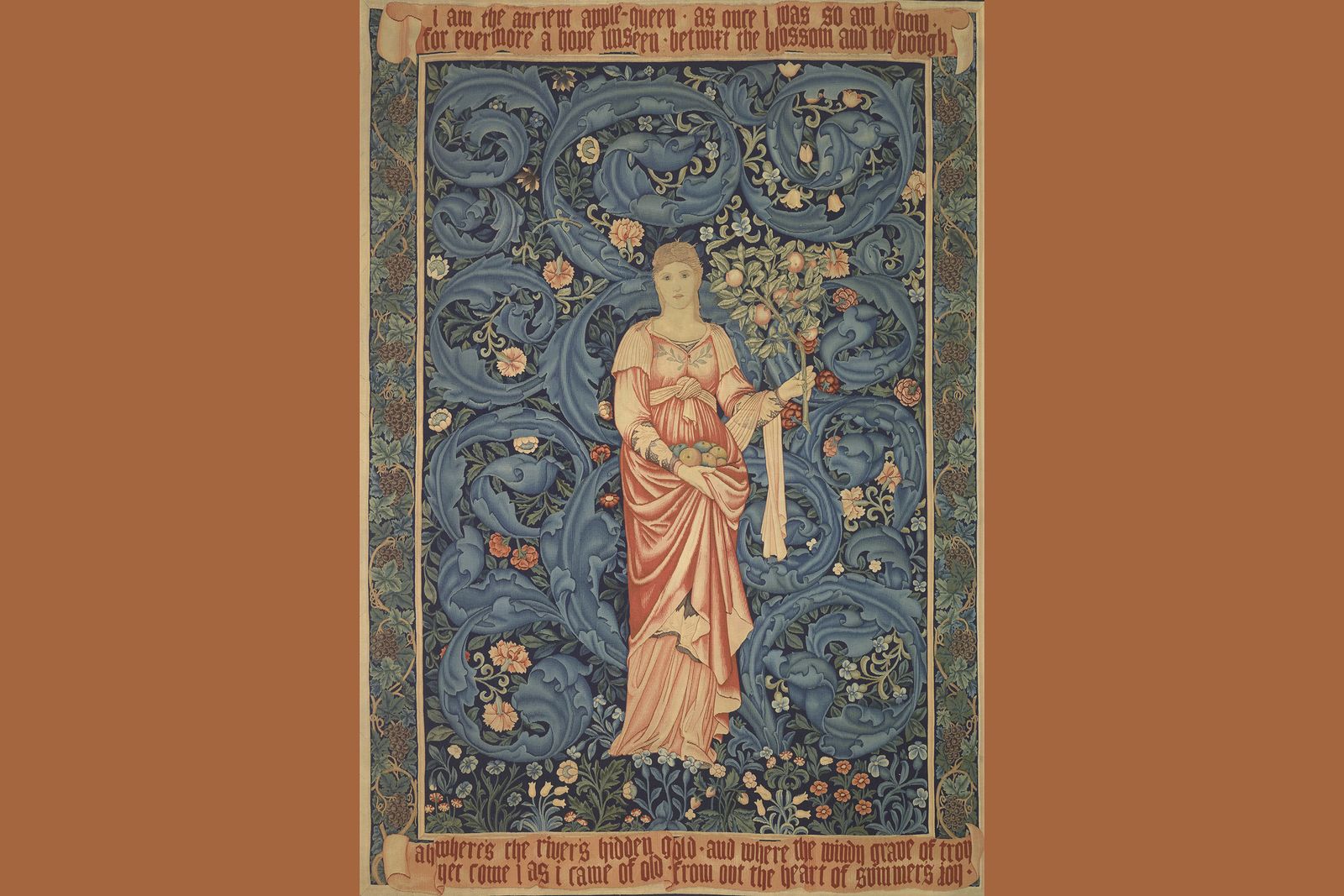
The 19th-century craftsman extolled the universal right to beauty. The problem was that his handmade items were necessarily expensive Pomona, designed by William Morris and Edward Coley Burne-Jones, made for Morris and Company, 1885. William Morris called tapestry “the noblest of the weaving arts … in which there is nothing mechanical.” Courtesy of The Whitworth, The University of Manchester; Photograph by Michael Pollard Born into a wealthy English family, William Morris (1834-1896) grew up in the countryside, honing a love for nature that found expression in fabric and wallpaper he designed for his successful firm, Morris & Company. An activist as well as an artist and businessman, he loathed the inequity of Victorian society and the soullessness of the industrial age, coming to embrace revolutionary socialism. Flora, designed by William Morris and Edward Coley Burne-Jones, made by William Knight, William Sleath and John Martin for Morris & Company, 1885. Courtesy of the Whitworth, the University of Manchester. Photography by Michael Pollard. But while he believed in a universal right to beauty, his own careful craftsmanship held a certain contradiction, says Amy George, curator of a retrospective of Morris’ original designs opening this month at the Whitworth Art Gallery in Manchester, England. “Anything handmade is expensive,” she notes. “And it should be expensive, because of the labor that goes into it.” Perhaps ironically, in recent years capitalism has made Morris’ work more accessible, as it has appeared on products from mass-market brands like H&M and Williams Sonoma. In a way, it seems, his goal of art for all may finally have been realized. Need to know: Exhibition details “Wiliam Morris: Common Paradise” is on view at the Whitworth in Manchester, England, from December 5, 2026 to October 31, 2027. You Might Also Like Get the latest Travel & Culture stories in your inbox. More about: Art Artists British History England Exhibitions Textiles
The Intricate Textile Designs of William Morris Bring Into Conflict the Concepts of Art and Accessibility
Full Article
Original Source
Read the full article at Smithsonianmag →KhanList aggregates and links to publicly available news content. We do not host full articles from third-party sources. Always verify important information with original sources.