
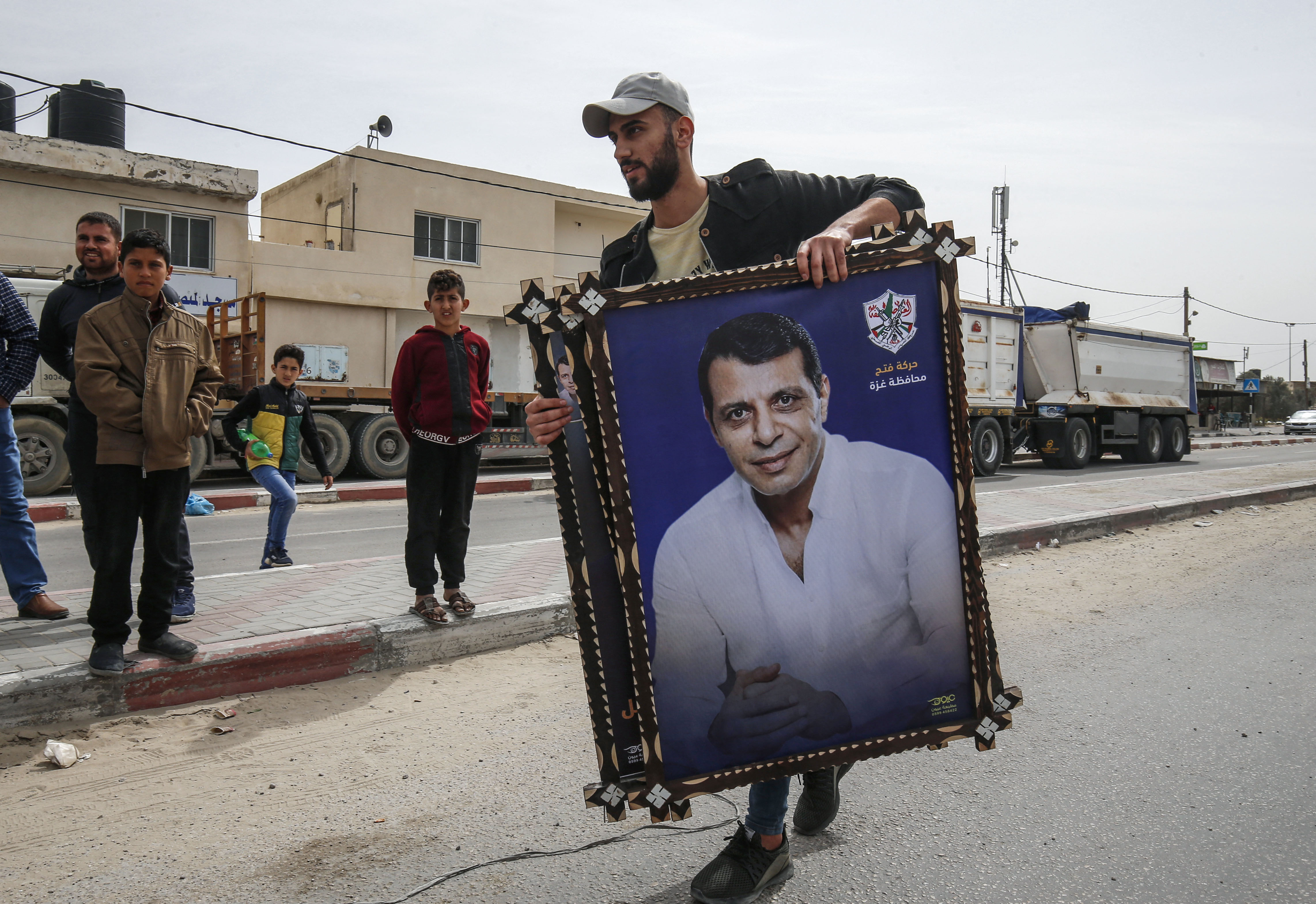
In 2006, the last time that Palestinians voted in an election, national power broker Mohammed Dahlan fiercely opposed the new Hamas-led administration in Gaza. Dahlan has been in exile in the United Arab Emirates since 2011. But he is now setting out again to win political power in Gaza by uniting the fractious Palestinian movement—this time by including Hamas. And he is suspected of doing so with the support of influential Arab leaders and Israelis and Americans across the political spectrum. Earlier this month, when Palestinian President Mahmoud Abbas postponed elections scheduled for November to next autumn, it wasn’t surprising. Every attempt since the last election 20 years ago has run into trouble either due to Abbas’s fear of losing or Israel’s refusal to allow voting in East Jerusalem. Fatah and Hamas, the two main Palestinian factions, clashed in 2006, which resulted in a de facto division of Palestinian territories into the West Bank and Gaza. In 2006, the last time that Palestinians voted in an election, national power broker Mohammed Dahlan fiercely opposed the new Hamas-led administration in Gaza. Dahlan has been in exile in the United Arab Emirates since 2011. But he is now setting out again to win political power in Gaza by uniting the fractious Palestinian movement—this time by including Hamas. And he is suspected of doing so with the support of influential Arab leaders and Israelis and Americans across the political spectrum. Earlier this month, when Palestinian President Mahmoud Abbas postponed elections scheduled for November to next autumn, it wasn’t surprising. Every attempt since the last election 20 years ago has run into trouble either due to Abbas’s fear of losing or Israel’s refusal to allow voting in East Jerusalem. Fatah and Hamas, the two main Palestinian factions, clashed in 2006, which resulted in a de facto division of Palestinian territories into the West Bank and Gaza. Israel has exploited Palestinian divisions, citing the absence of a unified Palestinian political entity as a reason it could not move forward on peace. Most Palestinians have relentlessly called for unity among Palestinian factions. Dahlan’s party, the Democratic Reform Bloc (DRC) is now trying to achieve that elusive aim. However, including Hamas in any political alliance risks rattling Israel, which is suspected of deploying myriad tools at its disposal to influence Palestinian politics. Born in Khan Younis, the same town as former Hamas leader Yahya Sinwar, who plotted the attack against Israel on Oct. 7, 2023, Dahlan is seen as a son of the soil. He learned the ropes from Yasser Arafat, the architect of the Palestine Liberation Organization (PLO), when Israel deported him to Jordan. In 1994, as the Oslo Accords were set in motion, Abbas appointed Dahlan to manage the enclave’s security as head of the Palestinian Authority’s (PA) Preventive Security organization. His reputation and reach soon earned him a reputation, and Gaza was often referred to as “Dahlistan.” Dahlan dealt with Israeli intelligence officials and quickly made a name for himself as someone who anyone could work with. He fought against Hamas in 2006, but it was Abbas who later exiled him on corruption charges. Abbas was wary of Dahlan’s ambition and access, fearing that he might be a fierce competitor one day. Dahlan relocated to the UAE and became a security advisor to the ruler of Abu Dhabi, Mohammed bin Zayed. He was close to the sheikh when the Abraham Accords were signed and during the military escalation in Gaza following Oct. 7, when the UAE maintained its diplomatic commitment and didn’t walk out of the deal. His proximity to Abu Dhabi’s leadership made him appealing to Israel. Could he be a Trojan horse in the Palestinian movement? “Many Israeli intelligence officials, even those close to [Israeli Prime Minister Benjamin] Netanyahu, have met him,” said Eran Lerman, a former Israeli deputy national security advisor and retired intelligence colonel who serves as vice president of the Jerusalem Institute for Strategy and Security. Dahlan played an instrumental role in convincing Hamas to decommission its weapons during talks with U.S. President Donald Trump’s Board of Peace—although the fate of that proposal hangs in balance as Israel demands full disarmament. Muhammad Shehada, a visiting fellow with the European Council on Foreign Relations, said that Dahlan was brought into the negotiations to build trust with Israel. Israel has signed peace treaties with both Egypt and the UAE, and it sees them as firm opponents of the Muslim Brotherhood, a pan-Arab movement that Israel views as an ideological fountainhead of Hamas. Dahlan maintains open channels with both Abu Dhabi and Cairo, and those relationships make him an interesting figure for Israeli strategists. In a 2024 interview with the New York Times, Dahlan laid out his vision for Palestine, declaring, “No Abbas, no Hamas,” and calling for a new generation to take charge of the PA. Dahlan has funneled Emirati funds into Gaza, helping him revive his standing and expand his reach. He has maintained a political base through the DRC. Dimitri Diliani, a DRC spokesperson, said that Dahlan was meeting with former Hamas chief Ismail Haniyeh in Doha when the Times article was published, yet Hamas raised no objections. “That was the first sign that Hamas was willing to give up control of Gaza,” Diliani said. “But neither the U.S. nor Israel took notice.” Hamas might accept a relegated status in Palestinian governance, but observers have questioned whether there is more than meets the eye. Some have argued that Dahlan is throwing Hamas a lifeline, ostensibly to challenge Abbas but also allowing it to survive another day as a political entity. The DRC has formed an alliance comprising Hamas, Palestinian Islamic Jihad, and Fatah breakaway factions to support a unified electoral list of independent candidates to compete against Abbas. “Hamas agreed they will not participate directly and will support whatever list we announce,” Diliani said. “It will be a national list that represents us, but none of our political figures will be in it.” That offers little comfort to Israel, which demands Hamas’s complete exit from Gaza rather than political influence by proxy. A former senior Israeli security official, who previously spoke highly of Dahlan as someone who could be acceptable to Israel to lead Gaza, now warned about his motives. The official described him as “a thief” who “can play both sides.” Is Dahlan playing Israel, or is there a larger strategy at play behind the scenes? When asked whether he could convince Israelis to discuss a two-state solution, Dahlan struck a harsh tone. “It’s not my job to convince the Israelis,” he told the Times. “Let them go to hell.” Adopting a firm stance against Israel remains a political necessity for any Palestinian leader—lest they be labeled as a puppet. Yet Dahlan has positioned himself as a rare figure capable of liaising between Israel, the United States, and Hamas. Dahlan maintains he has no desire to officially run the Palestinian territories but that is standard political speak to hide real intentions. However, Lerman noted that with business ventures spanning Belgrade and beyond, Dahlan is financially well-off and may have little interest in returning to Gaza and enduring the privations that come with it. Israel is also running out of options. It is unhappy with Abbas and sees him as ineffective in managing armed resistance, and it has called on the European Union to pressure Abbas to reform the PA and link European aid to reforms. A different version of PA reforms has been discussed in Palestinian circles. They wish to downgrade the PA, which was formed as part of the Oslo process to pave the path for a Palestinian state, and revive the PLO, which is the umbrella movement for self-determination. Palestinians argue that they didn’t get a state; instead, the PA has eroded the movement. In this vision, the PLO includes Hamas. Diliani said that it was pointless to seek Hamas’s decimation. Even if Hamas gives up weapons, another armed rebellion will rise. “As long as Israel occupies Palestinian lands, resistance will persist in one form or another,” he said. “Dahlan has an inclusive vision.” Israel may have to choose between Dahlan’s broader alliance that includes Hamas as a political actor or backing Abbas and his familiar operatives—such as Hussein al-Sheikh, the PA’s second-in-command, or Majed Faraj, the PA’s intelligence chief who recently called on Hamas to apologize for Oct. 7. Dahlan has a year to navigate these competing pressures and decide if he wants to jettison Hamas or risk being outmaneuvered by Israel.
The International Power Broker Trying to Normalize Hamas
Full Article
Original Source
Read the full article at Foreignpolicy →KhanList aggregates and links to publicly available news content. We do not host full articles from third-party sources. Always verify important information with original sources.