
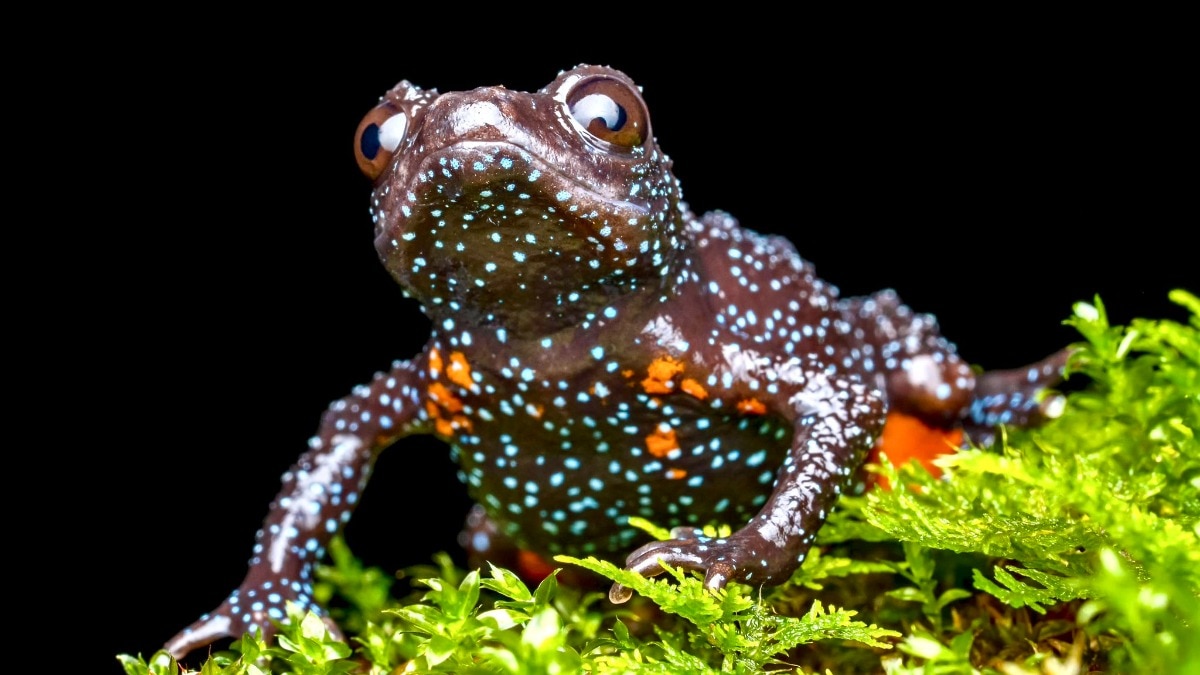
It looks like someone painted stars across its black back. Meet Melanobatrachus indicus, one of India's most elusive frogs.An image of the Galaxy Frog. (Photo: Dhanu Paran/Pravin Shanmughanandam)New Delhi,Sep 29, 2026 13:17 ISTDeep in the wet evergreen forests of the southern Western Ghats lives a frog that looks as though someone, using a toothbrush, specked a galaxy across its back.The rarely sighted frog returned to the spotlight after Supriya Sahu, Additional Chief Secretary, Environment, Climate Change and Forests Department of Tamil Nadu, shared new images of the frog, as its galaxy-like spots are being studied. Â A close-up image of the Galaxy Frog. (Photo: Pravin Shanmughanandam) The Galaxy Frog, scientifically known as Melanobatrachus indicus, is found only in the Western Ghats of southern India.The amphibian's dark body is covered with tiny bluish-white spots that resemble stars, while flashes of scarlet-orange appear underneath. It is barely a few centimetres long, spends much of its time hidden beneath fallen logs and forest debris, and is so rarely seen that even researchers can spend years studying it without finding one.A FROG WEARING A GALAXYThe Galaxy Frog is endemic to the southern Western Ghats, with records from parts of Kerala and Tamil Nadu. The rarely-sighted creature lives in wet evergreen and other moist forest habitats, generally at elevations of about 1,000 to 1,500 metres. The species was first described in 1878 from the Anamalai Hills of Tamil Nadu, and was later rediscovered in 1997, after decades in which it was exceptionally difficult to find.More recent surveys have added records from several locations in the southern Western Ghats, but it remains one of India's least frequently encountered frogs. A photo of the Galaxy Frog in the forest. (Photo: X/@sssaaagar) The IUCN classifies it as "Vulnerable", while the Zoological Society of London's EDGE programme considers it a high-priority Evolutionarily Distinct and Globally Endangered species.AN INTROVERTED CREATUREOwing to its rare public appearances, there is still a lot that scientists do not know about Melanobatrachus indicus.The species lacks a visible tympanum, or external eardrum, and males lack a vocal sac.Its unusual anatomy and the scarcity of sightings have made its behaviour particularly difficult to study.Some researchers have suggested that its vivid spots could have a role in communication, but this remains an area where more research is needed. A close-up image of the Galaxy Frog shows its vivid spots. (Photo: X/Shivang Mehta) The orange markings underneath serve a different, more established purpose of being a part of a defensive display. When the frog is stressed, these normally concealed colours can become visible, potentially startling predators.WHAT IS ITS GREATEST DANGER?The Galaxy Frog's dependence on very specific forest-floor microhabitats makes it particularly vulnerable to disturbance.Researchers have found individuals beneath rotting logs and among other ground cover, where even apparently small changes can destroy the conditions they need.The Galaxy Frog, thus, is a photogenic species but also an acutely vulnerable species. Its survival depends on leaving the tiny world beneath the forest canopy largely undisturbed.For a frog small enough to disappear beneath a fallen leaf, its existence illustrates how, in the Western Ghats, protecting biodiversity can sometimes mean simply leaving the forest floor exactly as it is.- Ends
The Indian frog with a galaxy: Rare amphibian spotted in Western Ghats
Full Article
Original Source
Read the full article at Indiatoday →KhanList aggregates and links to publicly available news content. We do not host full articles from third-party sources. Always verify important information with original sources.