
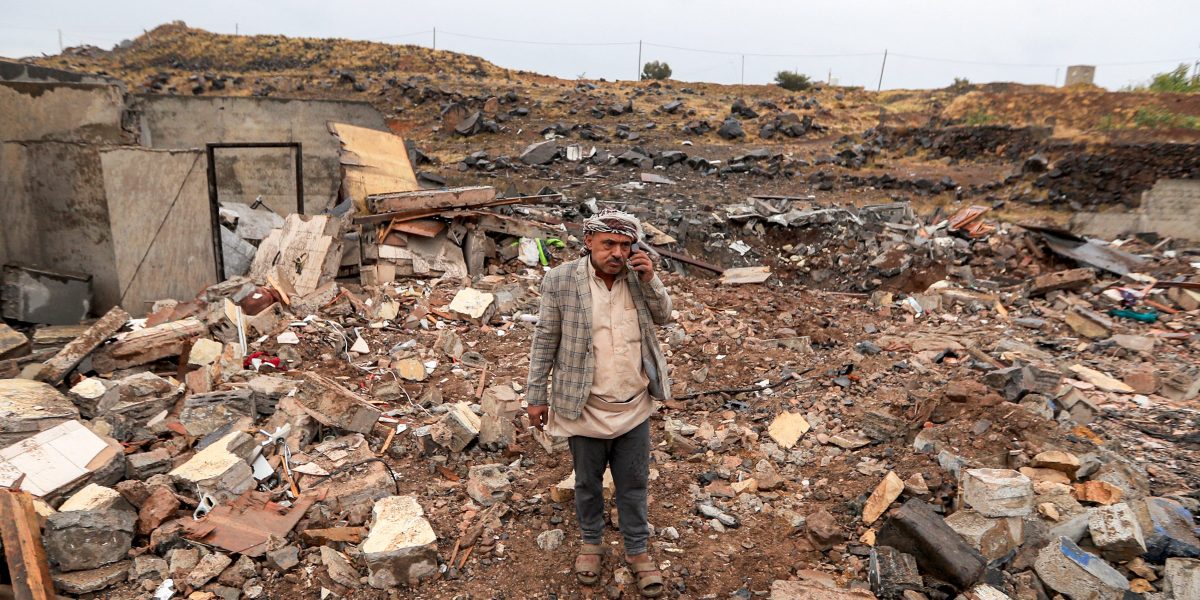
The Limits of American Might The failure of Tel Aviv and Washington to achieve their war aims in Iran has resulted in the most dramatic American retreat from a region since the U.S. flight from Vietnam in 1975. This startling American defeat — after a generation of forever war failures and stalemates — has been thrown into broad relief by the resumption of another regional conflict that has received far less attention than the Trump administration’s sputtering war with Tehran. This fall, the forces that most Americans know as “the Houthis” have conducted a blitzkrieg in their native Yemen and have been pummeling Saudi Arabia’s aviation and energy infrastructure with missiles and drones. In doing so, they have put a spotlight on the limits of American power, and the shrinking U.S. military footprint, in the Middle East. The long-standing conflict between Saudi Arabia and northern Yemen’s Ansarullah, or “Helpers of God,” led by the Houthi clan, heated up again in July 2026, when Saudi Arabia struck Sanaa International Airport to prevent a Houthi delegation from landing on its return from the funeral in Iran for slain Ayatollah Ali Khamenei. The Ansarullah government launched its own attacks and, in October, managed briefly to close Saudi Arabia’s own airport. The renewed war has now expanded into a regional conflict, with Pakistan, Türkiye, and, recently, Egypt pledging to defend the kingdom from attack, though none of these regional powers appear eager to conduct operations in Yemen itself. Notably absent from the current conflict is Saudi Arabia’s most powerful ally, the United States, since President Donald Trump has repeatedly declined to intervene on behalf of his Saudi allies. The typical U.S. press framing of Ansarullah as an “Iran-backed militia” is inaccurate, since the movement has local, Arab nationalist reasons for its actions and is a full-scale government that rules some 80 percent of Yemen’s population. Still, it does receive surreptitious technical and military support from Iran, though nothing like the hundreds of billions of dollars’ worth of high-tech armaments — from kits turning 2,000-pound “dumb” bombs into precision munitions to advanced air-to-air missiles — that the U.S. provides the Saudis. Ironically, Trump’s war on Iran, fought in conjunction with Israeli Prime Minister Benjamin Netanyahu, weakened the Saudis and exposed their vulnerabilities to military attack by Iranian drones and missiles, impelling them to seek a symbolic win over a less formidable enemy in neighboring Yemen. But the weaknesses exposed by Iran’s drones helped encourage a vigorous Ansarullah rejoinder. The Incredible Shrinking Superpower The American refusal to join Saudi Arabia’s war signals a profound degradation in U.S. capabilities and standing in the Middle East. The U.S. military had, for decades, dominated the region from a network of about 20 major bases. The U.S. Navy operated out of the headquarters of the Fifth Fleet in Manama, Bahrain. The U.S. Air Force flew missions from the massive al-Udeid Air Base in Qatar, which housed 10,000 U.S. personnel. Thousands of ground troops were barracked in Kuwait, the United Arab Emirates, and Jordan. The Pentagon admitted that “Iranian strikes damaged and destroyed hundreds of buildings and structures at U.S. bases in Kuwait, Bahrain, Qatar, UAE, Saudi Arabia, Iraq, Oman, and Jordan during the conflict. In addition, dozens of U.S. aircraft were destroyed or damaged during OEF.” The naval base at Manama, one of America’s most important naval facilities and headquarters of the Navy’s Fifth Fleet, was destroyed by Iranian strikes. (Acting Navy Secretary Hung Cao admitted last month that Iran “blew the hell out of Bahrain.”) The loss of Manama led to supply shortages and poor morale aboard the USS Lincoln and other ships patrolling the Strait of Hormuz, bedeviling Secretary of Defense Pete Hegseth. The CIA offices at the U.S. Embassy in Riyadh were annihilated. Iran struck al-Udeid’s evacuated Combined Air Operations Center in Qatar, from which the Pentagon had directed its strikes on enemies as diverse as the Taliban and ISIL over recent decades, and rendered this facility inoperable. All U.S. troops were also withdrawn from Iraq, a process accelerated by the inability of U.S. missile interceptors to protect them from attacks by Iran and allied Shiite militias there. Iran’s deployment of swarms of Shahed drones caused the United States and Israel to use up much of their stock of interceptors, which are time-consuming and expensive to replace. A basic Shahed costs as little as $20,000, though new hardened versions are more expensive — whereas a Patriot interceptor costs $4 million. One reason the Trump administration may be reluctant to intervene in Yemen is that if the U.S. cannot fly missions from al-Udeid, and cannot be sure any new fighter-jet fleets stationed in the region will be safe from Iran, given the paucity of interceptors, the Pentagon will have a limited ability to rescue any U.S. pilots shot down over Yemen. America’s Profound Weakness in the Middle East Saudi Arabia launched a war against the ascendant Ansarullah in 2015 when the latter staged a coup in the capital of Sanaa. The Ansarullah movement is rooted in Yemen’s Zaidi Shiism, though it is more radical than traditional Zaidism. (Zaidi Shiism differs substantially from Iranian Shiism, having no ayatollahs and having relatively good relations with Sunnis.) About a third of Yemenis are Zaidis, who predominate in the north of the country, and many have long resented the dominance of their politics and culture by neighboring, oil-rich, Sunni Saudi Arabia, whose official ideology is hard-line Wahhabism, a puritanical form of Islam that insists on a literal interpretation of the Quran. Wahhabi proselytizing among the Shia enraged the Houthi clan and their followers began rebelling against the government of military dictator Ali Abdullah Saleh in 2004. But when he was deposed by popular demonstrations during the Arab Spring in 2012, Saleh gradually allied with the Houthis, and by 2015 about half the Yemeni military rallied to their side, along with some major Sunni tribes. In response to the Houthis’ rise, a Saudi-led coalition that included the United Arab Emirates began bombing Yemen in 2015. Until 2022, the U.S, then militarily dominant in the region, provided the Saudis with strategic advice, weaponry, and in-air refueling for their fighter jets in the Yemen war, though Riyadh’s tendency to bomb civilian infrastructure rather than confining themselves to military targets caused tension between the two allies. While the Saudis and their coalition pushed the Houthis out of much of the south of the country, including Aden, they were unable to dislodge them from the north. The Saudis implicitly acknowledged their failure with a United Nations-brokered truce in April 2022, which largely held until this past summer. The Forever Wars Effect America’s forever wars against Middle Eastern countries that decline to accept the Israel project or American corporate neocolonialism helped reignite the Saudi–Yemeni conflict. Iran is the last major state in the region that rejects Israel and is off-limits to U.S. corporate investment, a stance that inspires much of Washington’s animus. Netanyahu was therefore easily able to persuade Trump, as a privileged visitor to the White House Situation Room, to attack Iran in February. The glib expectation of Netanyahu and of his Mossad chief at that time, David Barnea, that the Islamic Republic would crumble if Israel murdered Ayatollah Ali Khamenei and around 50 other high-ranking regime figures proved wishful thinking. The notion that Iran was vulnerable to a tightened petroleum blockade was turned on its head by the hard-liners who ascended to power after Khamenei’s death. Largely veterans of the grueling eight-year Iran–Iraq War of the 1980s, the country’s new leaders pursued a policy of “de-basing” toward the United States, taking out its main regional military facilities. By successfully striking Saudi Arabia, Iran demonstrated that the kingdom’s ability to protect itself is imperfect and its infrastructure is vulnerable. In addition, Iran launched precision strikes at the energy facilities of their Arab Gulf neighbors who had hosted those American bases. They struck Kuwait’s national petroleum company and its fields and refineries. They took out 17 percent of the production of Qatar’s Ras Laffan natural gas facility, even though Doha had good relations with Tehran and had mediated for Iran. Tehran also struck ships passing through the Strait of Hormuz, using missiles and drones, scaring the major shipping insurers into withdrawing their contracts. Few shipping magnates would risk cargoes worth billions of dollars without insurance. Iran threw the world into an energy crisis reminiscent of the 1970s, which would have been even more devastating had China not released oil from its vast private and public petroleum reserves and cut its oil imports from 11.5 million barrels a day to under 9 million barrels a day, a move partially enabled by its turn to electric vehicles, which saved it 1.5 million barrels a day. High gasoline and diesel prices hurt Asia more than the United States, but prices rose globally. A third of the world’s helium, essential for cooling computer chips in the production process, comes from the Gulf, and that supply was also interrupted, increasing the price of electronics. By successfully striking Saudi Arabia, Iran demonstrated that the kingdom’s ability to protect itself is imperfect and its infrastructure is vulnerable. By blockading the Strait of Hormuz in a way that the United States had difficulty undoing, Iran demonstrated the vulnerability of key world maritime arteries, something Ansarullah had already highlighted by striking at shipping in the Red Sea to protest the Gaza genocide. Blockade for Blockade When the Saudis bombed Sanaa’s airport in July 2026, Ansarullah’s leadership appears to have decided that Riyadh posed an ongoing existential danger to their state and sought to strangle the Yemeni economy, just as Israel had done to Gaza. Moreover, they sensed that the kingdom could be rolled back in the wake of the failure of the Israeli–U.S. war on Iran. Just as Iran had weakened the Gulf Arab states with its blockade of the Strait of Hormuz, the Houthis believed they could seriously degrade the Saudi economy by blocking Riyadh’s shipping through the Bab al-Mandab, “the Strait of Tears,” between the Red Sea and the Gulf of Aden. Saudi exports through the Strait of Hormuz had fallen substantially. The kingdom did, however, have an escape valve: its East-West pipeline to Yanbu on the Red Sea. Ships loading at Yanbu then headed for Saudi Arabia’s major Asian markets through the Bab al-Mandab. If Ansarullah could make the tanker captains fearful of this transit, they could reduce Saudi Arabia’s income even further. The Houthi spokesperson, Muhammad Abd al-Salam, warned that the prohibition of Saudi shipping was only the first step in a tit-for-tat strategy of “blockade for blockade.” The idea wasn’t original. The Saudis and the U.S. had often attempted to blockade petroleum imports to northern Yemen during the seven-year Saudi–Yemeni War. In the subsequent three months, Ansarullah deployed missiles and drones constructed from Iranian models by military engineers trained by the old nationalist government of Ali Abdullah Saleh, many of whom had joined the Ansarullah military, in what has been called a Yemeni “military industrial complex.” Just as the kingdom’s interceptors had proven unable to prevent Iranian strikes on targets such as the CIA section of the U.S. Embassy in Riyadh, they sometimes failed to halt the barrage of Yemeni missiles and drones. Refineries and oil installations, even the headquarters of the state oil giant, Saudi Aramco, in Dhahran, were hit. In October, Ansarullah closed Riyadh’s International Airport, just as the Saudis had attempted to close that of Sanaa in July. Ansarullah also surged out of their mountain strongholds and made a major push to Yemen’s southwest coast, taking the strategic port of Mocha overlooking the Bab al-Mandab. They also moved on Taiz, an inland industrial city of nearly 1 million inhabitants, one of the last major population centers not already under their control, in a campaign that tested the ability of the small Saudi-backed government of Rashad al-Alimi in Aden to resist it. Highlanders and Oil Sheikhs Just as the Vietnam War was one conflict among many fought in the Third World during the Cold War between the U.S. and the Soviet Union, so the Saudi–Yemeni War of 2026 is part of the larger struggle between the U.S. and Israel and Iran. Still, just as Vietnam was more about Vietnamese anticolonialism, nationalism, and sovereignty than about Communism and the ownership of the means of production, so the Saudi–Yemeni War is about Yemeni autonomy more than it is about the loose Houthi alliance with Iran. The conflict is not primarily between Zaidism and Wahhabism, though religious tensions are part of the story, but is far more rooted in a struggle between desperately poor Yemeni highlanders and fabulously wealthy Saudi sheikhs. The plutocratic Saudi ruling elite is closely tied to Washington and has secret dealings with the Israelis, with whom it shares a distrust of the poverty-stricken Palestinian resistance, and views Ansarullah as cat’s paws of Iran in the Arabian Peninsula and as radical republicans trying to overthrow the region’s oil monarchies in favor of populism. For its part, Ansarullah are Arab nationalists, anti-American, and seek to use oil resources for populist purposes. And they have been willing to attack Israel to defend the Palestinians of Gaza from genocide. Last week, Ansarullah battered targets across Saudi Arabia, prompting a further pullback from the region by Washington. The Yemeni forces attacked King Fahd International Airport in Dammam. An Ansarullah spokesperson said the group also targeted the Saudi defense ministry in the capital, Riyadh, along with an Aramco site in Yanbu, and an airport in the southern city of Abha. Reports also emerged of an attack on another Aramco oil field. “Houthis have increasingly engaged in hostilities against Saudi Arabia, including attacks on civilian airports and other critical infrastructure,” wrote State Department spokesperson Tommy Pigott in an October 21 post on X, after the wave of attacks, ordering “non-emergency U.S. government employees and their family members” out of Saudi Arabia. It’s just the latest evidence of the most significant regional retreat by the U.S. in half a century and evidence of profound American military decline. The outcome of their war with the Saudis will not determine the issue of the U.S.–Israeli contest with Iran, but the very ability of Ansarullah to prosecute it points to the profound weakening of the American posture in the Middle East.
The Incredible Shrinking Superpower
Full Article
Original Source
Read the full article at Theintercept →KhanList aggregates and links to publicly available news content. We do not host full articles from third-party sources. Always verify important information with original sources.