
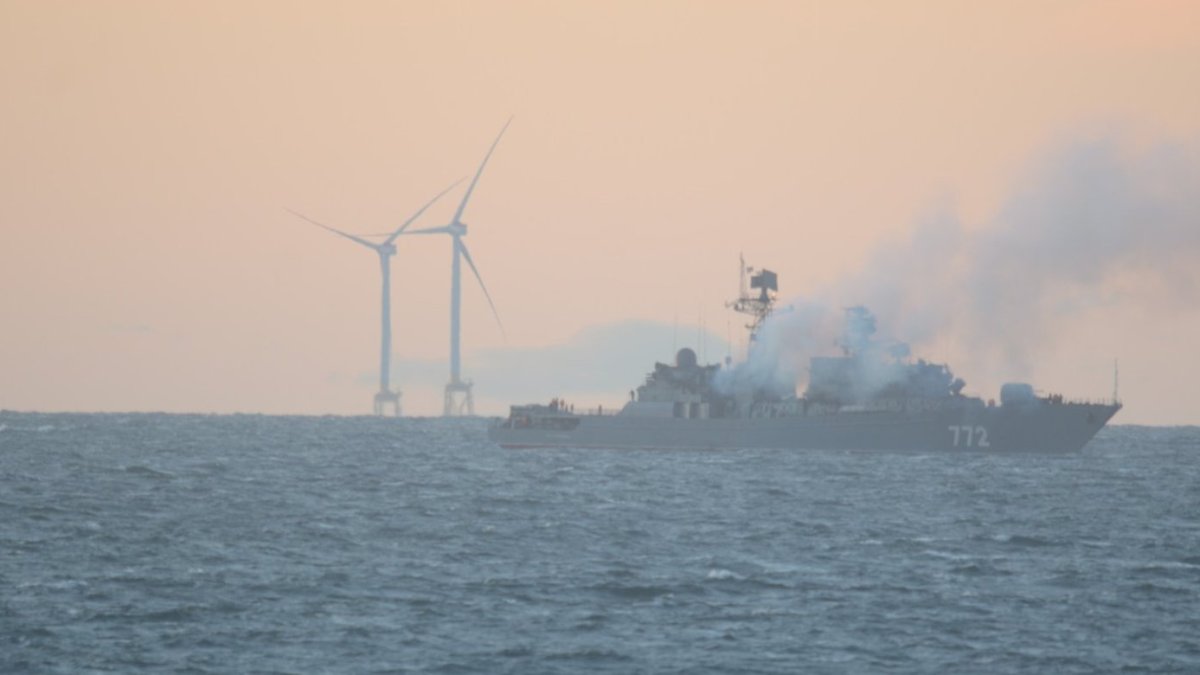
One of Vladimir Putin’s most prized warships was pictured billowing with smoke shortly after colliding with another Russian vessel off the coast of the UK. The Neustrashimy slammed into the replenishment tanker, Valentin Rykov, on 22 October during a botched two-day refuelling operation. Open-source analysis tracks what appears to be a failed attempt to refuel the frigate off the coast of Essex as the weather began to turn, before the pair of ships headed in the direction of Scotland in a doomed attempt to escape Storm Austen, which was looming off the UK coast at the time. Photos understood to be taken shortly after the collision when Neustrashimy was attempting the second refuelling near Edinburgh in rough weather conditions show plumes of smoke rising from the frigate. The ‘Neustrashimy 772’ was refuelling near Edinburgh in rough weather conditions when it slammed into the replenishment tanker (Photo: Russian Forces Spotter/TiaFarris10) Both refuelling attempts took place near UK offshore wind farms, the first near Galloper Wind Farm and the second took place close to Neart na Gaoithe. According to intercepted radio transmissions reported by The Times, shortly after the crash, one of the Russian crewman involved described the incident as “an absolute nightmare” before threatening to “execute” their crewmate over it. The incident comes amid growing concerns over the risks of potentially catastrophic collisions and oil spills off the coast of the UK from Russia’s ageing fleet of tankers and warships. Threat of oil spills In the months since the UK Navy dramatically boarded the Smyrtos in June, Moscow has been under pressure to guard its fleet of oil tankers.Putin has been taking more risks and has grown increasingly irritated with the friction the UK has created in the English Channel, the quickest route for vessels heading to pass its lucrative war-funding oil to the few countries willing to buy it. Tankers are increasingly having to circumnavigate the UK to avoid the Channel, and are escorted by Russian warships. This has included the Admiral Kasatonov, one of the most advanced warships in the Russian navy, as well as more recently the Neustrashimy. Along with the collision, a second serious incident has occurred off the coast of the UK and Ireland in one month alone. Tanker Myra issued a distress call during the heavy storms at the end of October, with the coastguard and RAF scrambling to help in the face of risk to those on board the tanker and a potential spill of fuel thought to be on board. How the frigate and tanker collided The Neustrashimy has been escorting a number of “shadow fleet” oil tankers, sanctioned vessels used by Russia to transport lucrative oil exports under another country’s flag, through the waters surrounding the UK as they pass through en route to drop off their cargo with buyers. Putin’s stretched warship fleet has meant the frigate has been months without a port call, forcing Moscow to repeatedly send supplies to it while off the coast of the UK. The Valentin Rykov is an oil tanker tasked with replenishing Russian ships with fuel. Open-source data from MarineTraffic analysed by this paper shows how the vessel travelled from the Baltiysk port in Kaliningrad, Russia, to around 30 miles off the coast of Essex, where it came to a standstill in the early hours of 20 October. While tracking data is not available for warships, this area has been used for refuelling before. Around 12 hours later, the tanker moved off and began to travel north. It turned off its tracker until 22 October, as it sailed towards the Scottish wind farm. A second refuelling attempt was made off the coast of Edinburgh amid ongoing challenging weather and choppy sea conditions. A British drone and warship were scrambled to monitor the Russian ships as they paused off the coast of Scotland and near the offshore energy source, The Telegraph previously reported, with the HMS Tyne understood to have been closely tracking the movements of the ships. A hazy Southern North Sea, east of Outer Gabbard Windfarm 31/10/26-Russian Navy Neustrashimy Class frigate RFS Neustrashimy (772) back in her holding position.It would seem that rumours of the ships stricken mechanicial status were a tad premature.@warshipcam pic.twitter.com/BWa4hbuILG— Ancient Mariner (@pegge49) October 31, 2026 Following the collision, the Valentin Rykov was recorded back at Baltiysk port on 29 October, with the Neustrashimy also reported in the Russian press as having returned to base. One Russian news site claimed the warship was spotted with thick smoke as “the crew was presumably practising defence against drones”. However, just days later the Neustrashimy appeared to have entered the Thames Estuary, having been spotted by another maritime photographer near the Essex wind farm again on 31 October. ‘There was thick, black smoke’ A maritime watcher who captured the images while photographing ships in waters near Edinburgh said it appeared the vessels collided while navigating difficult weather conditions. “If the ships were still dealing with a heavy swell on the second attempt [to refuel], it would have been harder to maintain a safe distance while replenishing alongside,” the photographer, who goes by the username Russian Forces Spotter on X, told The i Paper. The ‘Neustrashimy 772’ off the coast of Edinburgh. There have been concerns that Russian warships are being forced to spend longer at sea to protect Putin’s shadow fleet on journeys through UK waters (Photo: Russian Forces Spotter/TiaFarris10) He added there was “thick black smoke pouring from the warship”. The i Paper understands the UK Government is aware of the collision between the two Russian vessels. The ships appear to have suffered only minor damage. A number of the Kremlin’s ageing fleet are almost 30 years of age, when most major oil companies generally don’t operate vessels beyond 15 years for safety reasons. If an uninsured tanker becomes damaged and leaks its cargo, it can result in the coastal state – in this case the UK – footing the bill. There have also been concerns that Russian warships are being forced to spend longer at sea to protect Putin’s shadow fleet on journeys through UK waters, delaying critical repairs and maintenance. Defence specialist Tim de Zitter said: “The photographs have raised questions about the frigate’s machinery condition.” He noted the smoke may have been visible exhaust from the vessel’s engines, but added, “The wider operational context is nevertheless significant… The deployment and its demands on Russian naval availability are worth examining too.”
The images that show how Putin’s ailing warship could cause a disaster off UK coast
Full Article
Original Source
Read the full article at Inews →KhanList aggregates and links to publicly available news content. We do not host full articles from third-party sources. Always verify important information with original sources.