
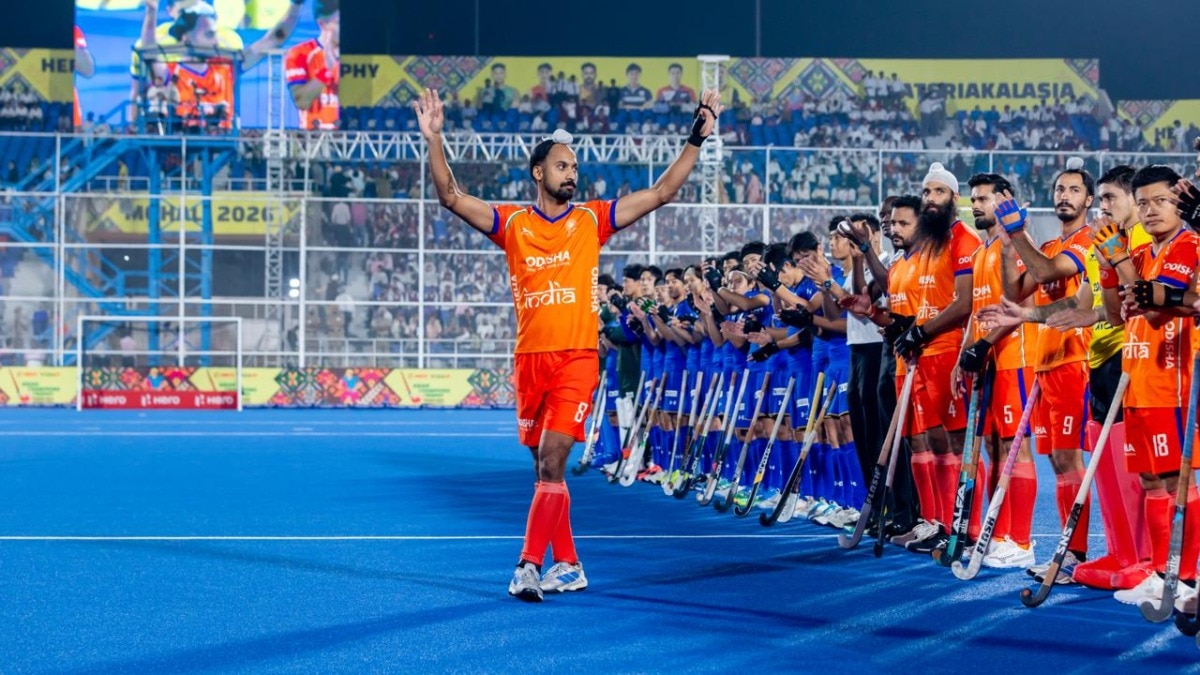
There is a unique frustration in watching Hardik Singh. The sheer delight of watching a gifted player and his stick work fused with his vision will inadvertently, eventually end in disappointment. It’s a contradiction: a play so sharp it constantly outruns the very team built around it.In his play there is a lustre, a dazzle, on the pitch, stick on ball, the play gets a luminosity that will either end in a glorious pass guaranteed to take your breath away or exasperation as the pass does not reach its natural conclusion; someone will be a fraction too late getting into position, or worse, fail to anticipate what Hardik has already seen in his mind.His play can, mostly, be condensed into two words – inspire and infuriate. Before you baulk at the severity of that judgment, understand what makes it so infuriating: Hardik’s genius does not always translate to the sticks and minds of those around him. And that is hardly their fault. Some players develop an instinctive understanding of each other’s movements and intentions. But such chemistry cannot be taken for granted. However, reading a midfielder isn’t exactly reading a defender, an advancing full-back aka Harpreet Singh or a Jarmanpreet or Abhishek outside the striking circle or a Sukhjeet inside the striking circle; reading a midfielder and someone like Hardik is like reading a hydra-headed midfielder, multi-faceted and complex.Contrary to what some coaches say – midfielders aren’t simplistic. The ones who are tend to be narcissistic, hanging on till every avenue is exhausted, the ball taken away, and a counter in motion. Hardik, on the contrary, tends to exhaust the opposition. When he is on the ball, prediction is a risky business; he could come fast, furious, ball dangling on the curve of the stick, or go parallel, using the space, dragging the opposition to one side, or he would rather push the ball back, create the space to his right and get the delivery there, all within a second, enough in field hockey to create extra space in the striking circle. You have to watch him closely. His facial expressions often betray where he intends to go next. Two decades ago, when Dhanraj Pillay played in midfield, or dropped deep to orchestrate an attack, opponents searched his face for clues and followed the curve of his stick as it swayed left and right, like the tiller of a boat, offering hints of a direction he could change in an instant.When Hardik is on a song, like he was in the Asian Champions Trophy final against Japan, he slips past players like a ghost, appearing in the striking circle when the stadium and opposition are looking the other way, dazzling his way past the defence. At times, he appears to be alone on the pitch. It is no indictment of the rest of the team, merely a measure of how extraordinary Hardik can be. Yet, on certain days, his brilliance seems almost futile, as the finished picture bears little resemblance to the painter’s inspired opening strokes, especially on a canvas where multiple artists need to put in their best to create a masterpiece.What is a midfielder if not an illusionist? He had started off playing with a low, deliberate style at the 2018 World Cup, ordinary by his standards - it was his debut - and today he plays like a classic schooner, fine hull lines, tall sails to slice cleanly through the defence, skimming the waves like an emperor. If today there is a Czar in the team, it is him.There will, of course, be differing opinions, most of them shaped by the goalscoring opportunities created or squandered. But it’s not always on how sharp the knife is, rather who holds it. The smallest of cuts can sometimes be the bloodiest and most fatal. That is the power Hardik holds in this Indian team which can occasionally be ordinary like hell and hope that he pulls them out of the morass. And on a good day, lifts them to the gates of heaven.The gates of heaven need to come more often. And that is where Hardik’s quality needs to rub off on the others.The trouble with being one of the few genuine match-winners in a side is that isolation becomes part of the job description. Being two ticks ahead is rarely an advantage; more often, it exposes the structural seams holding the squad together. When a playmaker sees an angle a split-second before a forward even initiates the diagonal run, the pass rolls harmlessly over the backline. On a television screen, it registers as an unforced error.Inside the stadium, a collective groan ripples through the stands. The illusionist is left standing near the half-line, stick lowered, waiting for an audience that hasn’t yet caught up to the trick.Indian hockey has lived inside this exact temporal lag before. During Sardar Singh’s peak years, the national side frequently looked oddly unbalanced, perpetually half a beat behind the rhythm of its own conductor. Sardar would glide out of tight corners with that unmistakable upright posture, absorbing pressure to draw two markers toward him before releasing the ball into a pocket of space - only to find his forward line either flat-footed or running across each other’s channels.Hardik, who grew up idolising Sardar and deliberately chose the number 8 jersey in his honour, has inherited not merely the crown of India’s midfield, but also its loneliest burden.“I can still remember when Paaji was playing HIL back in 2014 or 2015,” Hardik recalls, one can feel the unguarded awe of a teenager from Khusropur. “We were sitting in the stadium and not watching anyone else. We were just watching Paaji - how he moves, how he talks, everything. Even I’m wearing number 8 because I want to be like him.”In the great, well-balanced Indian teams of Olympic memory, even the most gifted midfielders were never expected to be solitary lifeboats, keeping an entire side from sinking. Look back at the 1984 Los Angeles squad: M.M. Somaya, Joaquim Carvalho and Hardeep Singh could dictate tempo from the centre knowing that any ball threaded forward would be met by the silken, telepathic movement of Mohammed Shahid, Zafar Iqbal, and Merwyn Fernandes, while Vineet Kumar and Manohar Topno held the fort behind them.Fast-forward sixteen years to the 2000 Sydney Olympics, where Thirumal Valavan, Mohammed Riaz and Baljit Singh Saini operated in front of a defensive wall anchored by Dilip Tirkey and Lazarus Barla, feeding a razor-sharp forward line featuring Dhanraj Pillay, Mukesh Kumar, Gagan Ajit Singh, and Deepak Thakur. In both eras, the midfield was a bridge connecting two equally formidable banks.Today, India’s architectural balance is far more delicate. Navigating the bruising cycle between a disappointing World Cup campaign - where a failure to reach the last four left deep psychological bruises - and the Olympic qualifying pressures of the Asian Games, the squad has looked caught between eras. With senior stalwarts retiring and the road to the 2028 Los Angeles Olympics demanding a generational churn, the temptation inside the camp is to treat Hardik as an all-purpose safety valve: hand him the ball when the structure frays and hope he invents an exit.Hardik himself feels the weight of that relentless calendar.“In hockey, playing back-to-back high-intensity tournaments is torture for your body and for your mind,” he says candidly.Pivoting from the heartbreak of the World Cup, where narrow tactical lapses against England and missed execution against the Netherlands proved costly, straight into the expectations of the Asian Games required a deliberate mental reset.“Two years ago, I was distributing balls, and it was not very perceptive - it wasn’t always accurate. I told myself that I have to be the calmest and most composed player on the field.”That shift - from a restless young talent trying to force magic on every possession to an architect who understands the value of restraint -marks his real maturation. He learned the cost of impatience at the Tokyo Olympics, where, by his own admission, he spent the opening matches trying too hard to manufacture an extraordinary assist or a fantasy-reel dodge out of thin air.“It doesn’t work like that at all,” he says now. “You have to find your own moment, and it will come. You just have to play normal - if it’s a five-meter pass, play the five-meter pass -because you will find your time in the match where you have to do your own thing.”Yet even when an illusionist waits patiently for his moment, the collective nerve of the team around him can fray under high pressure. Few fixtures test that fragility quite like an India-Pakistan encounter, particularly when a commanding 3-0 cushion suddenly unravels into a frantic 3-3 stalemate in the fourth quarter. From the press box, Hardik appears immune to panic. Inside his own head, the reality is far more human.“I’m not going to lie, I felt scared,” he admits of watching that 3-0 lead evaporate. “In your mind, you feel like we are giving them a match. And I thought, ‘Hardik, if there’s a turnover now, what will happen?’ Suddenly, out of nowhere, something clicked: I have done this in training so many times. I just have to do it twice or thrice. You need to trust your training. It’s all about the process, never about the outcome.”What makes Hardik’s candour compelling is how fiercely he resists the mythology of the solitary saviour. Mention the captain’s armband - a progression many around Indian hockey treat as a formality once the current leadership cycle turns - and he waves it away without a flicker of false modesty.“I like to be on the back foot and be the guy doing all the dirty work for the team,” he insists. “I didn’t start my hockey journey because I wanted to be captain. It never came into my mind. I don’t need a captain’s band to bring what I bring to the team. If someone else becomes captain after Harmanpreet, it’s completely fine.”Whether he wears the band or not, the march toward Los Angeles 2028 will demand an evolution that goes far beyond solo brilliance. As more senior figures step away, Hardik’s all-round capacity - his defensive tracking, his positional discipline when India loses the ball, his emotional steadiness when a match tilts - will be tested to its limits. More crucially, his influence cannot remain locked inside his own stick work. An orchestra cannot play a symphony if the conductor is operating at 140 beats per minute while the string section is stuck at 110.Hardik knows that closing that gap requires dismantling hierarchy inside the dressing room.“If you feel like you’re doing great as a hockey player and nobody can say anything to you, you cannot improve,” he says. “Even as a senior, sometimes you don’t know as much about a specific situation as your junior. In tournaments, I tell the forwards: ‘Tell me where you want the ball, I will pass it there. If I’m not doing something right, tell me. We are only doing this for you guys, and nobody is going to take it personally.’”That willingness to invite critique stems from a man who remains remarkably unvarnished off the turf. He speaks of himself not as some untouchable sporting icon, but as the son of a police officer who struggled in the classroom and found his escape in hockey. “Hockey was the only way to enjoy,” he says, adding that otherwise he might have ended up somewhere in Canada or Australia.He admits to snapping at his mother when she insists he wear a winter coat, only to apologise five minutes later. And beneath that everyday impatience lies a quiet, fiercely protective reverence for a woman who married at eighteen, made countless sacrifices for her son, and stood her ground against village scepticism when she sent him away to a sports hostel.Modern international hockey is drowning in data - video breakdowns of a defender’s unconscious weight shifts, GPS metrics, and rigid zonal pressing triggers. Yet no analyst can code telepathy into a forward line. Between now and Los Angeles, Hardik Singh’s greatest challenge will not be slipping past three defenders in a square foot of space or threading an impossible pass through a crowded circle. It will be pulling the rest of his team forward onto his clock, so that when the gates of heaven finally swing open, he isn’t standing there alone.- EndsTune In
The illusionist in the middle: Hardik Singh and the loneliness of genius
Full Article
Original Source
Read the full article at Indiatoday →KhanList aggregates and links to publicly available news content. We do not host full articles from third-party sources. Always verify important information with original sources.