
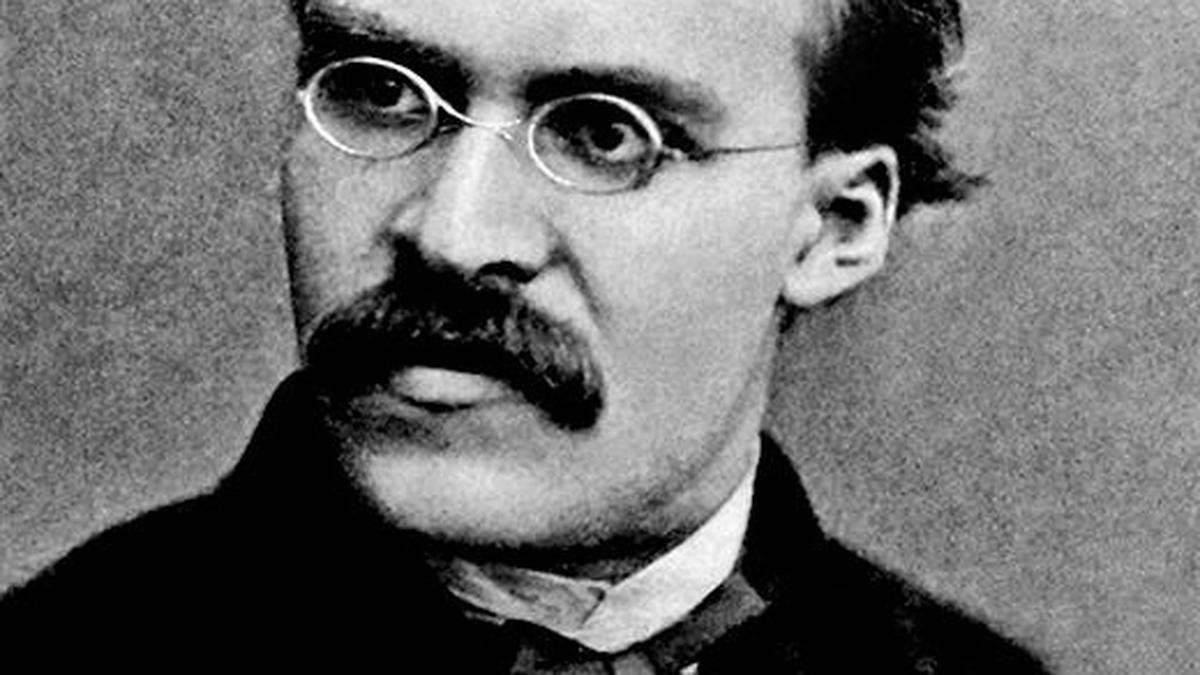
Friedrich Nietzsche | Photo Credit: Wikimedia Commons Recently, people I know have been getting a second ear piercing – a few centimetres away from the first – dangling rebelliously and drawing compliments. After a month of watching this trend grow, I couldn’t help but feel tempted by the idea and suddenly acquired an insatiable desire for another earring. After a week of nagging my mother, I eventually obtained it and was immediately satisfied. Looking back, I wonder, would I have ever wanted the piercing if my friends hadn’t gotten it? How many of our opinions do we actually choose? Perhaps this isn’t a uniquely modern anxiety. Representational image | Photo Credit: AI-generated image The dissonanceGerman philosopher Friedrich Nietzsche spent much of the 19th Century worrying about precisely this problem, that we would all become comfortably homogenous in our thoughts and opinions. In his book, The Gay Science, Nietzsche proclaimed the ‘death of god’ - which I interpret as more of a cultural diagnosis than a theological statement. He argued that the rise of scientific rationalism had eroded Europe’s belief in Christianity - not simply as a religion but as a moral compass to guide one’s conduct through life. This left questions such as ‘How should I live?’, ‘What is good?’ and ‘What gives life meaning?’ with no definite answer. Nietzsche’s concern was not that people stopped believing in God, but that they continued living as if the morals inherited from Christianity remained self-evident, despite no longer believing in the holistic worldview that justified them. This dissonance creates what Nietzsche viewed as the defining crisis of modernity – nihilism, the recognition that there is no pre-existing source of meaning or objective value. It is at this point that the Übermensch (Overman or Superman), a philosophical concept introduced by Nietzsche, emerges in his book Thus Spoke Zarathustra. The Übermensch is not biologically superior nor an eccentric individual who rejects convention. Instead, he represents Nietzsche’s response to nihilism: an individual who possesses the creative strength to become a legislator of values, generating their meaning rather than inheriting it.Who shapes our values?If nineteenth-century Europeans inherited their values from religion, today, consumers inherit them from advertising, influencers, algorithms, and brand identities that take everyone by storm each week. Are we creating our own values and ‘trends’, as Nietzsche hoped, or merely accepting a new set of externally produced ones? Modern consumer culture often sells individuality while surreptitiously encouraging conformity. It makes us marketable, it commodifies our identities, and it reinforces a capitalist agenda on individualist behaviours.Perhaps becoming an Übermensch was never about rejecting influence altogether. Every philosopher is influenced by another, and every reader is shaped by what they read. The challenge, Nietzsche suggests, is not to live untouched by the world but to develop a balance where you refuse to let it think on your behalf. In an age where our identities can be silently curated for us, perhaps individuality begins with a far simpler question: Why do I believe this? And perhaps a harder one; ‘If nobody else did, would I still?’(The author is a Class 10 student based in Chennai and a contributor to The Hindu Teen Digest.) Published - September 16, 2026 12:12 pm IST
The illusion of individuality
Full Article
Original Source
Read the full article at Thehindu →KhanList aggregates and links to publicly available news content. We do not host full articles from third-party sources. Always verify important information with original sources.