
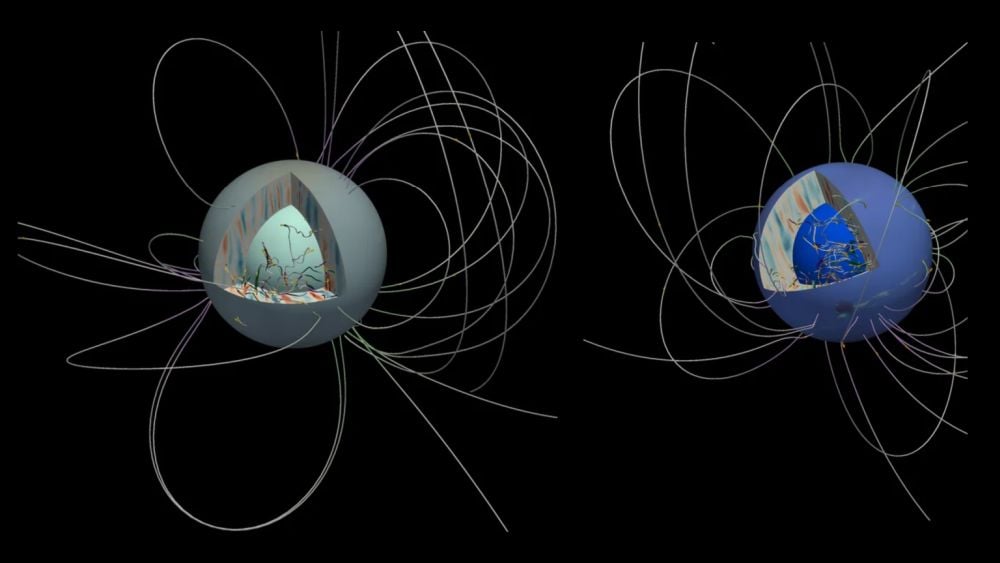
Most planets appear to have magnetic fields, even if they're only weak, remnant fields. Earth has a strong field generated by its internal geodynamo. The other rocky planets have magnetic fields of varying strengths, with the possible exception of Venus. The outer gas planets, Jupiter, Saturn, Uranus, and Neptune, all have strong dynamos. But the magnetic fields generated by the ice giants Uranus and Neptune have some strange properties. Earth's molten core and internal convection generate its magnetic fields. But the ice giants' magnetic fields are likely generated by fluids that are electrically conductive. These are water, ammonia, and methane ices under extreme pressure and temperatures that alter them and turn them into ionic and superionic phases. Not only is their electrical conductivity at play, but so is convection and the planets' rotations. But beyond what generates them, they also have other differences. Earth's magnetic field has well-defined north and south poles that drift a little over time, and even flip every couple of hundred thousand years or so. But Voyager 2 showed us how different Uranus and Neptune are. Their fields are in disarray compared to Earth's. They're tilted and multi-peaked. Uranus' magnetic field doesn't originate in its center, and is tilted almost 60 degrees from its axis of rotation. It's overall geometry is strange, and the magnetic field across its surface is asymmetrical in strength. Neptune's magnetic field is similarly strange, but weaker. Like Uranus' it's tilted from its rotational axis, by about 47 degrees. It's also offset from the planet's physical center like Uranus'. The most critical difference between the magnetic fields of Earth and those of Uranus and Neptune is that the fields around the ice giants experience shorter-term variability. In short, they're a weird mess. While planetary scientists know that these fields are generated inside the planets, they've had to make some guesses as to why they're so strange. New research in Nature Communications Physics has made some progress understanding the pair of ice giants and their strange magnetic fields. It's titled "Electrical conductivity structure drives anomalous and potentially time-varying magnetic fields at Uranus and Neptune," and the lead author is Chi Yan. Yan is a research associate at the University of Texax Jackson School of Geosciences. "Uranus and Neptune exhibit magnetic fields that are non-dipolar and non-axisymmetric, unlike those of any other known planet," the researchers write. "These fields are generated by fluid motions in electrically conducting planetary interiors via dynamo action, offering a window into otherwise inaccessible deep processes." As we often say at Universe Today, understanding the oddballs and outliers in a group of objects sheds light on how processes operate across the broader group they're a part of. This is true of the ice giants and their magnetic fields. "Understanding why Uranus and Neptune have such unusual magnetic fields provides critical insight into dynamo processes across planets and stars," the authors explain. This work is based on modelled dynamos that are controlled by interior composition and temperature. They assumed that electrical conductivity increases with depth. The authors say they "produce large-scale magnetic features consistent with the observed fields of Uranus and Neptune..." This schematic shows the different interior layouts used in the models. a through c show radially variable electrical conductivity profiles for dynamo models with convective shell geometries. d through f show the associated shell geometry for each of a through c. Image Credit: Yan, C., Soderlund, K.M., Aurnou, J.M. et al. Electrical conductivity structure drives anomalous and potentially time-varying magnetic fields at Uranus and Neptune. Commun Phys 9, 336 (2026). “Deep inside Uranus and Neptune, pressures and temperatures become extremely high,” lead author Yan said in a press release. “Under these conditions, which can cause water molecules to break apart into ions, the material may become increasingly electrically conductive with depth.” Voyager 2 gave us our only good close-up look at Uranus and Neptune. It likely caught those fields in a snapshot in time, and the model shows both planets' magnetic fields could shift and change markedly in only decades. The fields are most likely configured much differently than when Voyager 2 visited. This is much different than on Earth, where the magnetic north pole drifts between about 5 and 60 km per year, or about one degree every few decades. "These non-dipolar dynamos exhibit substantial temporal variation, although the rate fluctuates and can be transiently slow," the authors write. They explain that changes in both intensity and orientation are a possibility in the decades since Voyager 2 flew past Uranus and Neptune, "though the extent of any such variation remains poorly constrained observationally as each planet has been measured in situ only once." “Earth’s magnetic tilt drifts by only a degree or so over 50 years,” said Yan. “Our models show the ice giants can behave very differently. In some stretches the tilt swings by tens of degrees within decades. In others it shifts only slightly over the same span.” This figure compares observations of Uranus' and Neptune's surface magnetic fields with the fields from models. The figure "demonstrates that the most Uranus-like snapshot from Model 6 (panel c) and the most Neptune-like snapshot from Model 11 (panel d) can change substantially on decadal timescales, with their close morphological resemblance to the respective observed fields (panels a and b) deteriorating markedly after 32 years (panels e and f)," the authors explain. Image Credit: Yan, C., Soderlund, K.M., Aurnou, J.M. et al. Electrical conductivity structure drives anomalous and potentially time-varying magnetic fields at Uranus and Neptune. Commun Phys 9, 336 (2026). "We demonstrate that dynamo models incorporating an electrical conductivity that increases with depth can promote non-dipolar, non-axisymmetric magnetic fields," the authors write, including the M1 peak observed at Uranus and Neptune. The M1 peak is an important, maybe the most important part, of Voyager 2's magnetic field observations. M=1 represents the lop-sided parts of a magnetic field. On Earth and other planets like Jupiter and Saturn, the magnetic field's power is dominated by symmetric or M=0 components. So for those planets, the M-1 components are at least an order of magnitude weaker than their M-0 components. But that's not true on Uranus and Neptune. They show a stark contrast. They both have a very strong M-1 peak, the part that represents asymmetric fields. This means that they have dipoles, quadrupoles, and octupoles that are messy and skewed from the axis of rotation. "Despite current observational and computational limitations, our results indicate that ice-giant-like dynamos can, in some intervals, undergo substantial magnetic field variations on decadal timescales that, if confirmed by future in situ or auroral measurements, could have significant impacts on the surrounding planetary magnetospheres," the authors write. The JWST has observed the ice giant aurorae and the charged particles involved. These particles respond to the magnetic fields, and those observations could confirm if the magnetic fields have indeed shifted since Voyager 2 visited. Researchers are still working on those observations. The image on the left is an enhanced-color image of Neptune from NASA’s Hubble Space Telescope. On the right, that image is combined with data from NASA’s James Webb Space Telescope. The cyan splotches are auroral activity captured with the JWST's Near-Infrared Spectrograph (NIRSpec). Image Credit: NASA, ESA, CSA, STScI, Heidi Hammel (AURA), Henrik Melin (Northumbria University), Leigh Fletcher (University of Leicester), Stefanie Milam (NASA-GSFC) “We are busy working on what’s contained within these observations, but the shape and structure of the aurora, as well as other weird patterns in the ionosphere promises to provide us with a way of understanding how the magnetic fields have changed, an important stepping stone,” said Tom Stallard, a professor at Northumbria University who led the JWST observation campaign. The researchers will combine the JWST data with their models and data from Voyager 2 and take their results as far as they can to try to determine the state of the magnetic fields today. But they're up against some limitations, limitations that can only be lifted by another mission to the ice giants. There are no firm plans for a mission to the ice giants, but there are concepts. One is NASA's Uranus Orbiter & Probe that would study the planet and its moons, and even send a probe into Uranus' atmosphere. The Neptune Odyssey is another NASA concept. It would also consist of an orbiter and an atmospheric probe. The science community has recognized the importance of these missions, but they're just concepts at this point. This research may extend to the issue of habitability, though probably only tangentially. Uranus' four major moons could all potentially have subsurface oceans under icy covers, though this is far from confirmed. If they do, then Uranus' magnetic field and related radiation belts could affect these bodies of water, their longevity, and their potential habitability.
The Ice Giants' Magnetic Fields are Very Strange Compared to Earth's
Full Article
Original Source
Read the full article at Universetoday →KhanList aggregates and links to publicly available news content. We do not host full articles from third-party sources. Always verify important information with original sources.