
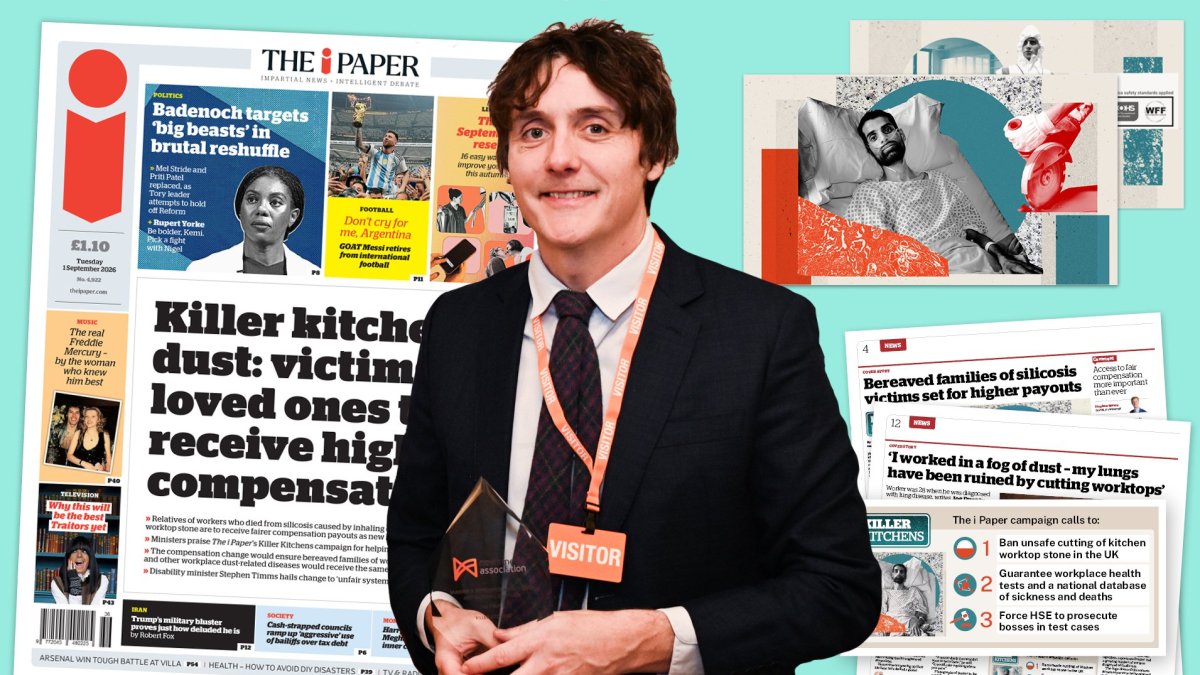
Joe Duggan, senior reporter at The i Paper, has won the News Media Association’s “Making a Difference” award for his “powerful and determined” reporting on the deadly lung disease silicosis, as part of our Killer Kitchens campaign. The award, voted for by the public, celebrates local and national media campaigns that drive real-world change and hold decision-makers to account. Killer Kitchens, spearheaded by Duggan, investigated cases of workers who fell ill and died from silicosis after inhaling dust while cutting quartz kitchen worktops without sufficient protection. The reporting contributed to the introduction of new safety rules that will save lives; a criminal investigation into one worker’s death; and the tabling of a parliamentary bill to outlaw unsafe cutting of engineered stone. Shorts Theo Bamber, CEO of the News Media Association (NMA), said: “Joe’s reporting is a brilliant example of journalism making a real difference. His investigation shone a light on the devastating impact engineered stone is having on workers’ lives, exposing an issue that urgently needed greater attention and helping to drive meaningful action to protect people. “It was powerful, determined public-interest journalism and a hugely deserving winner of this year’s Making a Difference award.” In 2024, Duggan revealed the UK’s first silicosis cases in young stonemasons who were cutting high-silica quartz worktops that have become hugely popular in kitchen renovations – a condition not many had heard of. Duggan is presented with the “Making a Difference” award by Theo Bamber of the NMA (Photo: Darren Salanson) His two-year investigation has since prompted the most significant safety changes yet in the sector, implemented by the Health and Safety Executive (HSE) and the kitchen stone industry – measures that will save lives. HSE issued regulatory guidance banning the “dry cutting” of quartz. The campaign also pressured the HSE into a nationwide inspection blitz on 1,000 workplaces over 12 months to clamp down on firms exposing workers to lethal stone particles. As a result, almost 400 enforcement notices have been served against companies for breaching health and safety law. The Government has considered changing benefits rules for seriously ill workers after Duggan exposed how sick and dying tradesmen were threatened with financial sanctions and eviction. Ministers have praised the campaign for driving reform, and the Government has announced that families of workers who died from silicosis will now receive higher compensation payouts. Legislation is currently going through Parliament that mirrors The i Paper’s calls for an outright ban on dry cutting high-silica engineered stone; a screening programme to identify cases of silicosis; and the monitoring of other diseases caused by exposure to the dust. In another campaign victory, Duggan’s reporting has prompted a new Kitemark scheme from the stone worktop industry to inform consumers that quartz had been cut without exposing workers to deadly dust. Retailers Wren and Howdens – the two biggest names in the UK kitchen market – have both joined it. The Kitemark scheme was hailed as “important” and “significant” by the HSE and the UK’s leading doctor treating quartz silicosis patients. The British Occupational Hygiene Society (BOHS) praised Duggan’s reporting for bringing change that will “save lives”. Many sufferers of silicosis are men in their twenties and thirties who have described being denied adequate protective equipment to prevent them from inhaling dust while at work. Marek Marzec died in November 2024, just seven months after he was diagnosed with silicosis Around 60 cases and four deaths have been detected in the UK, but doctors warn the true toll could be significantly higher, with action needed to prevent silicosis epidemics that have been seen in other countries. Duggan revealed that Marek Marzec, a father of two dying of silicosis, spent months battling for benefits and government compensation, only to be informed on the day he died that he was eligible. Marzec, who spoke to The i Paper from hospital weeks before he died, was asked by the Department for Work and Pensions to attend assessments despite receiving palliative care. As a result of the article, the Industrial Injuries Advisory Council recommended that cases of rapid-progression silicosis from quartz should be fast-tracked for the industrial injuries disablement benefit. Kevin Bampton, head of BOHS, said: “I can’t imagine the level of interest in Parliament, Government, [the] HSE and industry would have been anywhere near what it is without The i Paper campaign.” Duggan’s colleague Steve Robson won the “Making a Difference” award last year for uncovering the second Post Office IT scandal.
The i Paper’s life-saving Killer Kitchens campaign wins Making a Difference award
Full Article
Original Source
Read the full article at Inews →KhanList aggregates and links to publicly available news content. We do not host full articles from third-party sources. Always verify important information with original sources.