
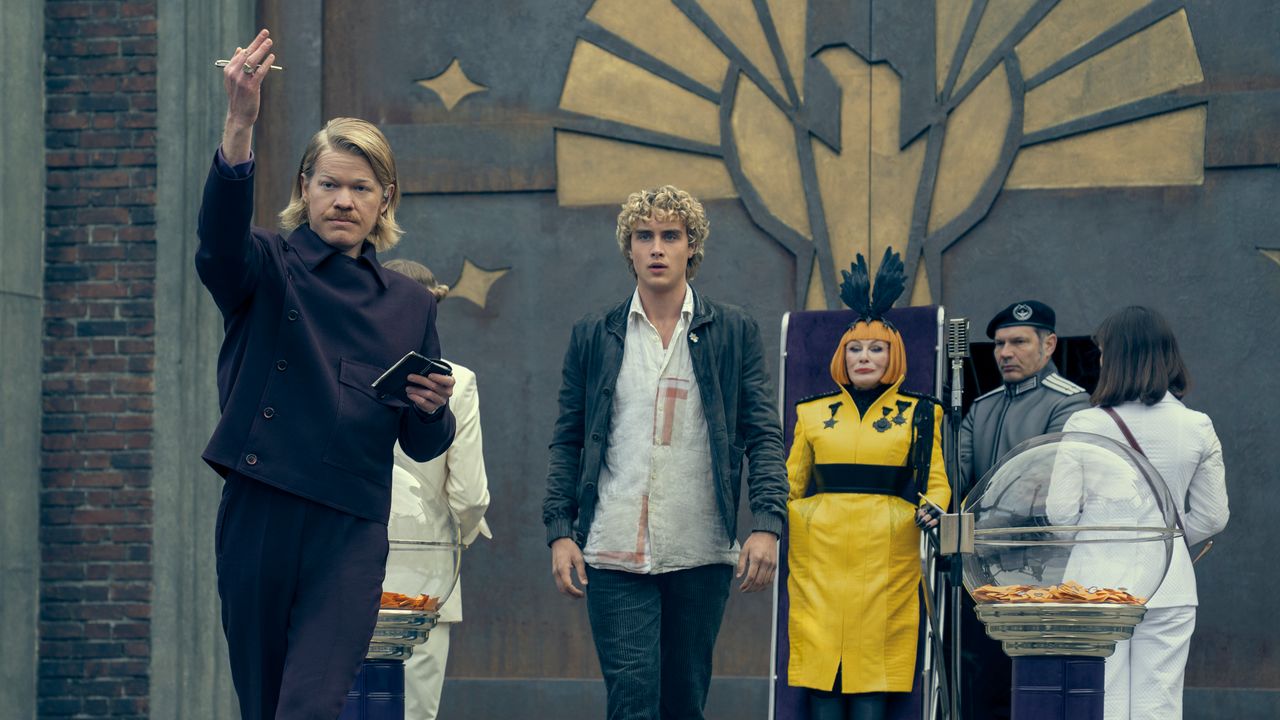
Francis Lawrence, director of The Hunger Games, has a tradition with author Suzanne Collins. Before bringing a new installment of her bestselling dystopian saga to the big screen, the two join forces to envision how the fictional world of Panem will take shape. “I go to New York each time, and we sit in a conference room at Scholastic,” says Lawrence, who has directed five of the franchise’s six films. “We go through the book page by page and beat out what we think the movie is going to look like.”Lawrence’s latest adaptation, The Hunger Games: Sunrise on the Reaping (in theaters today), returns to Panem, a postapocalyptic nation where the ruling Capitol controls twelve districts through extreme systemic oppression—most notoriously the titular spectacle in which children are selected by lottery and forced to fight to the death in an arena. Set twenty-four years before the original The Hunger Games (2012) plotline, the prequel follows District 12’s sixteen-year-old Haymitch Abernathy (Joseph Zada)—the future mentor (played by Woody Harrelson) to Katniss Everdeen (Jennifer Lawrence) and Peeta Mellark (Josh Hutcherson)—as he is selected to fight in the Second Quarter Quell, a particularly sadistic rendition of the Games held every twenty-five years.District 12’s female tribute Maysilee Donner (McKenna Grace) at the reaping. Photo: Murray Close/LionsgateThough the dystopia is set in a future North America, the previous prequel, The Ballad of Songbirds & Snakes (2023), drew from the architecture of 1940s and ’50s postwar Berlin to depict evil President Snow’s rise to tyranny. Set forty years later, Sunrise explores Panem at a new stage of its evolution. Designed by returning production designer Uli Hanisch, the film follows Haymitch from his impoverished mining district, which barely evolves throughout the series’s sixty-five year timeline, to the opulent Capitol, whose extravagance is expressed through a 1970s-inflected visual lexicon.“I realized the ’70s fall right smack in the middle between that movie and the originals, so we could lean into that,” says Lawrence. Hanisch and his team incorporated references to Andy Warhol, Studio 54, and the decade’s psychedelic color palette, appropriating its progressive spirit to convey the Capitol’s opulence and authoritarianism—and, particularly in the arena, using the aesthetic as a means of deception. “To turn the ’70s style from something progressive, liberal, young, and open-minded into something evil is a twist,” says Hanisch. “But that is the key to the entire film’s design.”Haymitch and Maysilee as allies in the arena. The forest portion was filmed separately near Cologne, Germany. Photo: Murray Close/LionsgateThe stylistic choice is also a poignant nod to Collins’s original inspiration for the book series. The 1970s marked a transformation in American television: as color TVs became ubiquitous in households across the country, sporting spectacles, variety shows, and beauty pageants flourished, establishing cultural touchstones that would help shape the contemporary reality programming Collins critiques and satirizes in The Hunger Games. “I was flipping through the channels one night between reality television programs and actual footage of the Iraq War, when the idea came to me,” Collins recalled in a 2018 interview with The New York Times. The juxtaposition inspired her to explore just-war theory for young people through an authoritarian dystopia in which mass entertainment is an instrument of political control.From an abandoned rural steel mill to authoritarian monuments from postwar Berlin, the film draws on politically charged German sites to capture Panem at a pivotal stage in its political and architectural evolution.District 12Production Designer Uli Hanisch at the District 12 set. “District 12 is the most sentimental set to me because I’d known this site near my hometown my entire life,” Hanisch says. Photo: Murray Close/LionsgateTo recreate the Appalachian-inspired, deteriorating industrial landscape of District 12 that was shot in Atlanta in the original series, the production utilized a sprawling abandoned steel mill in Duisburg, Germany, Hanisch’s hometown. “I wish we had it in the original movies, because it is an unbelievable space,” Lawrence says of the post-industrial, rural landscape, which also appeared in The Ballad of Songbirds & Snakes, Hanisch’s first film in the franchise. “Everywhere you look is exactly how I have always imagined District 12.”While District 12 was filmed near Atlanta in the original films, director Francis Lawrence’s fascination with German architecture brought production to Berlin for The Ballad of Songbirds & Snakes. It was there that he began collaborating with Berlin-based production designer Hanisch, who proposed this steel mill nearby his hometown for the new location. Upon seeing photographs, Lawrence exclaimed, “Are you kidding me? ... Let’s go tomorrow,” and promptly flew out to see it for himself. Courtesy of LionsgateThe production designer added modest huts at the edge of a nearby quarry to recreate the Seam, home to Haymitch, his girlfriend Lenore Dove (Whitney Peak), and fellow tribute Louella McCoy (Molly McCann), its humble dwellings contrasting the more prosperous merchant district inhabited by fellow tribute Maysilee Donner (Mckenna Grace).“Unlike the Capitol, District 12 doesn't evolve stylistically throughout the films. Nobody is investing in it, and everything is gradually deteriorating,” Hanisch explains. The vivid purples and oranges of the Capitol’s ‘70s palette are notably absent, only appearing prominently in propaganda decorating the reaping square, including Hunger Games campaign materials and posters portraying Snow as Panem’s number-one Peacekeeper.The CapitolDruscilla in the Capitol before the tribute interviews, which is broadcast to all of Panem. Courtesy of LionsgateIn the Capitol, however, the architecture takes on a distinctly ‘70s flair. Rooted in the Roman concept of panem et circenses, or “bread and circuses,” from which Panem takes its name, the architecture reinforces the government’s manipulation through spectacle. In the background is Berlin's International Congress Centrum, a colossal, aluminum-clad convention center that opened in 1979, which Lawrence describes as “Cold War-era Berlin showing off in a modern way.” As West Berlin’s most expensive postwar building, the futuristic complex was publicly subsidised to showcase economic prosperity and technological advancement—an evocative backdrop for the Capitol’s own display of authoritarianism.“It’s a time of peace for the Capitol with no rebel attacks, so Snow's had time to build the city up in a way that is an extravagant show of power,” Lawrence explains. The chariot parade, which introduces the tributes before the Games, similarly unfolds against the historically-charged Berlin Olympiastadion, which was designed by Werner March for the 1936 Olympics under Nazi Germany to project state power and an illusion of timeless permanence.The upstairs library in Plutarch’s home, which he inherited from the Heavensbee dynasty. Reflecting the Capitol’s classic style, it contrasts the Plutarch’s modern downstairs salon which features Warhol-inspired portraits, including one of director Lawrence. Photo: Murray Close/LionsgateThe Capitol's grandeur is also exhibited inside the mansion of Plutarch Heavensbee (Jesse Plemons), a cameraman with historic ties to Panem’s ruling class. “This was one of my favorite sets because of the scope and scale” Lawrence says, noting how its excess reflects the dynasty's immense wealth. Filmed at Berlin's late-1960s modernist Congress Center, the circular residence required twenty-five vans of retro-modern furniture to fill it. The salon, decked in vibrant 1970s furnishings and Warhol-inspired art, showcases Plutarch's modern sensibilities, in stark contrast to the upstairs library inherited from his family. “We wanted to distinguish Plutarch from the dynasty he comes from,” Lawrence explains, reflecting on how the expansive volumes must be a facade of intellectual sophistication.The set decoration department spent weeks hand-folding and assembling thousands of hollow cardboard books, interspersed with real volumes, including a collection of Edgar Allan Poe’s poetry, which Plutarch references to Haymitch. “We imagined Plutarch might actually be the first Heavensbee to read some of those books,” Hanisch says. “He even says the library is one of the few worthwhile things his ancestors accomplished.” Photo: Murray Close/LionsgateThe library's custom-built curved bookshelves envelope the characters, symbolising the insularity of Capitol society. “Circles represent both inclusion and exclusion,” Hanisch says. “If you are in the circle, you're in. And if you're not, you're out.” As fans of the franchise will know, Plutarch (originally played by Philip Seymour Hoffman) later reveals himself as a double agent and leader of the underground rebellion against Snow’s regime.The ArenaThe aspect ratio expands as Haymitch ascends into the eye-shaped arena, emphasizing the landscape’s immersive scale and beauty. While scouting locations, Lawrence drew inspiration from the dramatic landscapes in Terrence Malick’s A Hidden Life. “I had that in my head, only it was a little trippier. The Asturias were perfect,” he recalls. The kaleidoscopic design also inspired the official logo of the 50th Hunger Games, extending the arena’s psychedelic imagery into the Capitol’s propaganda. Courtesy of LionsgateThe Quarter Quell arena, in particular, embodies the surreal, fantastical ethos of the 1970s that permeates the film, illustrating how the Capitol exploits beauty to disguise its underlying manipulation and brutality. “As I was reading with Suzanne, I said there was an Alice in Wonderland-like element to it, which made me think of the song ‘White Rabbit,’ which made me think of the late ’60s, early ’70s,” Lawrence recalls. “That kind of broke something open for me.”Designed in the shape of an eye, the eight to ten mile arena serves as a metaphor for the Capitol's omnipresent surveillance. A golden Cornucopia forms its pupil; vibrant meadows its iris; and the surrounding mountain ranges its whites. In the book, Haymitch describes the especially lethal arena masquerading as an idyllic landscape as a “poisonous beauty of an arena.”Lawrence and Haymitch in the arena. The physical flowers were concentrated in the foreground, while visual effects extended the colorful landscape into the distance Photo: Murray Close/LionsgateSeeking to capture as much natural landscape as possible, Hanisch and location manager Klaus große Darrelmann discovered a remote valley in Asturias, Spain, surrounded by the Cantabrian Mountains. Transforming the isolated valley into a psychedelic paradise proved an enormous undertaking.“The arena was our nemesis,” says Hanisch, recalling how the production had to bring extensive resources to the remote terrain. “You can't even imagine how far away it was or how hard it was to get to.” Crews spent weeks individually installing hundreds of thousands of artificial flowers throughout the meadows and forests.Despite the arena’s dreamlike beauty, water sources, flowers, and vegetation conceal deadly poisons. “It’s the most colorful and playful dystopia you’ll ever see,” producer Nina Jacobson says. Perhaps more than anywhere else in Panem, the arena encapsulates how the Capitol weaponizes the electric zeitgeist of the ‘70s as an instrument of control. “To have something so overwhelmingly beautiful and seductive but poisonous and deadly is very cruel,” Hanisch says. “That contradiction captures the mentality of Panem at this point in its history.”
‘The Hunger Games: Sunrise on the Reaping’: Inside the Psychedelic 1970s-Inspired Dystopian Sets
Full Article
Original Source
Read the full article at Architecturaldigest →KhanList aggregates and links to publicly available news content. We do not host full articles from third-party sources. Always verify important information with original sources.