
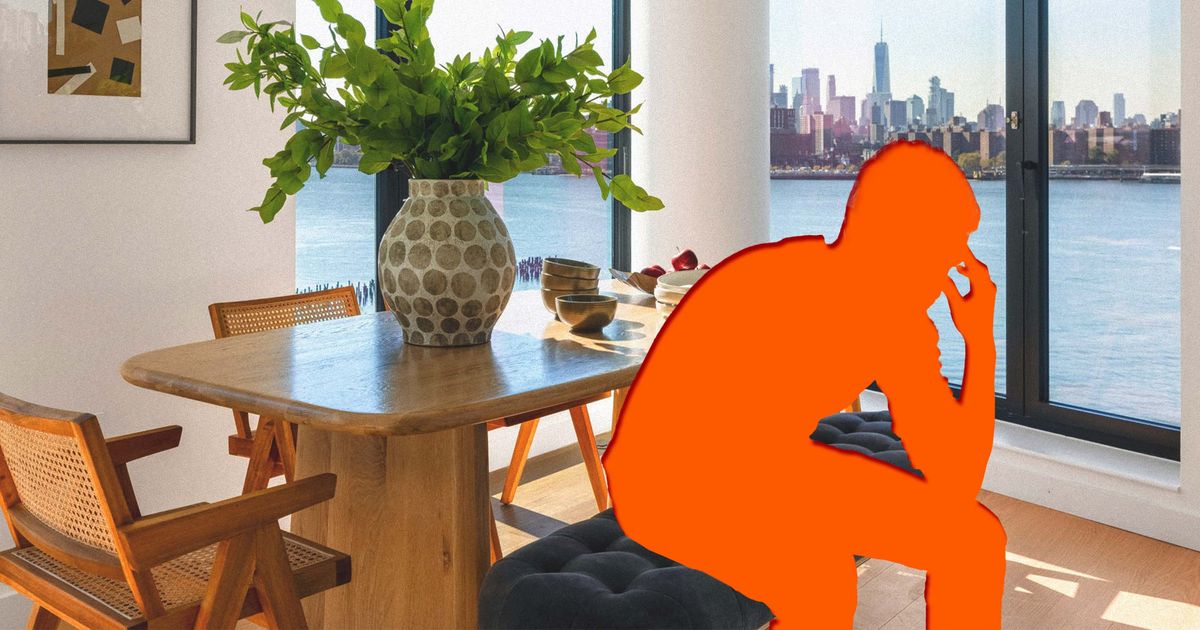
Intelligencer The Cut Vulture The Strategist Curbed Grub Street Subscribe There are affordable-housing-lottery apartments at the Eagle + West complex, as seen in this advertising photo, but it apparently isn’t always clear to prospective tenants that they might not get the more upscale perks. Photo-Illustration: Curbed; Photos: Brookfield Properties, Getty Miguel Castro couldn’t believe his luck. After the slog of filling out housing-lottery paperwork and months of waiting, the brand ambassador and bartender got picked for a rent-stabilized studio at 25 Water Street, a brand-new 1,300-unit office-to-residential conversion in the Financial District. The listing photos and renderings showed glistening lacquered cabinets, hardwood floors, and stainless-steel appliances, all on top of an amenity spread that included an outdoor and indoor swimming pool, a basketball court, and a library. The rent was just $2,250 a month (plus another $150 for amenity fees), compared to around $4,300 for a market-rate studio in the neighborhood; more important, it was stabilized. He was happy with his housing setup at the time — a spacious, one-bedroom apartment in Jamaica, Queens, which he also had won through the lottery — but the idea of living in the city proper was hard to pass up. “The allure of living in Manhattan was intense,” he says. “The Financial District — it sounds so elevated.” He grabbed it and moved in. Gradually, the red flags he had faintly picked up on during his tour became hard to ignore. It’s the tiniest apartment Castro has ever lived in, with just enough room for a full-size bed, a TV, and a small sofa. The walls are thin and uninsulated, which makes it easy to hear his neighbors and impossible to get a decent night’s sleep. There isn’t much natural light or ventilation, so he and some of his neighbors tend to keep their blinds up despite looking out in a shared courtyard — meaning that he occasionally glimpses people running around in the buff and vice versa. “This place is like a prison,” he says. “I am so mad at myself for moving here.” To New Yorkers who have been waiting years, sometimes more than a decade, to get picked in the affordable-housing lottery, it’s perhaps hard to hear Castro bemoaning his circumstances. Competition for the lottery is cutthroat, with more than 7 million applications submitted on the Housing Connect portal in 2025 for the 13,000 units advertised. Between the record-breaking rents this year and Zohran Mamdani’s historic two-year freeze for rent-regulated units (legal challenges pending), a stabilized lease that isn’t in a roach-infested, slumlord building seems like, well, winning the lottery. Yet Castro isn’t alone in reconsidering the open market — or at least having some serious regrets about his prize. “We thought we were getting a silver bullet,” Elijah DuPonty, a registrar at David Zwirner Gallery, says about getting picked to tour a lottery apartment earlier this year. He was living in a one-bedroom railroad flat on the Upper West Side with his partner and cat when he got a call to come down immediately to Tompkins Avenue in Bedford-Stuyvesant to see a one-bedroom unit there. He was excited — at least until he got to the address. Yes, it was a one-bedroom, with big, loftlike windows and sleek new appliances. But it was smaller than his current place, and the monthly rent, while stabilized, still was nearly $200 more than the $2,820 he was paying at the time for his market-rate unit. Near the very end of the application process, DuPonty pulled out, shocking his co-workers. It puzzled the building’s lottery manager, too. When DuPonty said he wasn’t interested, he recalls, “They replied, ‘Why not?’” A lottery unit at 25 Water Street, seen in this listing photo, seems at least in some ways comparable to what you’d find in a market-rate apartment with new appliances and shiny lacquered cabinetry. Photo: SoMA Leasing This sort of pickiness isn’t all that uncommon among middle-income applicants — that is, those who typically make around 130 percent of the area median income. Subsidized housing is offered in several “bands” that are tied to various income tiers, each based on a percentage of the local median income. Some apartments are restricted to the lowest incomes, 30 percent of the median, and those, unsurprisingly, are usually flooded with applications, according to a 2020 analysis by the City Reporter. The upper tiers — some of which accept people with incomes up to 130 percent of the median, like DuPonty — have far fewer applicants, and thus an acceptance rate that’s six times higher than at the lower levels. Better chances mean more options, and more ability to pay means they might find something on the open market as well. Which, if you spend any amount of time on the sub-Reddit dedicated to the city’s housing lottery, seems to check out: A number of people in this relatively high income bracket share their experiences of repeatedly getting picked — and turning down — apartments that weren’t much of a deal. One person who claims to fall in this category tells me that, even after repeatedly getting picked, he doesn’t want to leave his large $2,400-a-month one-bedroom for, say, a nearly $4,400 two-bedroom in Chelsea that’s much stingier on space. “There are one or two dream lottery apartments I applied to and would take in a heartbeat, but they have not contacted me,” this person says. Nate Bliss, a former executive director for economic development under the Adams administration who now runs a real-estate advisory firm, Latent Urban Ventures, explains that those higher rents come from the calculations that developers are doing to fund mixed-income housing projects — with public dollars coming from varying city, state, and federal programs, each with their own affordability requirements. “Whatever pencils” — that is, works out financially — “and is feasible, that is what gets delivered,” he says. In those buildings that include 130 percent–AMI tenants, the rents come out so close to market rate that those middle-income tenants simply have a lot of other options. Obtaining subsidized housing also demands that prospective renters submit a mountain of paperwork and undergo a process that Bliss describes as “invasive,” “cumbersome,” and “time-consuming,” and some may not think it’s worth what they see as mild savings. If there’s any savings to be had at all. Tanoopa, an executive assistant at a fintech firm, had been filling out housing-lottery applications since 1999 and turned down a handful of offers she received for apartments in less-than-ideal neighborhoods. In June 2025, she finally got picked for a 475-square-foot place in Greenpoint, at the Dupont. “Finally!” she says. “I felt like a kid in a candy store.” The apartment, she says, was an alcove studio on the 30th floor with the biggest bathroom she’d ever seen. The setup was tight on her finances — the roughly $3,100-a-month rent was eating up half her take-home pay — but still worth it for the location. But then she lost her job three months into the lease. “They said to me, ‘You can’t break your lease, because you will still owe that money until we find someone to rent your apartment,’” she claims, adding that the management company insisted it couldn’t show the apartment while she was still living there. “I was forced to stay until my lease was over,” she says. “It was a nightmare from start to finish.” An affordable-housing unit at 25 Water Street, seen in this listing photo, looks out into a shared courtyard, which means privacy might be hard to come by if you keep your blinds open for natural light. Photo: SoMA Leasing Many of these buildings also contain market-rate apartments, and among the lottery tenants, that can sometimes create a sense — whether based in fact or merely in vibes — of second-class citizenry. “I feel these people can smell you don’t have a trust fund,” Castro says about his wealthier neighbors at 25 Water. At the Eagle + West complex along the Greenpoint waterfront, a number of affordable units are clustered in one building in the complex, 27 Eagle Street. One of the lottery winners, a health-care manager, learned late in his application process that many of the sleek amenities in the building complex that were flaunted in the listing, like indoor and outdoor pools and a huge fitness center, wouldn’t be accessible to him or anyone else at 27 Eagle. (Tenants renting affordable apartments in 227 West, one of the other towers in the complex, are allowed to use these amenities.) He took the apartment, a studio for which he pays around $1,800 a month and gets access to a dingy basement gym. But, he says, “I definitely do feel like I was catfished.” Every summer, when he walks through the park area right outside his home, he has to take in the smell of barbecue wafting from Eagle + West’s communal grills that are also off-limits. He even got a reminder about his status this July when he learned that residents in his building weren’t allowed to watch the East River fireworks from the second-floor terrace with tenants from the other two towers, despite receiving a message from management informing him about the gathering. “You get that reminder of ‘Oh, there’s the haves and there’s the have-nots,’” he says. “I think of it like Animal Farm.” Are these indignities bad enough that he’s considering moving out? “I have looked at StreetEasy, and the rent is outrageous,” he says. (A spokesperson for Eagle + West tells me that it is clear during the application process which amenities come with which building. “We are proud to provide high-quality affordable housing in New York City and are committed to delivering a positive experience for all residents,” the spokesperson says.) Castro is more motivated to get out of what he sees as his velvet coffin at 25 Water, but he’s still in the same bind; the asking rents he’s seen for apartments on the market today dwarf his current rent. The lottery hasn’t given him another win, either, since the only building he was in the running for offered him a decent-size studio, but in East New York. (“The neighborhood was a deal-breaker,” he says.) He even looked into moving back to his old building in Jamaica. Except that a market-rate one-bedroom apartment there, not unlike the unit he once paid $2,000 for, is $2,900 a month. “Please, God,” he says, “don’t let my luck run out.” The Housing Lottery Winner-Losers Your product is saved! You’ll receive emails when your saved products go on sale. Manage preferences. Every product is independently selected by editors. Things you buy through our links may earn Vox Media a commission. ‘Kelly Clarkson Has Put Us in Danger’ The 7th Floor–8th Floor Marriage “Once I Got Into 150 Charles, I Wasn’t Leaving” The Graza Olive-Oil People Are Designing Mamdani’s New Groceries Gowanopolis Rising ‘Kelly Clarkson Has Put Us in Danger’ The 7th Floor–8th Floor Marriage “Once I Got Into 150 Charles, I Wasn’t Leaving” Gowanopolis Rising The Graza Olive-Oil People Are Designing Mamdani’s New Groceries ‘Kelly Clarkson Has Put Us in Danger’ The 7th Floor–8th Floor Marriage “Once I Got Into 150 Charles, I Wasn’t Leaving” The Graza Olive-Oil People Are Designing Mamdani’s New Groceries Gowanopolis Rising ‘Kelly Clarkson Has Put Us in Danger’ The 7th Floor–8th Floor Marriage “Once I Got Into 150 Charles, I Wasn’t Leaving” Gowanopolis Rising The Graza Olive-Oil People Are Designing Mamdani’s New Groceries
The Housing Lottery Winner-Losers
Full Article
Original Source
Read the full article at Curbed →KhanList aggregates and links to publicly available news content. We do not host full articles from third-party sources. Always verify important information with original sources.