
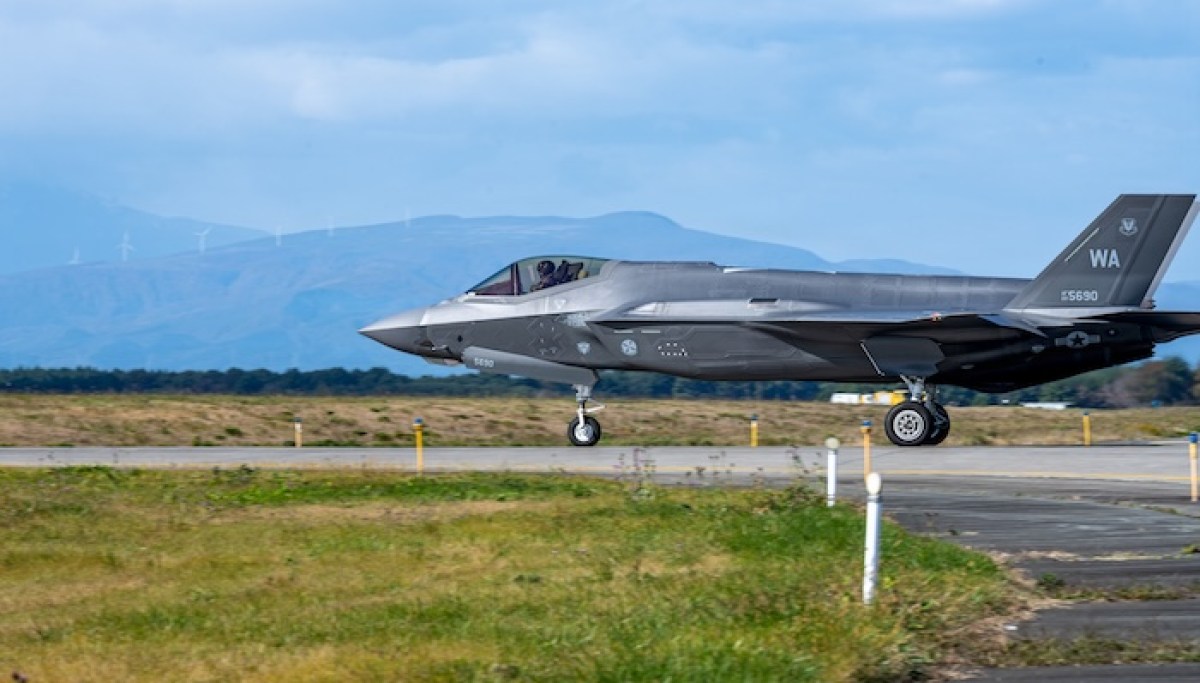
In August 1966, a Christian-Iraqi pilot defected by flying a Soviet MiG-21 directly to Israel’s Hatzor Airbase as part of “Operation Diamond.” Capitalizing on this geostrategic windfall, Israeli and American technicians completely stripped the airframe, engines, and avionics. This physical sample exposed critical design features that signals intelligence had only guessed at, allowing Western air forces to rewrite their combat tactics within months. History proved then what remains true today: limited physical possession yields operational insights that remote intelligence collection can never match. Now, a parallel material exposure threatens the F-35’s air superiority.In late May 2026, a UPS shipment of unserviceable F-35 parts left Australia for the United States. The consignment included a cockpit canopy and a weapons-bay door, both coated with highly sensitive radar-absorbent material. Although freight forwarders mapped a route through South Korea and Taiwan, a missed compliance email led to the cargo being diverted through Hong Kong. Chinese authorities immediately seized the components and have refused to return them since. While the F-35 Joint Program Office confirmed the shipping mishap and continues recovery efforts, Lockheed Martin downplayed the incident as a “low-risk exploitation hazard.” However, that assessment is dangerously optimistic; these coatings remain the jet’s primary, measurable low-observability element.To restore America’s stealth margin before Beijing converts these samples into a usable countermeasure file for itself and Iran, the Pentagon must implement three immediate interventions. First, the Department of Defense must field a spectral-divergence upgrade on Pacific-based F-35 squadrons. Drawing from the existing global inventory of more than 1,375 aircraft, this upgrade would replace current canopy and edge coatings with a formulation whose radar return shifts under a specific electronic stimulus generated by the aircraft’s own electronic-warfare suite. Because onboard software would command that shift on a sortie-by-sortie basis, Chinese analysts holding the Hong Kong samples would possess data on a completely static baseline, while American pilots fly a dynamic, variable profile. Targeting this change to high-priority Pacific units first protects critical front-line assets while avoiding a fleet-wide grounding.Second, production lots 21–30 — brokered under the Oct. 22, 2026, F-35 deal — must feature two distinct coating standards. This framework commits the U.S. to at least 850 additional aircraft over the next decade at a sustained rate of 156 per year, backed by a $7 billion private investment from Lockheed Martin. Under this structure, U.S. Air Force and Navy airframes will receive one revised chemistry, while a smaller subset destined for Australia, Japan, and Israel receives a second chemistry under separate security controls. This strategic split prevents Beijing from building a single, reliable countermeasure file for both American and allied fleets — leaving, for example, Iranian forces equipped only with Chinese data to face inconsistent and unpredictable radar signatures.CRITICIZE AIPAC. BUT APPLY THE SAME STANDARD TO EVERYONEFinally, the Pentagon must establish a six-person F-35 materials counter-exploitation cell inside the Joint Program Office. This team would manufacture limited quantities of decoy canopy and edge samples carrying false polymer and filler signatures, ready for controlled release if future diversion risks emerge. Simultaneously, this cell must formally classify all canopy, weapons-bay door, and edge shipments as “no-transit” items. Moving forward, each shipment must require dual commercial carriers, continuous satellite tracking, and an automated alert system that triggers an immediate diversion if the route deviates from its approved path — directly closing the commercial-shipping loophole that exposed the original parts in Hong Kong.The F-35 anchors global security, leaving the Trump administration with a stark binary choice: fund this coating overhaul or surrender air superiority. These dual-stealth standards aggressively strengthen Taiwan’s deterrence by forcing the Chinese Communist Party into an unpredictable, multifront tactical guessing game. Worse still, any delay allows Xi’s dictatorship to trade compromised U.S. signatures with the Islamic Republic of Iran, weaponizing a deadly, two-theater axis. Washington must act immediately; complacency today will permanently surrender the global threat landscape to our adversaries.Jose Lev Alvarez is an American–Israeli scholar specializing in international security policy. A multilingual veteran of the IDF special forces and the U.S. Army, he holds three master’s degrees and is completing a Ph.D. in Intelligence and Global Security in the Washington, D.C., area.
The Hong Kong leak demands an F-35 redesign
Full Article
Original Source
Read the full article at Washingtonexaminer →KhanList aggregates and links to publicly available news content. We do not host full articles from third-party sources. Always verify important information with original sources.