
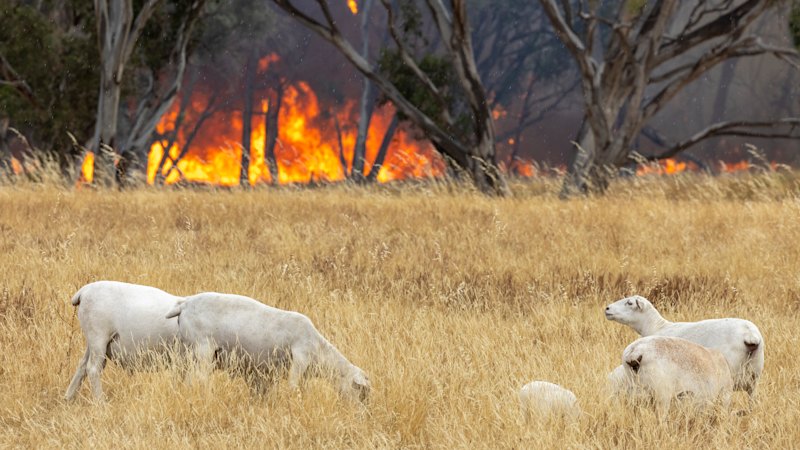
August 31, 2026 — 10:30pmSolving the housing shortage faces an overlooked competitor – the $11.3 billion spent rebuilding and repairing homes damaged by extreme weather over the past 4½ years.The Insurance Council of Australia describes them as “the homes we build twice”, noting they suck up the resources needed to build new homes without increasing housing supply.Sheep grazing near a bushfire in Longwood East, in north-east Victoria, in January.Jason SouthIn 2025 alone, declared catastrophes damaged 145,392 homes nationwide – almost as many as the 172,657 new homes completed that year, the council’s annual Insurance Catastrophe Resilience Report said.Between January 2022 and June 2026, insurers received 409,094 claims relating to declared catastrophes and significant weather events at a total insured cost of $11.3 billion.Insurance Council chief executive Andrew Hall said every insurance claim drew on the same builders, trades and materials needed to deliver new housing, while growing demand for AI data centre construction and the 2032 Olympic Games would add further demand to an already stretched sector.“Australia will not tackle the housing shortage while disasters keep pushing existing homes back into the repair queue, which is why resilience investment must be a core part of the government’s national housing strategy,” Hall said.The cost of building is climbing faster than inflation, with the report noting that the sharpest increases occurred in the materials and trades most relied upon after disasters.Cotality’s Cordell Construction Cost Index, which measures the cost to construct a home rather than its market value, rose 30 per cent in the five years to March 2026. The consumer price index rose 24 per cent over the same period.Natural disasters such as storms have increased demand for building.Louie DouvisThe cost of roof tiles increased 77 per cent in five years – more than three times CPI – the Cotality figures suggest. Windows, plaster, plywood, copper piping, structural steel, cement and concrete climbed between 37 and 48 per cent. The rising costs of roof, window and plaster products – elements commonly damaged by hail, storms and cyclones – were among the largest increases. Labour costs followed a similar trend, with roofers and glaziers recording the most significant wage growth.The cost to build is higher in remote and regional areas, with Alice Springs in the Northern Territory and Broome in Western Australia among the most expensive in the country. In NSW, the cost to build a home in Broken Hill has risen from $395,000 to $555,000, a 40.51 per cent increase in five years. In Wodonga, in Victoria, it’s a 43.01 per cent increase, from $379,000 to $542,000.Scott Hawkins, managing director for Australasia at global reinsurance company Munich RE, said the rising costs were connected to global supply chain disruptions.“In Australia, we’re largely a net importer of a lot of the goods that go into construction, and therefore we could be more exposed than someone who does that themselves locally,” Hawkins said.“I wouldn’t see that as an Australian-only topic. If we see what’s happened in the world in the last few years with supply chain disruptions, inflation globally has been at elevated levels. All of those things flow through to construction costs, and also the labour costs that go with that.”The Insurance Council is calling on governments to reform state taxes and levies that increase the cost of insurance, establish a Flood Defence Fund at a cost of $30.15 billion over 10 years to protect the most at-risk communities, strengthen the federal government’s Disaster Ready Fund, and prevent development of homes in high-risk locations.Since 2019, the peak body for the insurance industry has declared 29 extreme weather events, totalling $20.7 billion, from more than 760,720 home and building claims.In the 2025-26 financial year alone, there were $3.98 billion in losses incurred across 147,552 claims.The most expensive insurance event was severe storms and hail in Queensland and NSW over eight days in November 2025, which exceeded $2.2 billion in damage spread across 95,692 claims – an average of $23,252 a claim.The Victorian bushfires in January 2026 resulted in smaller losses for the industry but bigger individual claims, with $599 million in insured losses across 4852 claims, or $123,378 on average per claim.Insured losses from events declared by the Insurance Council since 2019Three bushfire events – $2.58 billion from 22,451 claimsOne cyclone – $374.2 million from 6696 claimsSixteen floods – $11.47 billion from 486,109 claimsThree storms – $2.62 billion from 119,670 claimsFive hail events – $3.51 billion from 108,573 claimsOne earthquake – $90.7 million from 17,221 claimsGet to the heart of what’s happening with climate change and the environment. Sign up for our fortnightly Environment newsletter.From our partners
‘The homes we build twice’: Repair bill for climate disasters climbing faster than inflation
Full Article
Original Source
Read the full article at Smh →KhanList aggregates and links to publicly available news content. We do not host full articles from third-party sources. Always verify important information with original sources.