
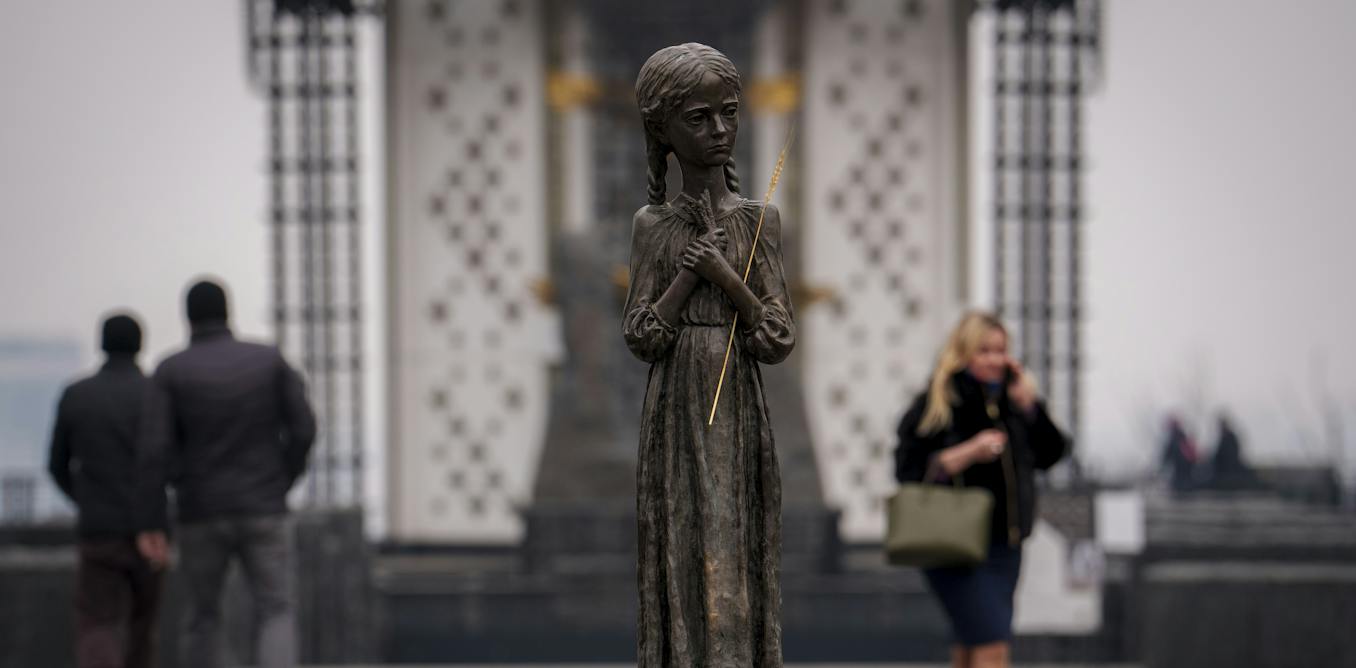
In the spring of 1933, an Austrian engineer was ambling through the outskirts of Soviet Ukraine’s capital city when he stumbled upon a horrific scene: a mass grave, and its gravedigger, who appeared to be smiling. Such scenes were not necessarily all that unusual in the Ukrainian countryside that year, as millions died from a forced famine now widely known as the Holodomor engineered by the Stalinist regime. What was unusual about this scene is that it was captured on film. This particular image, along with about 100 others, had to be secretly secretly smuggled out through the Austrian embassy’s diplomatic pouch. Mass grave burial site on the outskirts of Kharkiv, Soviet Ukraine, with a gravedigger at work in 1933, photographed by Alexander Wienerberger. (Alexander Wienerberger/the Holodomor Research and Education Consortium) The Soviet government had banned foreign journalists from Ukraine in early 1933 as it instituted a military blockade. This prevented starving peasants from leaving, even as state security forces rampaged through the countryside stealing or destroying much of whatever food remained. The result was both massive death and destruction and its concurrent and subsequent dismissal and denial by authorities. Today, destruction and denial continue to go hand in hand. For example, invading Russian forces have systematically destroyed Holodomor memorials in occupied Ukraine. They have done this while denying that this tragedy and crime even occurred at all — while reportedly starving Ukrainian civilians in cities like Oleshky. Communist Propaganda in Pre-Cold War America by Henry Prown. (Bloomsbury Academic) As a historian who specializes in media and mass atrocity, this intersection between what I call “ecosystems of destruction” and “ecosystems of denial” is key to understanding the history of modern famine. It is also a prominent subject in my new book, Communist Propaganda in Pre-Cold War America. My research digging through declassified Soviet archives and long-defunct newspaper issues revealed that Stalinist-controlled press outlets in the United States during the early 1930s attacked whistle-blowers and spread misinformation about the ongoing forced starvation in Ukraine. This was part of a long-running and globe-spanning Soviet — and now Russian — negation campaign that continues to this day. Memorial to the victims of the Holodomor in Mariupol, Ukraine, prior to its destruction by Russian occupation troops in 2023. (Olena Suhak/Wikimedia Commons) Teaching the Holodomor My course at the University of Alberta, “Famine as Genocide in the 20th Century,” similarly treats this theme in multiple historical contexts, as does an open online course I helped develop. Now in its fourth year, the university course cap had to be raised above its normal student limit for the upcoming offering — something that may relate to the unfortunate relevance of the material. As this year’s United Nations and World Food Program Global Report on Food Crisis warned, the spectre of famine and food insecurity has festered with frightful force from Sudan to Palestine, Myanmar and Ukraine. For students with roots and cultural connections in Ukraine and other countries and regions impacted by deprivation, the subjects we explore can often have deep personal and political, and historical and contemporary, significance. In teaching a subject that must contend with contested narratives and disinformation, I borrow from the field of comparative genocide studies to explore political machinations and the ensuing statistical evidence. Photograph taken by James Abbe in Kharkiv, Soviet Ukraine, of which he wrote: ‘Starved peasants wait weeklong for trains to some objective they vainly imagine is the Promised Land where they may find enough food to keep alive.’ (James Abbe/the Holodomor Research and Education Consortium), Author provided (no reuse) At the same time, in keeping with pedagogical approaches related to teaching sensitive topics, I incorporate personal stories and witness testimony, and introduce content and assignments that invite students to locate themselves in the histories we explore. This supports students’ learning to lean into what can be intense connections to and emotions around famine and genocide. Being of both Irish-Catholic and Belarussian-Jewish descent, I feel these connections and emotions too: Historian Tim Pat Coogan has argued that the Irish Famine constituted one of the first modern acts of genocide, and Belarus was at the epicentre of Nazi Germany’s food deprivation schemes in Eastern Europe during the Holocaust. Powerful case study What makes the Holodomor such a powerful case study of contemporary famine is that it is perhaps the prototypical one. This is because, as the anthropologist Alex de Waal has observed, humanity has possessed both the materials and the means to feed starving populations across the world since about the middle of the 19th century. The Bokan family, in Chernihiv, Soviet Ukraine, share a meagre meal. (Nikolai Bokan/the Holodomor Research and Education Consortium) As such, modern famine is invariably manufactured. It is enabled and engineered by human forces and political decisions, rather than being the passive product of the vagaries of weather and other circumstances. In few historical cases is this as clear as in 1930s Ukraine. Soviet dictator Joseph Stalin admitted by mid-1932 that much of rural Ukraine was in a “state of impoverishment and famine,” while nonetheless telling his underlings to “fulfil the (grain procurement) plan itself at any cost” and “do not undertake additional grain deliveries to Ukraine.” Free online course My teaching of this sordid history has been aided by a growing and increasingly public-facing scholarship on the Holodomor. Earlier this year, the Holodomor Research and Education Consortium, an initiative of the Canadian Institute of Ukrainian Studies at the University of Alberta, launched a free online course that consists of 14 modules comprising short videos, readings and assignments related to the Holodomor, with units on: Famine in modern history; The Soviet context of the Holomodor; Defining genocide: origins of the concept and legal and public understandings; Efforts to cover up the Holomodor; Living and dying: survivor-witness testimonies from Ukraine. I co-developed this course with more than a dozen scholars, and had the privilege of editing their contributions, which represent the culmination of decades of scholarship. In the process, I considered how I and other educators might be able to incorporate the course’s short, video-based modules into university classrooms. The series of historical vignettes can work individually or as a group, and potentially serve as a resource for instructors focused not only on famine and genocide studies, or Soviet and Slavic studies, but also modern history more generally. Lessons of the Holomodor This public online course points to a lesson to be learned from the Holodomor and its aftermath: the need to fight what sociologist and historian Stanley Cohen aptly described as states of denial, which often surround crimes against humanity. Faced with concerted dismissal and disinterest, Ukrainians and their diaspora communities — especially in Canada — engaged in concerted efforts in both scholarly fact-finding and public memorialization. These efforts continue to this day. Holodomor survivor Mykola Latishko speaks at the opening of the Holodomor Memorial in Toronto in 2018. (Mykola Swarnyk/Wikimedia Commons) For other communities encountering comparable silencing in the wake of forced famine or similar forms of mass atrocity, the resilience and resourcefulness of Ukrainians and the ongoing battles over Holodomor recognition and remembrance can offer both cautionary and exemplary insight. This Holodomor Memorial Day, on Nov. 28, I will speak at the Ukrainian Museum of Canada and reflect as both a scholar of, and a participant in, these ongoing personal, historical and political processes.
The Holomodor: Lessons about genocidal famine remain important today
Full Article
Original Source
Read the full article at Theconversation →KhanList aggregates and links to publicly available news content. We do not host full articles from third-party sources. Always verify important information with original sources.