
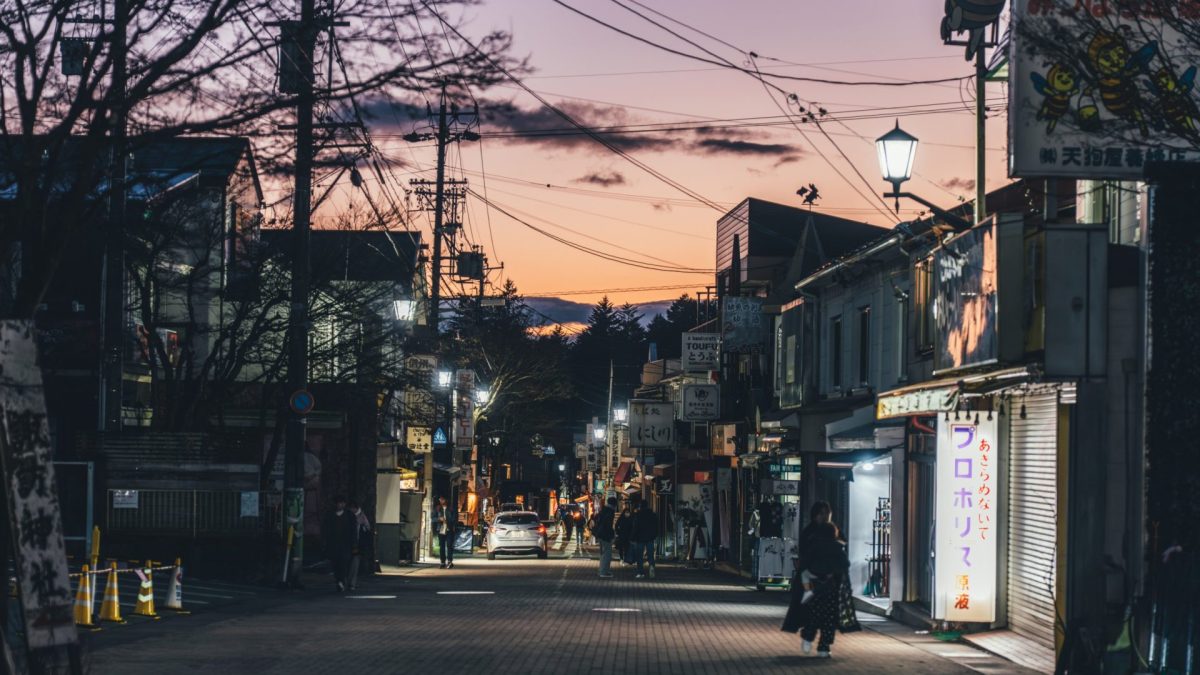
The last streaks of twilight expired. Seven of us stood still and quiet, equidistant between three trees. Occasionally a 4×4 would roll past, headlights picking up reflective panels on our clothes. But everyone’s gaze, and a night-vision camera, was trained on a nest box attached to one of the tree trunks. Suddenly, a snout appeared at the entry hole, perhaps sniffing tentatively, and a shining pair of eyes. It was prime “peeking out time” for musasabi (Japanese giant flying squirrels), according to my guide, Kazune Terai. Then the creature climbed on to her box, ready to perform her stunt. She glided several metres to the next tree, her “wings” splayed out either side of her narrow body, her pouffy tail stretched behind. We let out a collective “ahh”. Hoshinoya Karuizawa, a landmark property in Karuizawa, is surrounded by forest, which provides a habitat to flying squirrels With their wing-like flaps of skin, or patagia, flying squirrels are surely the oddest, and most charming, inhabitants of Karuizawa, a mild, highland escape in Japan’s Nagano prefecture on the central Honshu island. In the 17th century, Karuizawa was established as a post station town on the Nakasendo highway connecting Edo (Tokyo) and Kyoto before gaining attention as a summer resort in the late 19th century, soon after which its railway station was built. Now an hour north-west of Tokyo by shinkansen (bullet trains), it is a popular getaway for domestic tourists, but is still undervalued among foreigners. In 2025, the wider Nagano prefecture recorded more than 16.5 million overnight stays by domestic tourists, compared with 48,500 by visitors from the UK. I didn’t meet any other British tourists at Hoshinoya Karuizawa, a landmark five-star hotel about 10 minutes by car from the main street of old Karuizawa. An onsen ryokan (hot spring inn) was opened within the modern hotel’s boundaries in 1914 by Kuniji Hoshino, the great-grandfather of Hoshino Resorts’ chief executive, Yoshiharu Hoshino. Kuniji’s father had built a fortune from the silk industry, which his son used to buy land and dig for a spring. Hoshino Onsen is open to bookings from guests of the hotel and the general public Almost a century later, this led to Hoshinoya Karuizawa. It is situated in a valley at the foot of Mount Asama among acres of forest, with 77 villas and a central, high-ceilinged wood and glass building. Guests are shaded by native trees such as Japanese red pine, magnolia (a staple in the diet of flying squirrels, which number up to 20 around the hotel), larch and white birch, as they cross footbridges over the Yukawa River. My stay began with a welcome ritual. I sat among streams trickling towards the river, sipping aromatic tea and training my ears to birdsong. It was a short cut to calm – just the day before, I had been marching among commuters on the capital’s Shibuya Crossing, dawdling behind selfie takers at Senso-ji and standing in a coveted sunset viewing spot at the 634-metre Tokyo Skytree. Karuizawa’s nature offers an antidote to the city’s rush, as decades’ worth of mini-breakers had proven. A few Tokyo escapees were among the group of 13 who arrived at the hotel’s on-site wildlife centre at 10am one morning, kitted out in high-end hiking gear and binoculars for a birdwatching session. Birdwatching draws many visitors to Karuizawa (Photo: Hirofumi Inaba/Hoshino Resorts) A trainee guide wore a bell on her bag to alert the area’s biggest predator of our presence ahead of time, rather than startling them – the resort lies within an Asian black bear habitat. Picchio, a wildlife research centre and non-profit organisation that runs such tours at Karuizawa, helps to manage the relationship between bears and humans. I didn’t see any of the former, but it was reassuring to know that, at night, a patrol team of Karelian Bear Dogs drives the mammals deeper into the forest, without causing them harm. Our sightings were of a feathered variety: an eastern crowned leaf warbler, coal tits and an ashy minivet. Most moved too fast to admire their plumage, but the lead guide, Keigo Ito, could adeptly mimic their calls. The fresh air worked up an appetite. And service in the hotel’s main restaurant, Kasuke, was as elegant as any bird’s flight. Settled on its tiered seating, designed to evoke a mountainside, I was presented with a series of small-to-tiny boxes and plates, each holding a meticulously made portion. Ingredients included tofu, sea bream, eel, abalone, purple potatoes, miso and soy. Every flavour-rich course was explained by a member of the wait team as they arranged the meal in a precise choreography. After a closing scoop of saké ice cream, I walked back to the wildlife centre, which had been transformed into a low-lit bar. I tried a whisky and matcha cocktail while looking out at a pond from floor-to-ceiling windows. Shiraito Waterfall is among the local beauty spots (Photo: Chen Hung/Getty) The tranquility set me up for a peaceful night’s sleep before a 20-minute taxi ride to a local beauty spot, Shiraito Waterfall, which, at 7.30am, I had to myself. Like thousands of threads of silver beads, the flowing curtain is 70 metres wide, but just three metres high and, in summer, was surrounded by vibrant green. I took another taxi to see Karuizawa’s old town. Here, I stopped to buy a pastry from the French Bakery, one among several businesses in the town with a connection to former Karuizawa regular John Lennon – he liked its baguettes. Shorts From there, it was a 10-minute walk to Mampei Hotel, a property that dates to 1894 but the interior of which has a good helping of 1970s memorabilia from Lennon’s long summer retreats at Mampei with his family. I ordered a Royal Milk Tea, apparently introduced to its kitchen staff by the Beatle. Eking out one last morning on my villa balcony at Hoshinoya Karuizawa, while tucking into an elaborate Bento box breakfast, I pictured its riverside greenery fading to shades of burnt red, yellow and orange. The acrobatics of the musasabi were well worth a second, autumnal viewing – maybe followed by another, potent whisky and matcha cocktail. Getting there Several airlines offer flights between London and Tokyo. Take the train from Tokyo Station to Karuizawa, then change for a train to Naka-Karuizawa station. Hoshinoya Karuizawa offers a free shuttle bus between Naka-Karuizawa station and the hotel. Staying there The writer was a guest of Hoshinoya Karuizawa. From £785 per night (two sharing, room-only), hoshinoresorts.com/en/hotels/hoshinoyakaruizawa/ More information visitkaruizawa.com/en/japan.travel/en/uk/
The historic town with flying squirrels that’s beloved by Tokyo mini-breakers
Full Article
Original Source
Read the full article at Inews →KhanList aggregates and links to publicly available news content. We do not host full articles from third-party sources. Always verify important information with original sources.