
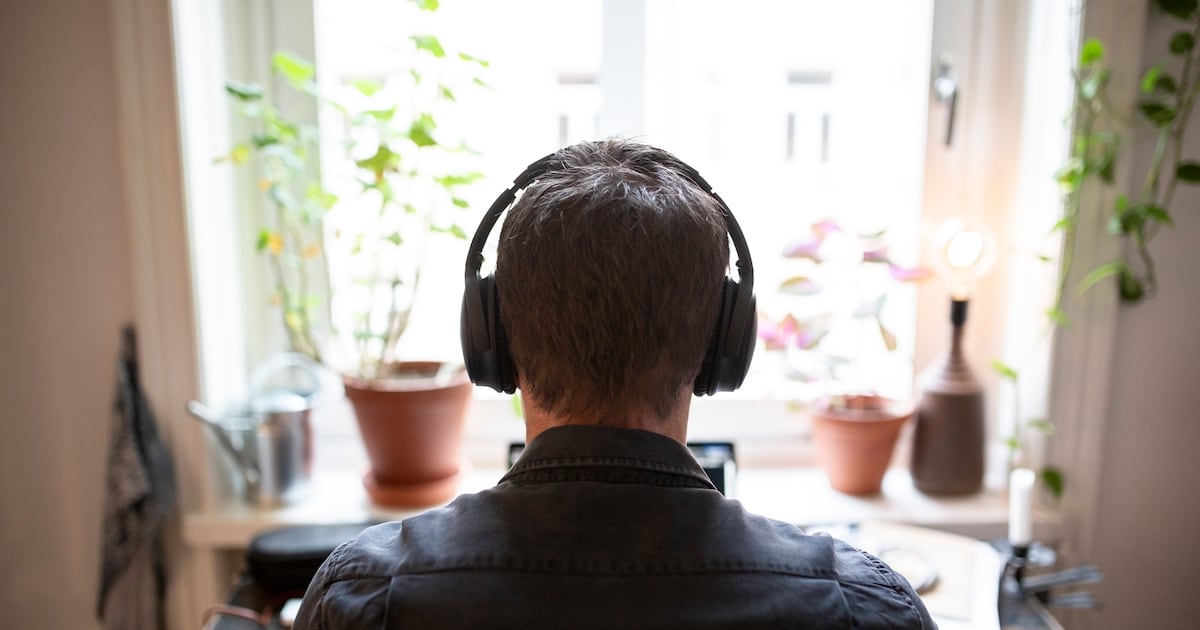
Among the hordes of people making their way through Dublin city centre last Friday, one item was almost constant.Headphones appeared to be worn by every second person during a busy lunchtime hour.On Dawson Street, a pair of friends wore headphones over their ears as they walked and talked towards Stephen’s Green.Others watched and listened to videos, necks bent as they marched, somehow manoeuvring the crowds.READ MOREWired earphones have also made a clear comeback, and were seen plugged into the ears of several teenagers and young adults carrying iced matcha.Twisting a pair in her hands is Laoise Lopez, a 21-year-old history student at Trinity College Dublin, who admits she sometimes wears them without music playing.“Really? That’s weird,” says her friend Clara Rogers.“I don’t know why, actually. To look busy, probably?” Lopez says.She also believes Gen Z, as a collective, “wear them more” than older generations.Headphones reduce 'human interaction' and 'observing the things around you', says Caitlin Evoy, a student at Trinity College Dublin pictured with friends Clara Rogers and Laoise Lopez Rogers agrees: “If I was going to the bathroom in the library, I’d put them on for the three minutes I’m going, whereas our parents definitely wouldn’t do that.”Asked why she wears them to the bathroom, Rogers replies: “I don’t know. It’s nice to listen to music. Bit of a break, like. Also a bit of a distraction.”“A distraction from what?” Lopez asks.Rogers pauses to gather her thoughts, laughing in the process, before responding: “A distraction from, like, being awkward ... when you’re walking?”The group, including third friend Caitlin Evoy, collectively nod.Evoy says she wears earphones “every day”, including during commutes to college and work, and while studying.[ Ever since we started tracking everything, we’ve lost our mindsOpens in new window ]“It probably reduces a bit of human interaction and kind of observing the things around you a little bit. Everyone’s walking around listening to music all the time,” she says.There are more obvious risks from prolonged use of earphones at high volumes, including to hearing and perhaps even a risk to life, according to an audiologist and consultant in emergency medicine who spoke to The Irish Times.But they may also affect how we live our lives, particularly if we have become accustomed to filling increasingly rare moments of solitude with music or podcasts.Sarah Cassidy, a psychologist of more than 25 years and president of the Psychological Society of Ireland, has given the issue much thought.“We need to absorb the teeny tiny moments of every day, and we’re missing that. It’s not just that we’re listening to lots of stuff, we’re missing our own lives,” she says.'We’re losing our ability to think, to reason, to process, to feel,' says Sarah Cassidy, president of the Psychological Society of Ireland. Photograph: Dara Mac Dónaill/The Irish Times Cassidy says most of us filling silence with sound are in effect on “autopilot”.“What that means is we’re not actively taking part in our own lives. Someone else is curating every single solitary experience we have, and I think it’s truly worrisome,” she says.“We’re losing our ability to think, to reason, to process, to feel.” Cassidy says music can be a powerful tool for many, including in moments of sadness or overstimulation, but the rate at which most use headphones “is totally unsustainable”.Having time without distraction to process the day is an “important part of life”, Cassidy says, adding that “constantly having someone or something talking in your ear” without any “unfilled or empty time” is a “real loss for modern young people”.“We need to actively take part in our own lives, in our minds and bodies, and we simply can’t do that if we lose the time and space to generate our own thoughts and beliefs and to process life as it unfolds,” she says.Losing the ability to process does “not bode well” for long-term mental health, she says, adding that such “accidental habits of avoidance” can be passed down to children.[ Perils of headphones in the officeOpens in new window ]Another concern, Cassidy says, is that people are listening to content to help them sleep, which can damage the natural ability to rest and “truly consolidate memory [and] learning”.“I think this habit of listening ourselves to sleep, rather than allowing our mind and body to slowly drift off naturally, will have very far-reaching consequences on mental and physical health that society has not begun to unpack yet.”She points to “strong correlations” between poor sleep and cognitive decline, Alzheimer’s and related difficulties.Some, like Cian McElligott from Dublin, a 21-year-old engineering student at Trinity, are making a conscious decision to reduce the amount of time they use headphones.“If I walk into a shop or a coffee shop, I try to take them out, but I didn’t before,” he says.“I used to work in a pub, and I remember serving someone with their headphones in, and I was like, that’s really rude, and I would do that with a coffee,” he says, waiting for the Luas.Since he has limited use, he says he is a “little bit more aware”.Nearby, on Dublin’s ever-busy College Green, a jogger runs across a road while wearing headphones. Although the pedestrian light was green, he glances for any oncoming traffic after nearly reaching the other side.Not long after, a cyclist wearing headphones cycles through red lights, giving a side-eye glance to a pedestrian about to cross.According to the WHO, more than one billion young people aged 12-35 risk permanent hearing loss due to prolonged exposure to loud sounds. Photograph: Getty Images There is a lack of research on the connection between headphones and serious injuries or fatalities in Ireland, according to Prof Conor Deasy, a consultant in emergency medicine.Deasy, who is clinical director for emergency and acute care at Cork University Hospital and president of the Irish Association for Emergency Medicine, says it would be “worth our while” for paramedics and those in emergency departments to document whether headphones were worn by those struck by vehicles or involved in collisions.“It may well be that these are causing people to be oblivious of dangers around them,” he says, noting that hearing is “one of our vital senses” and is there to “keep us safe”.“We are putting ourselves at a disadvantage. But in some cases that disadvantage doesn’t matter because we’re in safe surroundings.“In other places – where we’re sharing a road, for example, with motorised road users – then it does obviously create a risk, but we haven’t quantified that risk through research just yet and we should prioritise doing so.”The findings of such research could warrant regulations around the use of headphones by cyclists and those using other vehicles, such as e-scooters, he says.[ Why scheduling quiet time every day is good for your healthOpens in new window ]What is known, however, is the clear risk to hearing.According to the World Health Organisation, more than one billion young people aged 12 to 35 face a risk of permanent hearing loss due to prolonged exposure to loud sounds during “recreational pastimes” such as listening to music and video gameplay.Dolores Madden, an audiologist and marketing director at Hidden Hearing, and who also sits on the board of the Irish Society of Hearing Aid Audiologists, says audiologists are seeing a rising number of people with noise-induced hearing loss due to headphones.“It’s more about the consistency of it, and the constant loud level that’s detrimental,” she says, adding that inner-ear earphones that bring sound closer to the eardrum pose a greater risk.She advises limiting headphone use to 60 per cent of maximum volume for 60 minutes a day to avoid damage.“It is important because continued exposure to noise levels higher than 60 decibels (a typical face-to-face conversation) will create issues for you down the road,” Madden says.
The hidden harm of headphones: ‘Hearing is one of our vital senses’
Full Article
Original Source
Read the full article at Irishtimes →KhanList aggregates and links to publicly available news content. We do not host full articles from third-party sources. Always verify important information with original sources.