
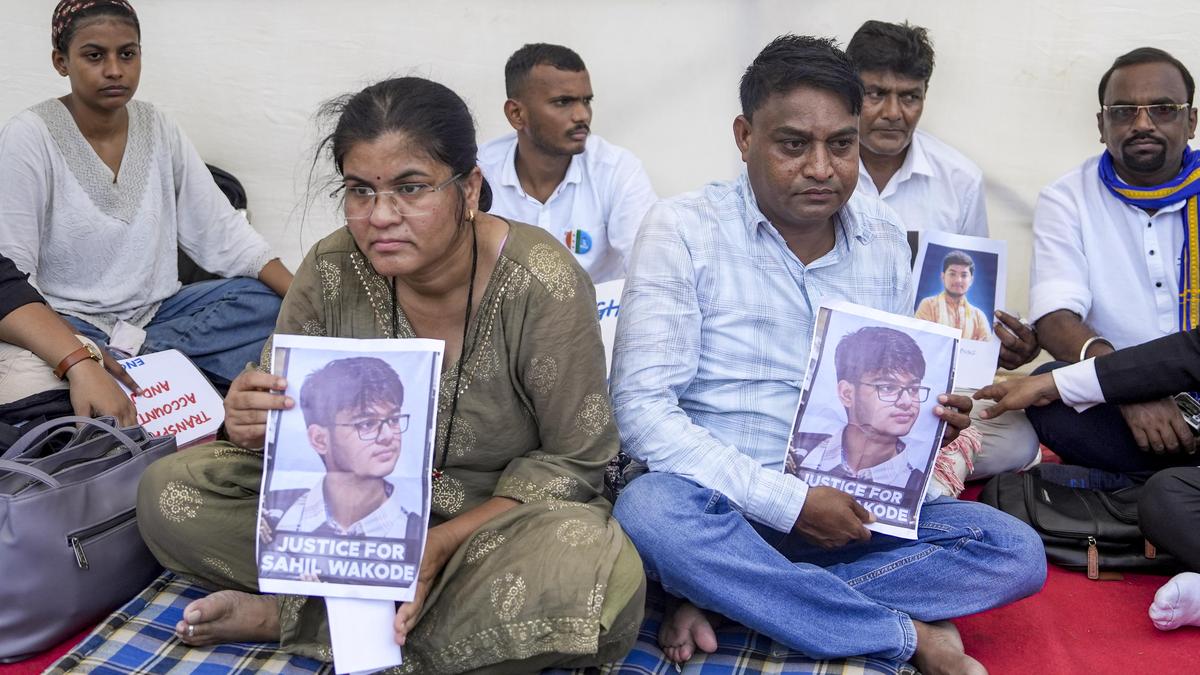
Sahil Wakode, a second-year B.Tech student from a Dalit community, died by suicide in his hostel room at IIT-Bombay on September 18, 2026. While a probe is under way, former students and activists have been pointing to what they call “deep structural biases” that cast a shadow over the credibility of institutions in dealing with such situations.Sahil’s family has alleged caste-based harassment by Professor Suryanarayana Doolla, his course instructor and invigilator, who has been named in a First Information Report (FIR) under the provisions of the Scheduled Castes and Scheduled Tribes (Prevention of Atrocities) Act and for abetment of suicide. He has been suspended as the Dean of Administrative Affairs.On September 21, 2026, the IIT-Bombay Faculty Forum members took out a march on campus in support of Mr. Doolla. The Forum in a statement, said that he was “merely discharging his academic duties”.Vennela Morchela, former president of the Ambedkar Students Association at the University of Hyderabad, reads the march taken out by the faculty as caste doing what it does. “To justify this stance, what caste also does is it mobilises around it,” she said, “to preserve what they believe as fundamentally correct.” At IITs, she said, the instructor’s position is “held as something unchallengeable”. That power, she added, “need not necessarily go against a Dalit alone; it turns on anyone who breaks norms.”Ms. Vennela said the march “led to much hate on social media against Dalits at large”, with “this caricature of Dalits being caught cheating”. “The questions around merit have resurfaced,” she said.Feeling excludedAn IIT-Bombay Faculty Forum professor told the media that the institute has an SC/ST Cell and that Sahil never approached it. A student who stayed silent might simply have been afraid of being targeted, Ms. Vennela said.Many recall Aniket Ambhore, a dual-degree electrical engineering student at IIT-Bombay who died by suicide in 2014. He had told his parents months before his death that he wanted to rewrite JEE — but in the General category because his rank was questioned repeatedly.“The seriousness of what Aniket was facing didn’t strike the parents at the time, when Aniket was telling his parents that he wanted to write the JEE exam again this time from the General category,” Kunal*, a former IIT-Bombay Ph.D. scholar, who was a student at IIT-Bombay at that time.The A.K. Suresh Committee was constituted to investigate the case. However, even after many years, the committee’s report has not been made public and there is no information whether its recommendations have been implemented.Kunal now working outside academia described several incidents that showed how caste operates on campuses in everyday interactions.“In one classroom incident, a Dalit student simply asked a professor to repeat an explanation that the student had not understood; the professor’s response was very loud and sharp,” the scholar recalled. The professor then shouted at the student, saying, “Your kind of people come here, and then they find difficulty in academics”.“At that time, many students did not quite think of professors’ comments as casteist,” he said. The same professor pointed at Kunal during a problem-solving session and said, “No, no, anyway you won’t answer,” before moving to another student. Terms such as “your kind” and “other kind” of students can cut deep, he says, adding: “These incidents may seem small, but they come from deep prejudice towards marginalised students,” Kunal said.Shiva*, a student from IIT-Hyderabad, said, “People are so interested in listening to the surnames of others. They want to guess which community they belong to.”Shiva, who is from a Dalit community, said that when a major oil company visited the campus in 2023-2024 for recruitment, students had to mention their caste category in the application form. “Before the interview stage, the company itself published a document listing all applicants — their names, categories, 10th and 12th marks, JEE rank, CGPA — openly,” he said.Once that sheet was circulated, “everyone in the class got to know who belongs to which category,” he added, noting that it changed how peers and recruiters viewed reserved-category students.Merit as discriminationIn IITs, merit is often labelled as equal and neutral, but for many students from marginalised backgrounds, merit is a label that excludes them. “There should not be any single definition of merit,” says Akash* from IIT-Hyderabad, who comes from a rural background and belongs to a marginalised community. He said, “There is a difference in equal opportunities when it comes to opportunities; more than 72% of SC/ST students go to government schools, but that’s not the case with general category.”“There has to be a caste and gender sensitisation course, where, from professors to students, everyone should get training,” Kunal said.Shiva said: “Students from marginalised communities have typically studied in single-teacher government schools. We don’t go to coaching classes or high-end schools where we can become fluent in English. Our merit is not acknowledged here.”“We have to deconstruct the meaning of merit,” says Anoop Kumar, a teacher who runs community-led coaching institutes in Wardha, Maharashtra. He noted that in India, “merit means marks in entrance exams — one will talk about Navodaya, where so many SC/ST students pass in huge numbers.” “There might have been so many Einsteins, but they never got the environment to succeed,” he added, pointing out that SC/ST students are often first- or second-generation learners without role models, infrastructure or institutional support.IITs do have institutional mechanisms to deal with problems faced by SC/ST students. Several alumni of IITs from SC/ST communities argue that these institutional bodies are managed largely by upper-caste faculty. Kunal said, “These can be puppet bodies; they should have their own agency, where they can act without any pressure.”Ms. Vennella says the SC/ST Atrocities Act applies largely to the village context against individuals, but institutions also “reproduce forms of discrimination on account of prejudices” in their rules. “You cannot ask an individual to go and change or transform,” she said. “It must be an institutional vision.”An SC/ST Atrocities Act for institutionsMeanwhile, ten years after Rohith Vemula, a Dalit Ph.D. scholar from Hyderabad Central University, died by suicide, the Karnataka Cabinet approved the Karnataka Rohith Vemula (Prevention of Discrimination, Exclusion or Injustice) (Right to Education and Dignity) Bill, 2026, on April 16, 2026. This Act specifically looks at institutional conduct. The Bill includes fines of up to ₹10 lakh and an equity committee in every institution. It identifies two categories of discrimination: institutional and indirect. Telangana’s Bill of the same name currently sits with a Cabinet sub-committee.“When we articulate the Rohith Act for higher educational institutions, it takes into account both commissions and omissions. It also brings institutional discrimination within the ambit of what constitutes discrimination. Discrimination is not limited to individuals; institutions can reproduce discriminatory practices through the prejudices embedded in their regulations. If those regulations adversely affect an entire social group, that is discriminatory in nature. The Act also highlights the role of indirect forms of discrimination,” said a member of the Rohith Act drafting committee, who did not wish to be named, adding this Act could be a starting point.*Names of the students have been changed for privacy concernsFor those in distress, counselling is available at Tele MANAS 14416
The hidden forms of caste bias inside IITs
Full Article
Original Source
Read the full article at Thehindu →KhanList aggregates and links to publicly available news content. We do not host full articles from third-party sources. Always verify important information with original sources.