
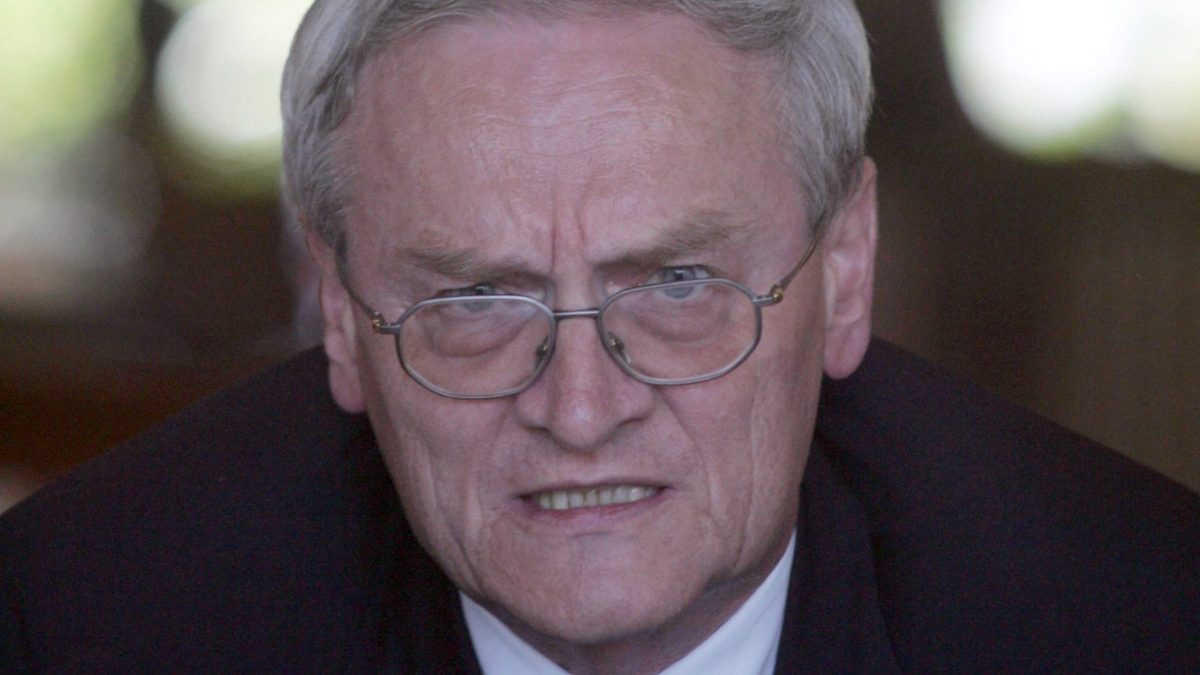
While visiting Azerbaijan in 2012, August Hanning went out of his way to put his hosts at ease. Among the compliments offered by the former German spy chief was his admiration for the security operation surrounding the Eurovision Song Contest held in the oil-rich country a few weeks earlier. Hanning, known among his fellow senior spooks for his diplomatic ease, also took the opportunity to burnish his credentials by recalling the fact that he had previously met with Azerbaijan’s former strongman president, Heydar Aliyev. The meeting with Hanning – the former head of Germany’s foreign intelligence service, the BND – was perhaps unsurprising given that prior to leading his country, Aliyev had cut his teeth in the Soviet Union as a senior member of the KGB. Hanning’s pleasantry, dutifully recorded 14 years ago by Azerbaijan’s state news agency, this week took on a renewed significance following the incendiary announcement that the 80-year-old had been arrested on charges of passing state secrets to at least one foreign intelligence service since 2010. Shorts German prosecutors allege that after leaving his post as head of the BND in 2005, Hanning paid a former senior aide who had remained within the intelligence agency to pass him some 2,000 highly sensitive documents until at least 2022. ‘Disinformation operation’ The subsequent tumult this week in the upper echelons of the world of state-sponsored espionage was further deepened by briefing to the German media that prosecutors were investigating whether a document allegedly written by Hanning on the basis of the top secret papers had been prepared for the security services of Azerbaijan. The suggestion that Azerbaijani spies, hitherto regarded as relative minnows in the ranks of the world’s clandestine operatives, had succeeded in securing the services of the man who once headed Europe’s biggest intelligence agency immediately drew an outraged response from the country’s authoritarian regime. Human rights groups have repeatedly accused Azerbaijan’s president, Ilham Aliyev – the son of Heydar – of restricting freedoms, including those of independent media. Such concerns did not prevent Azerbaijan’s Media and Broadcasting Council, a state regulator and censor, from decrying the claims of the regime’s alleged involvement with Hanning as a “disinformation operation” which was “aimed at groundlessly portraying Azerbaijan in a negative context in the international information space”. Lengthy and enduring links For all its bluster, there is evidence that the links between Hanning and those in charge in Baku, Azerbaijan’s capital, are lengthy and enduring. The former spy chief, who after leaving public service assumed various consultancy roles in the private sector, has served for a number of years on the board of a German-Azerbaijan Forum (DAF), a body promoting economic, political and cultural ties between the two countries. Public records show the former German intelligence chief was also a not-infrequent visitor to Azerbaijan while still in office as well as after leaving public life. In 2009, Hanning met his Azerbaijani counterpart while he was Germany’s deputy federal minister of the interior, a senior security post he held until 2009, after leaving the BND in 2005. Hanning then returned for the visit to Baku in 2012, this time travelling as a member of the board of a German publisher. Parallel Cold War histories There is no evidence to suggest that when he used this visit to refer to his undated meeting with Heydar, Hanning was doing anything more than emphasising his long-standing ties with the country. At the same time, it seems unlikely that both men would not have been aware of their parallel histories as senior figures in intelligence services on opposing sides in the Cold War. Prior to becoming Azerbaijan’s president in the post-Soviet era, Heydar Aliyev was a senior figure in the Moscow security apparatus and worked for the KGB (Photo: Daniel Simon/Getty) Heydar served for the best part of three decades within the security apparatus of the Soviet Union, including nine years as head of the KGB in Azerbaijan before later becoming a member of the Politburo in Moscow until 1987. For his part, Hanning spent four years until 1990 as head of counter-espionage in the former West Germany’s diplomatic headquarters in East Germany during the tumultuous years prior to the fall of the Berlin Wall in 1989. Coincidentally, the same period coincided with the posting of a young Russian KGB officer to the East German city of Dresden by the name of Vladimir Putin. ‘Unjustly prosecuted’ German prosecutors this week emphasised that investigations into Hanning, who was remanded into custody on Wednesday, are continuing. A German government spokesperson said: “Serious allegations have been raised, but so far they remain just that, allegations, and the task now is to analyse, investigate, and verify which of them are valid.” The spy chief’s lawyer insisted his client was being “unjustly prosecuted”, saying that while he may have possessed “confidential documents” he had not passed on any information “to the detriment” of Germany, nor received payment. Police outside Hanning’s home following his arrest in Nordwalde, Germany. His lawyer says he had not passed on any information ‘to the detriment’ of Germany (Christoph Reichwein/AP) Nonetheless, the entanglement of Azerbaijan in the Hanning case adds a further level of intrigue to a saga which is already drawing comparisons with the disastrous case of Kim Philby, the Russian double agent whose activities inflicted vast damage on Britain’s MI6 during the Cold War. Azerbaijan’s location on the cusp of western and eastern spheres of influence, as well as its proximity to key Middle Eastern players such as Iran and Turkey, has long made it a focus for the activities of multiple competing intelligence services. Intelligence sources said the nature of the information allegedly sought by the Azerbaijani intelligence service from Hanning was unclear. German investigators have said that it was not known if the file claimed to have been produced by Hanning for Azerbaijan was actually delivered. They have also made it known that Russian involvement with Hanning is not currently part of their investigations. ‘Baku is skilled at looking after its own interests’ Nonetheless, there are several types of information which would have been potentially useful for Baku to obtain. One intelligence analyst underlined that Azerbaijan is known for its “pragmatism” in dealing with the competing interests on its doorstep. The intelligence expert said: “Azerbaijan is a tipping point [in the intelligence world]. It is culturally close to Turkey but it was also part of the Soviet Union and those ties remain strong despite problems in recent years. “Its geography puts it at the junction of Western, Russian and Middle Eastern spheres of influence. So it should surprise no one that it is and has been for some time a focus for intelligence activity… Baku is skilled at pragmatism and looking after its own interests.” Among the files provided to Hanning by his alleged accomplice were sensitive documents relating to the Russian military and Iran’s nuclear programme, both of which could have been valuable to attempts by either country to understand Western estimates of their respective strengths. An Azerbaijan Airlines flight with 67 people on board, traveling from Baku to Grozny in Russia’s Chechnya region, crashed near the Kazakh Caspian city of Aktau in 2024, which strained ties between Azerbaijan and Russia (Photo: Issa Tazhenbayev/Getty) Azerbaijan continues to have strong historic links with Russia, although relations between the two countries have been strained in recent years, not least by the downing of an Azerbaijan Airlines passenger plane on Christmas Day 2024 by a Russian anti-aircraft missile. The incident, which left 38 dead, drew an apology from Putin. Dispute with France At the same time, Azerbaijan has also found itself in a protracted diplomatic dispute with France after Paris offered strong support, including weaponry sales, to neighbouring Armenia in a long-standing dispute over the enclave of Nagorno-Karabakh. In 2024, France accused Baku of actively fomenting violent unrest in its Pacific territory of New Caledonia as part of the fall out between the two countries. Among the Western espionage services known to have extensively shared information with the BND is the French DGSE, responsible for France’s external security. Azerbaijan also hosts the Baku Security Forum, an annual gathering of representatives of law enforcement agencies from more than 100 countries which has garnered a reputation as an informal back channel for senior figures from rival intelligence agencies to exchange views. As the analyst put it: “If you wanted to make contact with a lot people whose job descriptions don’t quite match what they do for a living, then Baku wouldn’t be a bad place to start.”
The hidden clues that link Russia to German ‘super-spy’ scandal
Full Article
Original Source
Read the full article at Inews →KhanList aggregates and links to publicly available news content. We do not host full articles from third-party sources. Always verify important information with original sources.