
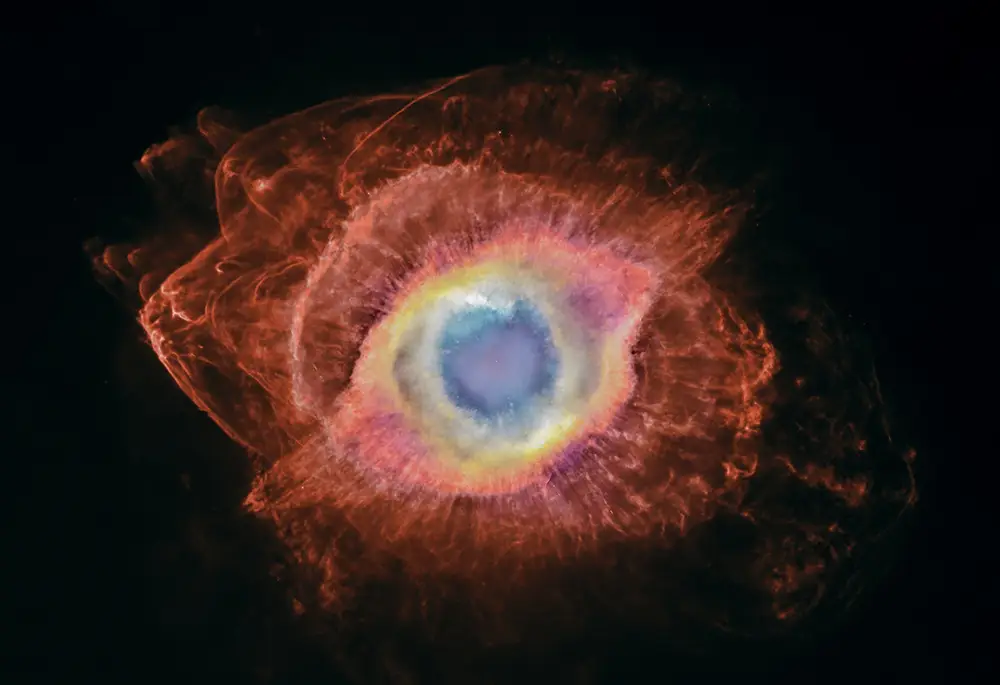
The star at the heart of the oft-observed Helix Nebula powered a clumpy wind before it died. Now, new images capture these clumps’ dissolution into the space between stars. This composite image of the Helix Nebula combines data from MOTHRA, the Hubble Space Telescope, and the Kitt Peak 4-meter telescope.MOTHRA and NASA / ESA / C. R. O’Dell (Vanderbilt Univ.) and M. Meixner, P. McCullough and G. Bacon (STScI) Some 650 light-years away in the Aquarius constellation lie the spectacular remains of an imploded star. It’s now an incandescent white dwarf that lights up the gas still unfurling around it, known as the Helix Nebula — a planetary nebula that’s within reach of a moderately sized backyard telescope. Before such stars implode, they shed their outer layers of gas. These dense, gaseous winds, enriched in heavier elements, dissolve into the sparse interstellar medium, eventually fueling the next generation of stars. We’ve had limited opportunities to actually watch this happen, since the winds themselves are so difficult to see. Now, we have new observations of the Helix Nebula from a telescopic array that specializes in imaging some of the faintest features in the universe, published on August 12th in Nature. “We are seeing material shed near the end of a star’s life being broken apart and returned to the galaxy,” says team lead Pieter van Dokkum (Yale University). “Far in the future, the Sun will go through a broadly similar process, and its material will enter the same cycle.” The image was originally taken not for science but to help calibrate the Modular Optical Telephoto Hyperspectral Robotic Array (MOTHRA), under construction at El Sauce Observatory in Chile. MOTHRA imaged the Helix at specific wavelengths, including the light from energized hydrogen known as hydrogen-alpha emission. The bright central nebula surrounds a white dwarf, the remnant of the star that created it. Farther out (in grayscale), newly revealed bow shocks show fragments of material cast off by that star colliding with surrounding interstellar gas. The fragments become progressively smaller and more disrupted as they are stripped, shredded and mixed into space. The new MOTHRA data is shown in black, withprevious data from the Hubble Space Telescope and the Kitt Peak 4m telescope in color. Grayscale image: MOTHRA; Color image: NASA / ESA / C. R. O’Dell (Vanderbilt Univ.) and M. Meixner, P. McCullough and G. Bacon (STScI) By this light, MOTHRA captured a “forest of arcs” off the upper left edge of the Helix’s donut of ionized gases. The arcs — 22 in all — are bow shocks, like those that form in front of fighter jets as they blow past the speed of sound. There are no fighter jets around the Helix, though, just clumps of neutral gas fleeing the star at 35 to 45 kilometers per second (80,000–100,000 mph). They’re only on one side of the Helix, because the whole structure is itself moving through the interstellar medium, also at 45 km/s. Van Dokkum’s team found no emission from the clumps themselves. They’re neutral gas, and the only reason we see them is because they’re plowing so fast into the surrounding gas. That ambient medium is moving too slowly to get out of the way, so it piles up into the bow shocks that MOTHRA saw. The bow shocks closer to the nebula are sharply defined, but those further out become fuzzy. That’s likely because the gaseous clods these shocks are forming around are themselves disintegrating, becoming part of the interstellar medium they were once passing through. Van Dokkum’s team estimates any given clump survives only about 10,000 years. Considering astronomical timescales, that makes for rapid recycling. Kazimierz Borkowski (North Carolina State University), who was not involved in this study, notes that one way to investigate further would be to look to the archive of ultraviolet images from NASA’s GALEX mission. The shocked gas emits ultraviolet light as it cools down, and GALEX imaged at least some of these bow shocks before the space telescope was retired more than a decade ago. However, Borkowski also cautions that finding similar bow shocks around other planetary nebulae might be more difficult. The whole Helix Nebula is traveling at a good pace relative to the gas around it, which means the gas bullets the star ejected before its implosion have an added boost to their speed. The shocks created as the gas dissolves into the interstellar medium are thus more visible around the Helix than they might be elsewhere. “In my view, such favorable conditions might not necessarily be common in planetary nebulae,” he says. “It is a step forward,” Borkowski adds, “but I think that our understanding of what's going on is far from complete.” The MOTHRA array will ultimately contain 1,140 lenses (Canon 400mm f2.8 III) on 30 Software Bisque mounts, with Atik APX6 cameras and Iridian Spectral Technologies narrowband filters. The whole kit-and-caboodle is the equivalent of a 4.8-meter telescope. While these observations took more than two hours using less than a fifth of the array, van Dokkum says the same observations on the fully built MOTHRA will take just 20 minutes. Given that this study is based on a single calibration image, we can expect much more when the array is fully online. Read more about the Dragonfly array that preceded and inspired MOTHRA in the May 2019 issue of Sky & Telescope. The latest on Dragonfly and the under-construction MOTHRA can be found in Sky & Telescope's May 2026 issue.
The Helix Nebula is Hurling Clumps of Gas through Space
Full Article
Original Source
Read the full article at Skyandtelescope →KhanList aggregates and links to publicly available news content. We do not host full articles from third-party sources. Always verify important information with original sources.