
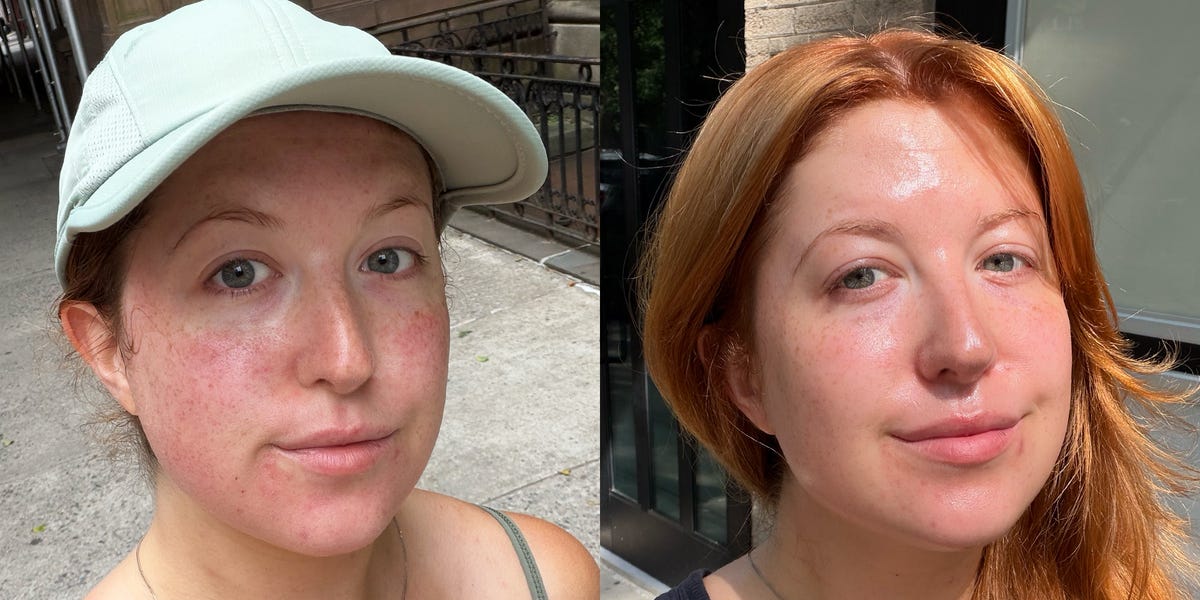
As a beauty editor, I'm no stranger to cosmetic procedures—especially laser treatments. Over the years, I've tested lasers like Clear and Brilliant for uneven skin texture, PicoSure for dark spots, and AviClear for acne. They've all been great for my skin, but after a summer filled with sun, lack of sleep, and raging postpartum hormones, my face needed more. Enter: Halo. An intense laser treatment that promises to minimize pores, fade sun spots and acne scars, soften lines and wrinkles, and give skin a visible glow.Since its launch in 2014, the Halo fractional laser has become a cult-favorite, once-a-year maintenance treatment for those who want a clear, glowing, glass-like complexion. However, the Halo Tribrid—the Halo’s new sibling that uses three resurfacing wavelengths instead of two—is quickly growing in popularity. There are nuances between the two, and just because the Halo Tribrid is newer, it’s not necessarily the better option for you’re skin’s needs.Keep reading for our full review of both Halo lasers—including info on how they work, what to expect before, during, and after each treatment, and ultimately which Halo laser treatment is right for you.What does the Halo laser do?Halo is a hybrid fractional laser, meaning it uses ablative and non-ablative wavelengths to target the skin's surface and the deeper layers of the skin at the same time, says dermatologist Heather Rogers, MD. The ablative wavelength targets the superficial layers of the skin to address brown spots, large pores, and superficial texture concerns, while the non-ablative wavelength goes deeper to stimulate collagen production and provide longer-lasting firming and tightening results. Overall dermatologists love the Halo laser for its ability to:Fade hyperpigmentation, including sun spots, melasma, and post-inflammatory hyperpigmentationSoften lines and wrinklesSmooth uneven texture and acne scarsMinimize the appearance of poresTighten and firm skinWhat is the difference between the Halo and the Halo Tribrid laser?While both the Halo and Halo Tribrid use ablative and non-ablative wavelengths, the main defining difference between the two is the number of wavelengths, explains double board-certified plastic surgeon Jennifer Levine, MD. The addition of a third wavelength “allows the Halo Tribrid to be tailored into a more focused treatment or more comprehensive resurfacing experience based on your personal skin journey,” she says.Each wavelength targets a specific skin concern, too, while also stimulating collagen for a tightening and firming effect:- One smooths and renews surface texture.- One addresses discoloration, sun damage, and uneven tone often associated with melasma-prone skin.- One reaches deeper into the dermis to address concerns such as fine lines, wrinkles, and acne scars. Every wavelength is independently controlled, so, for example, if you primarily want to diminish wrinkles, your practitioner can amp up one wavelength and tone down another, creating a more customizable experience. “If you want a gentle refresh, it can stay light. If you want to address deeper concerns, it can go deeper,” says Dr. Levine. “If you have several concerns, such as sun damage, uneven tone, rough texture, fine lines, or the appearance of enlarged pores, it can address them together in one customized session.”What does your face look like after Halo laser?Honestly, not great (this is not a quickie lunchtime treatment, folks). Immediately after my Halo treatment, my skin looked like I had severe sunburn (see photo evidence below) and my face felt uncomfortably hot too. The good news is that the heat and redness went away for my fairly quickly. By the time I got home that night, my skin was back to a normal temp and looked pink instead of tomato-like.Lauren BalsamoLauren Balsamo immediately after her Halo treatmentThe next morning, the pinkness was replaced with brown discoloration and tiny brown flecks called MENDS, or microscopic epidermal necrotic debris. While unsightly, dermatologist Ellen Marmur, MD (I did my Halo laser at her NYC practice) assured me that MENDS are normal. "These little coffee ground looking spots appear on the skin post-treatment and are a sign your skin is regenerating," says Dr. Marmur, who adds that they usually disappear about a week later.For me, the discoloration and MENDS were most noticeable on days two, three, and four and were pretty much gone by day five. I did get some tiny breakouts along my chin as a result of the laser, but they healed fairly quickly so I wasn't super concerned. Basically, expect your face to look not-so-great for about a week after your Halo laser, and then nice and glowy after that.Lauren BalsamoLauren Balsamo after her Halo treatmentSimilar to the Halo, the Halo Tribrid will leave your face sunburn-level red immediately after the treatment. Contributing beauty editor Mary Honkus experienced some heat and tightness directly after her facial, too, but she says it wasn’t unbearable.“Sitting in the A/C kept me cool and comfortable as I finished my work day. My face felt rough and sandpaper-y to touch for about three days post-treatment as MENDS started to form. (I have a freckly face, so the dots blended right in with my natural coloration.),” Honkus adds.Along with the MENDS, Honkus experienced some facial swelling, which is totally normal. “I looked puffy for about three days after the laser. The swelling was mild, though. Friends couldn’t tell a difference, but I sure could. The most annoying part of the healing process was when my chin started to flake at day four. Slathering on a rich cream helped. The MENDS cleared pretty quickly, too. The only spots that remained on day five were along the outer rim of my face.”Mary HonkusMary Honkus immediately before and after the Halo Tribrid treatmentDoes Halo laser hurt?Based on Reddit reviews I read before my treatment, I expected Halo to be super painful. Surprisingly though, it wasn't so bad. It mostly felt very hot with the occasional sensation of a rubber band being snapped against your skin. I know this objectively sounds awful, but I swear it's not so bad. The treatment is fast too—like 10 minutes start to finish—so as soon as your like, okay my face must be on fire by now, it's all over.That said, my skin was numbed with topical lidocaine for a full hour pre-treatment. I have to imagine that without the numbing the laser would be absolutely excruciating, so definitely make sure you factor in plenty of time for that before your treatment.The exact same protocol is in place for the Halo Tribrid. Prior to her treatment, Honkus was numbed with topical lidocaine for a full hour. Then, the facial itself took less than five minutes. While uncomfortable, she says it wasn’t unbearable. “It was around a three out of 10 on the pain scale,” she says. Her practitioner opted for a low level because her primary concern was post-acne pigmentation on her chin, not deep-set wrinkles or fine lines.How long does Halo recovery last?Both the Halo and Halo Tribrid recoveries are largely dependent on the intensity of your treatment, explains Dr. Rogers who says that generally more intensity = more downtime = better results. Both of our testers completed gentler treatments, so their recoveries only lasted a week.During my post-Halo recovery, I was super diligent about my at-home skincare, per Dr. Marmur's orders. I swapped my usual AHA treatments and retinol serum for simpler, more gentle products and focused on moisturizing and protecting my face.In the morning and at night I’d wash my face with La Roche-Posay's hydrating cleanser. It really does a good job at removing any excess oil, makeup, and SPF but without stripping your skin, which is key for after a laser treatment since your skin can feel a bit raw and sensitive after. Post-wash, I’d apply a thick layer of Avene’s Tolerance cream to help hydrate and soothe. In my regular life this would probably be too rich for my oily skin, but post laser it's exactly what my vulnerable skin needed.And of course, SPF—a must every day but absolutely non-negotiable post-laser. I alternated between Dr. Marmur's Tinted Sunscreen and EltaMD’s UV Clear Tinted—applying one or the other every morning and then reapplying in the afternoon too. Post-Halo, the move is definitely tinted sunscreen—it's great for diffusing MENDS and blotchiness without having to put makeup on while your skin is healing.My Halo post-care essentials:La Roche-Posay Toleriane Hydrating Gentle Face CleanserAvène Tolerance Control Soothing Skin Recovery CreamEltaMD UV Clear Tinted Face SunscreenNow 15% OffHow many Halo laser treatments are needed?Generally, most people see results after just one Halo laser treatment. I did Halo with the hopes of lightening the marks on my chin and jawline from old breakouts, shrinking the pores on my T-zone, and softening the fine lines on my forehead. And while one Halo laser didn't fully address all of these concerns, I did notice a slight improvement in my skin tone and definite improvement in skin texture around day 7 (check out my after shot below).I'm sure if my treatment were more intense, I would have noticed a more dramatic result but I don't love the idea of intense downtime so overall I'm happy with how my skin looked post-treatment.Lauren Balsmo 7 days after the Halo laserHonkus had similar concerns she wanted to address—mainly post-acne scarring on her chin. The laser did trigger some new breakouts (which is totally normal, BTW). That said, the glowing results were almost immediate. Two days after her treatment, friends began commenting on how glassy her skin appeared, and that was when the MENDS were at their peak. One week post-treatment, all of the MENDS had disappeared, and in their place was that lit-from-within Halo radiance.Mary HonkusMary Honkus 4 days and one week post-Halo Tribrid laserHow long do Halo results last?Around 1 to 2 weeks post-treatment is when people really notice that "Halo glow." How long that glow lasts largely depends on how well you take care of your skin after the treatment. If you sleep in your makeup and skip SPF, your uneven texture and dark spots will surely come back. If you follow a good skincare routine and protect yourself from the sun, your results can last for years, says Dr. Marmur.How much does Halo laser cost?The cost is the biggest downside to Halo IMO. A single treatment will set you back anywhere from $1,500 to $2,000 depending on where you live, which feels like a lot considering you could get Botox for an entire year (or more) for around the same price. On the flip side, the fact that one Halo can address a multitude of skin issues at once makes the price more justifiable IMO.The Halo Tribrid costs a tad bit more because the technology is newer. One session can range between $1,800 to $2,500, depending on where you’re based and whether you opt only for a face treatment or include your neck too.Is Halo laser worth the money?Ultimately, yes, I think a Halo laser is worth the money...and the downtime. I don't think it should be a first option for improving skin texture or tone, but instead a treatment worth trying if you have stubborn skin issues that haven't responded to topical or other types of treatments. Overall, "it's a great laser and most people with sun damage, skin dullness, large pores, texture issues, fine lines will see improvement from it," adds Dr. Rogers.One more thing here: Halo is only worth the money if you go to a provider who has extensive experience treating people with your skin tone and skin issues. Dr. Marmur says that even though the laser’s settings are highly customizable, making it safer for darker skin tones and people with melasma, it's only safe when used in the right hands. So before you book a treatment, do your research and steer clear of any Groupon-type deals that look too good to be true.Should I get a regular Halo laser treatment or the Halo Tribrid?It’s so easy to think that newer technology is automatically better. However, Dr. Levine says the Halo Tribrid isn’t always the right choice for every patient. “Halo remains an excellent option for patients who can benefit from its customizable two-wavelength approach. Halo Tribrid may be a better fit if you want to address several concerns in one appointment or want greater flexibility in how focused your treatment can be.”Ultimately, you should speak with your dermatologist about your skin concerns so they can guide you to the best treatment.Meet the experts: Heather Rogers, MD, is a board-certified dermatologist in Seattle. Dr. Rogers is the co-founder of Modern Dermatology and the CEO of Doctor Rogers Skin Care.Jennifer Levine, MD, is a double board-certified plastic surgeon in New York City. Ellen Marmur, MD, is a board-certified dermatologist in New York City. Dr. Marmur is the founder of Marmur Medical and a clinical professor in the department of dermatology at Mount Sinai.Why trust Cosmo?Mary Honkus is a contributor for Cosmopolitan with over eight years of experience researching, writing, and editing beauty stories. She’s an authority in all beauty categories and will try just about any treatment. For this story, she tested the Halo Tribrid laser.Lauren Balsamo is deputy beauty director at Cosmopolitan with a decade of experience researching, writing, and editing skincare stories that range from the best retinol eye creams to the best pore-minimizing treatments. She’s an authority in all skincare categories but an expert when it comes to professional treatments.Mary Honkus is a freelance writer who covers beauty, home, fashion, health, and wellness (just call her a jack of all trades!). She has held staff roles at Real Simple, People, and InStyle, and her bylines can be found in numerous other publications. When she's not testing the latest and greatest products, she can be found chilling on her Hell's Kitchen rooftop, checking out NYC's hottest new restaurants, or recording her podcast Good Trouble NYC. Follow her on Instagram.Lauren Balsamo is the beauty director at Cosmopolitan where she writes, edits, and produces all types of beauty content—from product reviews to personal essays and trend reports. She has covered beauty for more than a decade at Cosmopolitan. Follow her on Instagram.
The Halo Vs. Halo Tribrid Laser—Which Resurfacing Treatment Is Right for You?
Full Article
Original Source
Read the full article at Cosmopolitan →KhanList aggregates and links to publicly available news content. We do not host full articles from third-party sources. Always verify important information with original sources.