
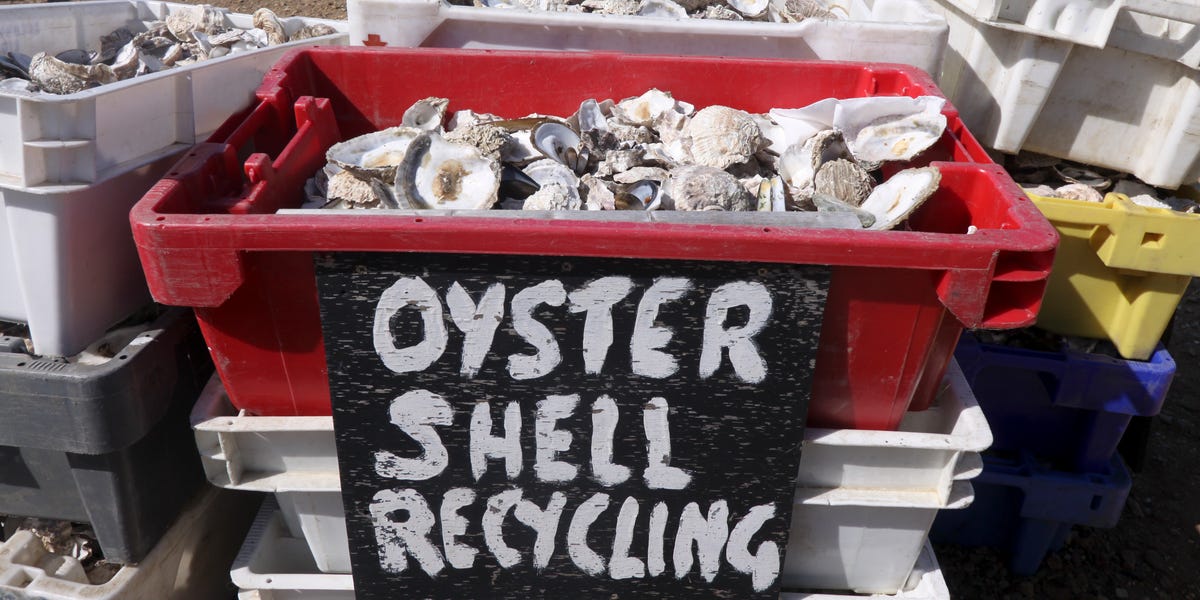
3 min readHere’s what you’ll learn when you read this story:Oyster populations in the Gulf of Mexico have crashed in recent decades due to environmental changes, overconsumption, and ecological disasters, such as the Deepwater Horizon oil spill in 2010. Local communities and restaurants have been working together for decades to recycle used oyster shells in an effort to build artificial reefs for oyster larvae to utilize. Building these reefs helps protect shorelines, provides vital habitat for oysters (and upwards of 170 other species), and bolsters a $250 million industry by supporting the largest wild oyster fishery in the world.Long before the Gulf of Mexico became an etymological controversy, the 600,000-square-mile salty body of water was known for its oysters. Today, the Gulf contains the largest wild oyster fisheries in the world and supplies half of the oysters in the U.S. alone—a $250 million dollar industry that impacts fishermen, oyster farmers, seafood processors, and, eventually, the very restaurants that serve the bivalve delicacy.However, like many marine ecosystems across the planet, these fisheries are under severe threat from habitat degradation, oil spills (especially Deepwater Horizon in 2010), and changing water conditions, including an influx of freshwater from flooding along the Mississippi River Basin—the largest drainage system in North America.As a result, all of the states that line the Gulf of Mexico—Texas, Louisiana, Mississippi, Alabama, and Florida—have lost a majority of their reefs, and with them, a natural defense against storms and rising seas and a natural filter for harmful pollutants.“Most of the world's oyster reefs have been lost in the last 200 years, and nearly one-third of those that remain are functionally extinct,” a 2020 study in the journal Biology Letters reported. “Thus, conservation efforts must be directed towards identifying the increasingly few locations where oyster reefs remain at or near past levels of ecosystem structure and function.”One of those locations is the Gulf of Mexico, and for nearly 20 years, a conservation project using discarded oyster shells has provided a new hope for these endangered mollusks and the people that rely on them. In 2007, the NOAA Community-based Restoration Program and the Southeast Aquatic Research Partnership (SARP) began a multitude of projects aimed at improving habitats for marine and anadromous fish (fish that spawn in fresh water before moving out to salt water), one of which was a program to develop artificial reefs using used recycled oyster shells.While there were initially concerns about the spread of disease and unregulated ocean dumping, the effort has been a big success. Shells account for 75 percent of an oyster’s total biomass, and according to the website Upworthy, Florida has dumped roughly 500,000 tons of them back into the ocean. These shells don’t travel straight from a restaurant back into the sea, but rather cure outside for three to six months to rid them of harmful bacteria as well as excess meat and tissue (eagerly gobbled up by opportunistic scavengers). Most of the shells are then packed into mesh bags and placed strategically along the coast. There, they develop a biofilm that serves as a vital substrate for oyster larvae to attach to, while also providing habitat for some 170 other species of fish, crab, and shrimp, according to National Science Foundation (NSF) research.“When community members are involved, they realize that actions have impact,” Serra Herndon, Habitat Restoration Director for Tampa Bay Watch, told NOAA. “And when they go home and they tell their neighbor or friends or whomever and the positive story reverberates.”Darren lives in Portland, has a cat, and writes/edits about sci-fi and how our world works. You can find his previous stuff at Gizmodo and Paste if you look hard enough.
The Gulf of Mexico’s Reefs Have Suffered for Years. Local Communities Are Saving Them—by Recycling Oyster Shells
Full Article
Original Source
Read the full article at Popularmechanics →KhanList aggregates and links to publicly available news content. We do not host full articles from third-party sources. Always verify important information with original sources.