
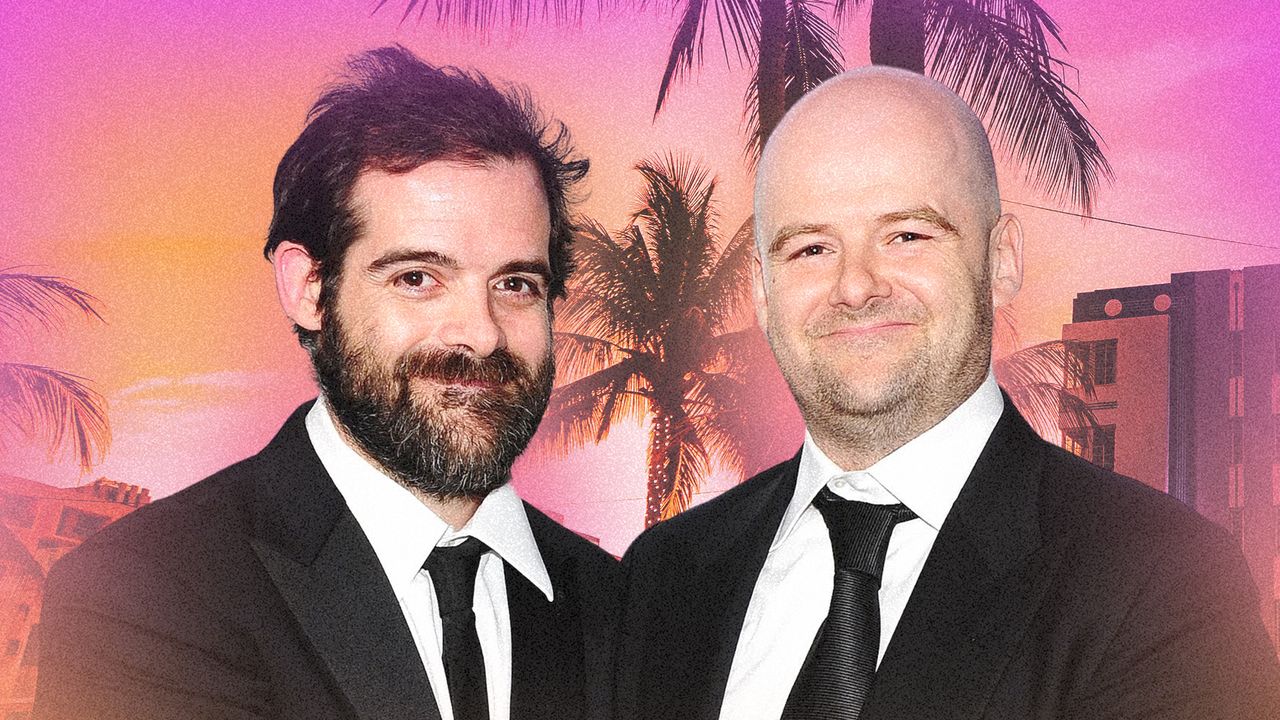
In 2002, weeks before the release of Grand Theft Auto: Vice City, the journalist David Kushner met Sam and Dan Houser, plus Rockstar co-founder Terry Donovan, at their SoHo loft. It would be their last and only in-depth sit-down before they decided that the world’s most successful video game required little explanation.“You can’t fuck with Keith Richards.” That’s what Sam Houser told me when I asked the inspiration for his company name, Rockstar Games. “I’m a huge fan of the classic golden era of rock stars—both the music, but also the life,” he went on. “You can't argue with Keith Moon riding in a Rolls Royce with a blowup doll hanging out the back and a woman in there screaming, ‘I'm being raped.’ The guy is the original punk rocker. And if we can bring a fraction of that to games, then we’re doing something.”It was October 2002, just a few weeks before the release of their latest blockbuster, Grand Theft Auto: Vice City. I’d come to their glossy loft in Soho, Manhattan to interview the elusive 30-year-old Houser and Rockstar co-founders, his younger brother Dan Houser and managing director Terry Donovan, for Rolling Stone. It would be one of their first, last and only in-depth sit-downs together before they decided that the world’s most successful and controversial video game required little explanation from them at all.I continued reporting on them and their games during the raucous and turbulent years to follow: hitting over $10 billion in sales, getting compared to Balzac and Dickens in Time magazine, being sued (unsuccessfully) for causing real-life violence. As I investigated in my book Jacked: The Outlaw Story of Grand Theft Auto, they also triggered what remains the most outrageous and cinematic scandal ever to hit the industry: the discovery of a hidden sex scene in 2005’s GTA San Andreas that would inspire attempts to legislate and ban the game. As Hilary Clinton said at the time, “The disturbing material in Grand Theft Auto and other games like it is stealing the innocence of our children and it’s making the difficult job of being a parent even harder.”With the gamer generation now grown up and in power, the Reefer Madness panic around GTA has finally given way to something more important: this little game out of Scotland has become the most successful and influential entertainment product of all time. Today, Rockstar returns to Vice City with the launch of Grand Theft Auto VI. More than a decade in the making, with a budget Rockstar has never disclosed but analysts put between $1 billion and $2 billion, the game follows Jason Duval, an ex-soldier, and Lucia Caminos, who phones him from prison, as they’re pulled into a criminal conspiracy across a send-up of Miami. Its first trailer has been viewed more than 300 million times on YouTube, and footage premiering on Netflix nearly crashed the streamer’s servers. Take-Two Interactive, Rockstar’s parent company, expects record revenue of $8.1 billion this fiscal year.For longtime fans, GTA 6 marks something more personal: the first game in the franchise since the original band behind it broke up. Following the departure of Donovan and other central figures, Dan Houser exited Rockstar in 2020, leaving his big brother Sam as the last founder still there. With Sam remaining notoriously quiet about the new game, I went digging through my old tapes and found my long-lost interview with gaming’s original punk rockers. During our two-hour talk, the young co-founders were brash, unrepentant, and championing a lifetime of obsessions, as Sam put it. “I wasn’t just obsessed about games,” he told me, “we were obsessed about everything—obsessive about music, obsessive about film, obsessive about fashion.”GTA 6 shows that the obsession never left him. Here in this exclusive excerpt from my interview, the Rockstars share how it all started.From left, John Davis (the downtown New York nightclub promoter), Terry Donovan (COO of Rockstar Games) and Sam Houser (the president of Rockstar Games) at a loft in Lower Manhattan on February 3, 2000. Together they launched regular Rockstar Loft parties in New York City. (Photo by Hiroyuki Ito/Getty Images)Hiroyuki Ito/Getty ImagesDavid Kushner: Sam and Dan, you guys are brothers. Is it ever like an Oasis relationship? How volatile does it get?Sam Houser: We nearly had a fist fight last week. We have one argument a year.What was the first video game that blew your minds?Sam Houser: That was an old arcade game called Mr. Do! It used to be in like, a bodega, a corner store. You go in there and buy a cigarette for seven P. And you get a couple of games of Mr. Do!. But the games that really got me hooked was when I got into the Sinclair ZX Spectrum. It was very British: a weird little computer with rubber keys, and it was the games that came out then. I was obsessive about everything, really. We had every significant game on every game system going.What did your parents think of this?Dan Houser: They thought it was interesting. Sam was probably more into games throughout the time. I would come in and out from being interested in them, or being forced to play them. There was physical violence.Sam Houser: I would beat him into playing.Terry Donovan: I think for me, there was a period of arcade games: Defender, Track and Field, Tron, Pole Position. So that was that was like the golden age. You would you stand there and if a bloke lasted two hours on 10p on Defender, you thought he was it. If you grew up in the '70s, you probably wanted to be a guitarist. If you were in the '80s, you probably wanted to be a DJ. The things you grow up wanting now, you probably want to be a video game designer.Those games had something in common: they each suggested there was a larger world beyond the screen.Sam Houser: Absolutely. That’s one of the essential things, for me, in games. Look at the games we do now. The game that really coined that in the early days, particularly for me, was this game Elite. You were a space smuggler, and it was just very simple graphics—black screen with just white lights on it. And you flew around space, interacting with other spaceships and other colonies and other planets and so on.Why was that appealing? What was it about having an immersive world?Dan Houser: It's like reading any kind of book when you're a kid or anything that makes you feel like you're not in the real world.The first GTA was created by Dave Jones and his company DMA Design in Dundee, Scotland. What struck you about the game and made you want to develop sequels?Sam Houser: What was interesting about GTA 1 was that graphically it was top down. It wasn't as sharp or appealing as things that were popular at the time, like Tomb Raider and all these other games that were coming out. You were put into the world, and you were given choices. It was a very sort of non-linear experience. Because it showed all these people out there that wanted this kind of experience that were prepared to forego the graphical gratification you got at the Tomb Raider—you know, that girl with the nice breasts. Suddenly you were playing in 2D and it was top down. It was utterly compelling.I thought the subject matter was a really appealing hook. We felt that the sort of the fantasy sci-fi, fantasy, you know, Dungeons & Dragons, and here's my sword and there's that orc. We didn't feel that the mass market was that into that stuff. We wanted to make things that felt a little bit more relevant to people like ourselves. The reason it sold is it was incredibly fun to play. It was originally called Race n' Chase. Kind of catchy name. In the UK, the game was in the House of Parliament, and it got a massive share of media attention. It was on BBC News five times in one day. Like, oh my God!Terry Donovan: It was one first piece of entertainment that was sort of unashamed antihero. There's no twist at the end where he turns out to be a good guy.Dan Houser: Freedom was the thing that appealed. Because as free as games like Defender and Scramble were for us, 10 years on, they felt restrictive. I don't consider myself a master gamer. I play every game. I'm good at them. But I think that we try and make games that can be played by normal folk as well as hardcore too. And the problem with some of those other games is when you hit a point that's frustrating, you can't get past it. But in Grand Theft Auto, any of them, when you hit a point that's tough, you just go and do something else. And then while you're doing the other thing, you're thinking about this other thing that you've been stuck on, and then you come back to it and crack it. I think that's fucking great.(Left to right) Aaron Garbut, Sam Houser, Dan Houser and Leslie Benzies of Rockstar Games, win the Fellowship Award at the British Academy Games Awards at Tobacco Dock, London. (Photo by Ian West/PA Images via Getty Images)Ian West - PA Images/Getty ImagesWhat was the reception out here when you first suggested you bring the game? The game was well known in the UK but had no publisher in the U.S.Sam Houser: I came out here and did a very energetic pitch where I must have sweated through three layers of clothing in my kind of insanely sweaty way, and everyone in the office was like, "Who the fuck is that guy?"Publishers afraid to touch it?Sam Houser: They just didn't want it. Business is so like, “What's that person doing? We must copy that.” Everybody else was doing 3D platform games and 3D sports games, all these shooters.How’d you like coming to New York?Sam Houser: I first came here in my 18th birthday. It my 18th birthday present or whatever to just go and buy leather hip-hop puffers and Air Jordan Mark V's. From that moment I was chronically in love with the place. The idea that I would end up here making games where games is traditionally a West Coast thing, to me it's just like… in some ways I feel it was meant to be. We were kind of enlisted to sort of build that.What was the mission you wanted to accomplish?Sam Houser: The mission was basically to bring our attitude, to try and make games that felt more relevant to the audience that was playing.Dan Houser: It’s more modern, more accessible, gameplay over graphics, but with a slightly anarchic, edgy fantasy—a fantasy you would have walking down the street rather than from reading Dungeons & Dragons. It’s a fantasy where you're a street racer rather than a wizard.You found inspiration in Def Jam Records, what was it about them?Terry Donovan: [to Sam] How much did you want a Def Jam baseball jacket?Sam Houser: More than anything in the world. They had this attitude: “Here's where we from. Here's what we do. If you don't like us, fuck you. Everything we touch is somehow made more magical.” A guy like Rick Rubin is such a fucking hero, because you go from doing the hip-hop that he pioneered to doing Slayer, to doing The Cult.Where were you living in New York when you first started out here?Sam Houser: We call it The Commune.Terry Donovan: It was a first-floor apartment on Water Street, in the South Street Seaport, and it had glass on the front. There was no fucking light in it.Sam Houser: There was about 20 people. By the time I was in there, there was about seven people living in there. That whole teenager-in-the-bedroom-with-the-bottle-top-specs thing comes around the games industry like a fucking albatross. This wasn't the kind of lonely nine-year-old or 12-year-old kid, or the one who's going to end up exposing himself to schoolgirl doing this.You’ve brought that attitude to gaming, but where do you draw the line with how far you can push the content?Terry Donovan: The lines are our decision of what's funny and what's tasteful. What isn't relevant to what a lot of what other people think. If you think it's funny, you put it in your machine, if you don't think it's funny, you don't. By the time you've reduced Grand Theft Auto on national television to a 30-second soundbite, it's a game with a hooker in it, and that's offensive to the very, very maximum. That's the thing—you realize that [gamers] aren't all 10 years old. There isn't some overriding social responsibility to have a redeeming social value. Our responsibility is to provide a toolkit with which young adults can entertain themselves.There’s been so much controversy over the sex and violence in GTA, but what’s your view of the morality in the game?Sam Houser: When you do something wrong in the game, the police come and get you. You don't just run around on a rampage and carry on. You commit crimes, the police are on you. You commit more, they're on you more. You commit more, the FBI will turn up, the SWAT will turn up, and then the Army turns up. When you play the missions, you're only you're only doing bad things to bad people. You're whacking other gangsters.How do you like to play the game?Sam Houser: When I play it for fun, I tend to just drive around and look at cool things and drive in as cinematic a way as possible— sort of like I’m a stifled film director. And I’m carrying out my own little stories in my own head, listening the music. I mean, gosh, I am 30 years old. It's sort of tragic, isn't it? I just sort of go off in my own world.What drew you guys to Miami? Why base Vice City there?Sam Houser: Oh, well, Scarface, Miami Vice. At the end of GTA III, we took our whole team out to Miami. We're all out there. This is we live and breathe this place, learn this place. For research, we were staying in a very average hotel on Ocean Drive. You know, it was 30 Scottish guys walking around with cameras in the day. The second half of the week, everyone got insanely burned.Dan Houser: Vice City is not quite Miami. It's Miami through the Grand Theft Auto lens. On the other hand, you don't want to offend the nerds because you've not put the right number of bridges in, or things are a little bit different. You know, we're so anal that we don't want to offend other anal people. For example, with the radio commercials, me and the other guy, one of the other guys who just then with me would sit for hours and listen to '80s radio commercials. We got we ring up advertising agencies and say, ‘send us all your best best '80s radio and TV commercials.’Sam Houser: We're trying to do a satire about the 80s.How involved are you in casting the game with real celebs?Sam Houser: We cast them ourselves. Contact their agents ourselves. Tommy Vercetti is played by Ray Liotta, interacting with Lance Vance, Philip Michael Thomas, [Ricardo] Tubbs from Miami Vice. The two of them together, they have these really entertaining moments.You also decided to cast porn star Jenna Jameson.Dan Houser: Her character is a porn star. She was really sweet, though. She was really lovely. She turned up with her husband and her mother and father, and I'm particularly very English in these situations, so I'm feeling slightly… I'm going, "Oh, hello, Jenna. Could you sound like you're excited?" And she's looking at me more and more obliquely and says "Well, how would it be if I sound like I was having sex?" And I'm like, “Well, that'd be actually perfect.”What are your favorite moments in Vice City?Sam Houser: My favorite thing is probably the overall look. I think the thing that we set up so much stuff on was, get me neon. We've got to have neon!Dan Houser: You can do everything you can do in a film and more. It's all the bits that go in between the equivalent plots of about five films. But it's a different experience compared to a film.You’ve spoken about the open world design of GTA. Is there any other medium that gives people that freedom you can get in gaming?Sam Houser: Almost by definition, no. Apart from choose-your-own-adventure books. You feel like, “Hey, [I have] my little piece of digital real estate, and there's my car and everything. I own this little space.” It's just some numbers and ones and all this code. When the machine's on and it's going, it's there, it's real.What do you see in the future of GTA? How do you raise the bar on the content when people expect it to be new and edgy?Terry Donovan: There's no point being edgy if your game's a shit.Sam Houser: At the end of the day, there's enough people in the country that would like to see us thrown out and/or locked up for doing what we do. Look at the trouble we got in for the prostitute thing. You'd be amazed how conservative people are.Sign up for Manual to receive useful advice on style, health, and more, six days a week.
The GTA Files: My Long-Lost Interview With the Brothers Who Founded Rockstar
Full Article
Original Source
Read the full article at Gq →KhanList aggregates and links to publicly available news content. We do not host full articles from third-party sources. Always verify important information with original sources.