
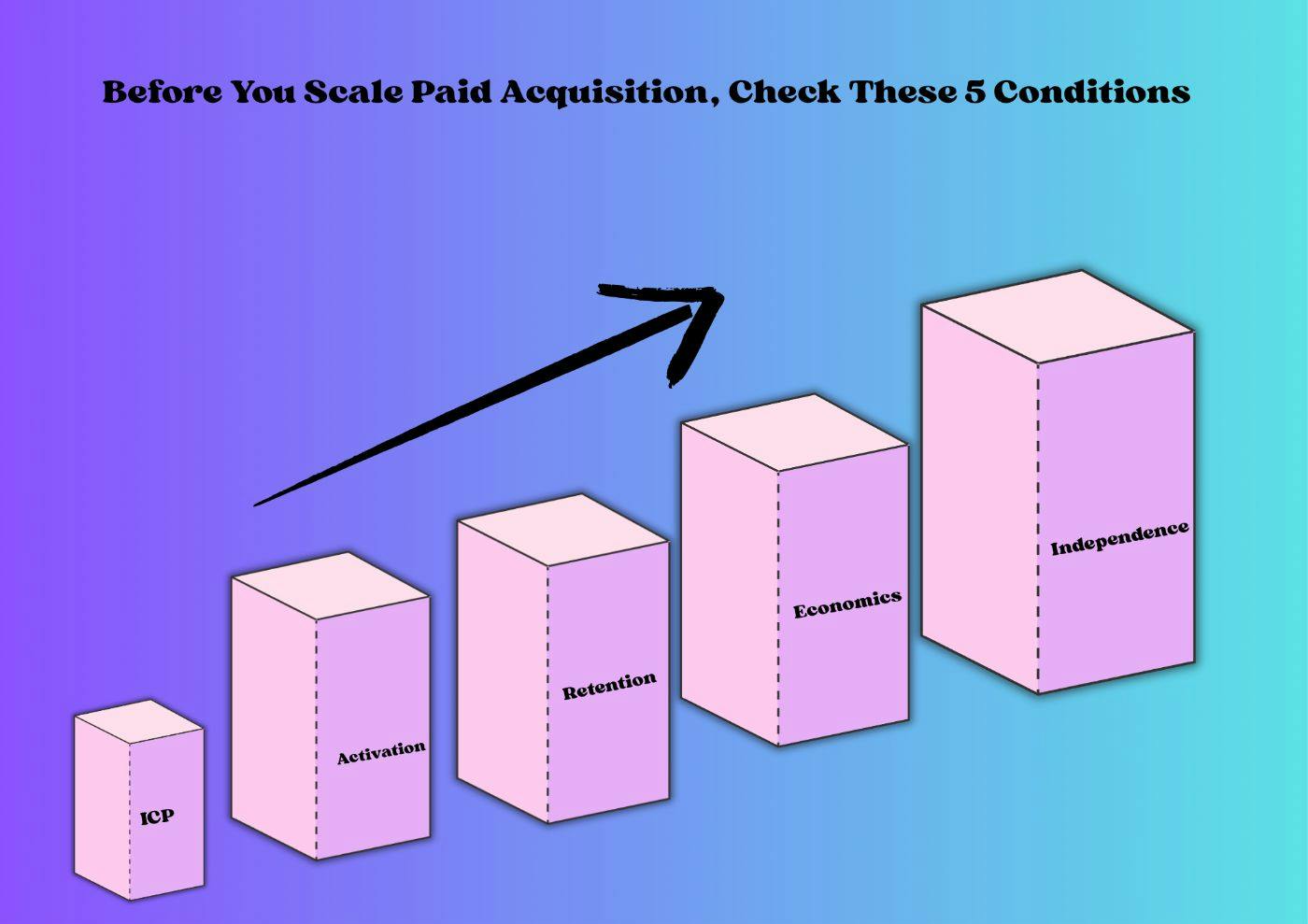
One of the most expensive mistakes a product team can make is scaling acquisition before the product is actually ready for it. The mistake rarely looks like a product problem at first. CAC rises. ROAS disappoints. A new channel underperforms. Conversion stops improving. The natural response is to test new creatives, adjust targeting, rebuild the landing page, or increase spend in the hope that more data will make the answer clearer. Sometimes that is the right move. But often acquisition is not the real bottleneck. It is simply exposing weaknesses that already exist inside the product. I have seen teams try to scale products where new users were not consistently reaching first value, where healthy retention existed only inside a narrow group of early adopters, or where activation depended heavily on founders personally explaining the product and guiding onboarding. In other cases, the company still had only a vague idea of its ideal customer, but was already trying to buy traffic at scale. In all of these situations, more acquisition does not create growth. It amplifies uncertainty. That led me to a question I now think teams should answer before materially increasing paid acquisition: What has to be true about the product before buying more traffic becomes a rational decision? I started treating the answer not as one metric, but as a system of conditions. I call it the Growth Readiness Framework. The framework grew out of the same product-validation logic I use in The Solo Founder Product System: before trying to grow a product, first establish who it works for, whether those users reach real value, and whether that value is strong enough to repeat. Growth readiness is what happens when those signals are considered together rather than in isolation. The core idea is simple: a product is ready to scale only when several different forms of evidence are true at the same time. A strong signal in one area cannot always compensate for weakness in another. This is why I think about growth readiness as a multiplication problem: Growth Readiness = Beachhead ICP × Repeatable Activation × Retention Stability × Economic Viability × Acquisition Independence The equation is not meant to produce a precise score. Its purpose is to show how the system behaves. If one factor is close to zero, the entire system becomes fragile. A product with excellent retention but no repeatable way to activate new users is difficult to scale. A product with low CAC and weak retention simply acquires churn more efficiently. A product with strong activation that depends on founder-led onboarding has proven that it can create value, but not that it can deliver that value at scale. That is why growth readiness should be treated as a system of constraints, not as a collection of encouraging metrics. Condition 1: Beachhead ICP The first condition is often described as “knowing your ICP,” but that phrase is usually too broad to be useful. A more useful question is whether the team has found a beachhead ICP: a narrow group of customers for whom the problem is especially painful, the product is especially relevant, and access to the audience is realistic. For an early-stage product, I find four criteria especially useful. The first is pain intensity. The problem should be serious enough that the customer wants to solve it now, not someday. The second is budget access. The customer should either control the budget or be close enough to the purchasing decision that payment is realistic. The third is audience accessibility. You should know where these customers are and how to reach them. For a small team or solo founder, proximity often matters more than theoretical market size. The fourth is weak existing alternatives. A strong beachhead usually exists where current tools are too generic, too manual, too expensive, or simply fail to solve the job well enough. Two behavioral signals make this diagnosis stronger. The first is language match. When customers describe the problem, do they use the same language you use? The second is existing workaround behavior. Have customers already built a spreadsheet, created a manual process, hired someone, or adopted an imperfect tool to deal with the problem? At that point, ICP stops being a positioning exercise and becomes evidence. Before scaling acquisition, the team should be able to answer a specific question: For which narrow segment does this product already work repeatedly? If the answer is still changing every week, paid acquisition is likely to generate more noise than useful learning. Condition 2: Repeatable Activation The second condition is activation, but activation is often measured too loosely. A signup is not activation. Completing onboarding is not necessarily activation either. Activation happens when the user receives the first real benefit from the product. A useful activation event should answer four questions: who is the user, what action did they complete, what value did they receive, and what subsequent behavior tells us they actually recognized that value? Imagine a product that helps SaaS founders understand failed Stripe payments. Uploading a CSV is activity, not necessarily value. A stronger activation event might be that the user uploads payment data, understands why payments failed, and opens one of the recommended recovery actions. At that point, there is a measurable event tied to an actual outcome. This way of thinking about activation is close to what Mark Roberge describes as a “leading indicator of retention.” In a Harvard Business Review discussion on Product-Market Fit, he argues that early-stage teams should identify the customer behavior that predicts future retention instead of using revenue or acquisition alone as proof that the product works. The important signal is not simply that a customer signed up or paid, but that they performed the action associated with receiving enough value to remain successful later. Once the activation event is defined, the more important question is whether users can reach it repeatedly. This is where early-stage products often look stronger than they really are. Founders explain confusing flows on calls, personally configure accounts, answer questions in Slack, or guide important users toward the right workflow. The user gets value, but the delivery mechanism does not scale. I find three tests useful here. The Definition Test asks whether the team can name the exact event that represents first value. The Independence Test asks whether qualified users can reach that event without exceptional founder intervention. The Downstream Test asks whether activation leads to stronger behavior later, such as repeat usage, deeper use, or requests for more capability around the same core job. The last test matters because activation can improve without the product actually becoming stronger. A shorter onboarding flow may increase the percentage of users who complete the first session, but if they disappear immediately afterward, the team has improved the path to value without proving that the value itself is strong enough. There is also the honeymoon effect. Early users are usually more forgiving than the broader market. They tolerate bugs, confusing interfaces, incomplete workflows, and manual processes. Paid acquisition introduces colder and less patient users. Activation becomes truly repeatable only when first value survives those less favorable conditions. Paid acquisition can increase signups overnight. It cannot manufacture first value. Condition 3: Retention Stability Activation proves that the user received value once. Retention asks whether that value was important enough to receive again. Retention is not simply a second visit. It is repeated value. What counts as repeated value depends on the product. For a habit app, it may mean returning the next day. For a weekly planning tool, it may mean using the product again the following week. For a B2B workflow product, the meaningful return may happen in the next operating cycle. This is why universal retention benchmarks are often less useful than they appear. What matters more is the shape and direction of behavior. One of the most useful tools here is the cohort curve. Cohorts allow you to observe whether each new group continues to return after receiving first value. There are three patterns worth paying attention to. If the curve consistently decays toward zero, users tried the product but did not find enough reason to keep using it. If the curve declines and then reaches a plateau, that is more encouraging. It suggests that a subset of users continues to receive recurring value. If newer cohorts retain better than earlier ones, the signal becomes stronger still. It suggests that product changes are improving the product’s ability to create repeated value. This is also why behavioral cohorts can be more useful than topline retention alone. Amplitude describes how the personal finance product Dave identified a specific onboarding behavior associated with much stronger long-term retention: users who added recurring expenses during onboarding were 5.7 times more likely to still be using the product three months later. Dave then redesigned onboarding around that behavior. The interesting part is not the 5.7x number itself; it is the method — connect an early behavior to later retention, then use that relationship to change the product. I find three retention tests especially useful. The Value-Return Test asks whether users are returning to repeat the core value, not simply reopening the product. The Plateau Test asks whether the retention curve stabilizes or keeps moving toward zero. The Cohort Progression Test asks whether newer cohorts retain at least as well as previous ones, and ideally better. There is also an important measurement detail. Retention should not be viewed only from signup. It is often more useful to build a cohort from the moment users reach first value. If retention is calculated only from registration, onboarding failure and product-value failure become mixed together. A user who never reached value and a user who reached value once but never returned will appear inside the same number, even though those are different problems. Measuring retention from first_value_reached creates a cleaner diagnosis. If users drop before activation, investigate onboarding, clarity, trust, or usability. If users activate but do not return, the problem is more likely to be the strength, frequency, or relevance of the value itself. This leads to a rule I think teams should take seriously: If the retention curve does not flatten, do not scale acquisition. More traffic does not fix unstable retention. It simply allows the company to lose more users, faster and more expensively. A retention plateau is not proof that the product is ready to scale. But the absence of one is a strong reason not to. Condition 4: Economic Viability Most growth conversations start with economics. Teams look at CAC, LTV, payback period, gross margin, and ROAS and try to determine whether the acquisition engine works. I think economics should come after the product signals above. Financial metrics become useful only when the behavior underneath them is stable enough to make those numbers meaningful. If retention changes dramatically every month, LTV is still mostly an assumption. If activation depends on founder support, the real cost of acquiring and serving a customer is understated. If the ICP is unclear, average CAC may simply be blending together segments with completely different economics. Economic viability does not mean having a perfect financial model. It means having enough evidence to believe that acquiring the next customer can create more economic value than it destroys. At a minimum, the team should understand the acquisition cost through the channel it wants to scale, the gross margin available to recover that cost, the likely payback period, and the assumptions about retention or expansion the model depends on. The more important question is whether the model still works when those assumptions get slightly worse. This is the Stress Test. What happens if CAC rises by 20%? What happens if retention weakens slightly? What happens if users from a broader audience take longer to activate? Does the model still make sense, or does it fall apart immediately? A growth model that works only under perfect conditions is not really a growth model. It is a spreadsheet describing one favorable moment in time. Before scaling, the economics should be resilient enough to survive contact with a broader and colder market. Condition 5: Acquisition Independence The final condition is especially important in founder-led companies. Early customers often come through personal networks, referrals, communities, direct outreach, warm introductions, or highly targeted conversations. There is nothing wrong with that. In many cases, that is exactly how an early-stage product should find its first users. The problem begins when success in those channels is treated as proof that the product will behave the same way under scalable acquisition. Founder-led acquisition comes with hidden advantages. The founder can choose unusually relevant prospects, adapt the pitch in real time, and manually compensate for weak onboarding. Paid acquisition removes most of those advantages. A user who arrives from an ad has less context, less trust, less patience, and no personal relationship with the company. That user has to understand the value proposition, reach activation, experience recurring value, and eventually pay with far less support. This is why Growth Readiness needs one final condition: Acquisition Independence. The question is simple: Can users who arrive without a personal relationship with the company still understand the product, activate, retain, and convert? Until the answer is yes, the company may have proven that the founder can sell the product. It has not necessarily proven that the product can scale. The Growth Readiness Framework Taken together, these five conditions form a practical diagnostic model. A growth-ready product should have a narrow beachhead segment with urgent pain and realistic access. Qualified users should be able to reach a clearly defined first-value event without exceptional founder support. Activated users should return for recurring value, retention should begin to stabilize, and newer cohorts should not be deteriorating. The economics should remain rational under slightly worse assumptions. And the product should continue to work when users arrive through channels that do not depend on founder relationships. But the main value of these conditions is not in evaluating them separately. The most useful information often appears when the signals contradict each other. The Contradiction Test A product can look healthy across several dashboards and still be unready to scale. This is why I use one more layer on top of the Growth Readiness Framework: the Contradiction Test. Instead of asking only which metrics look strong, ask which signals disagree with each other. High activation combined with low retention tells you that users understand the product well enough to get started, but the value is not strong or recurring enough to bring them back. Strong retention combined with weak Acquisition Independence suggests that the product works well for warm or carefully selected users, but has not yet proven that it can survive a broader market. Low CAC combined with weak retention means marketing is efficiently acquiring users the product cannot keep. Strong retention combined with poor payback suggests that the product creates real value, but the current monetization model or acquisition channel does not support scalable economics. High conversion combined with an unclear beachhead ICP may mean the team is good at selling without yet knowing which customers are actually worth acquiring. These contradictions help distinguish between different classes of problems. A product problem should not be solved with more media spend. A segmentation problem should not be solved by adding features. A channel problem should not automatically trigger an onboarding redesign. The framework becomes valuable when it helps the team understand not only whether it is ready to scale, but what kind of problem it is actually trying to solve. Paid Acquisition Should Be a Test, Not a Rescue Plan This is the central idea behind the model. Paid acquisition should not be used to rescue a product that is still uncertain about its value. It should be used to test whether a product that already works can continue to work under less favorable and more scalable conditions. Instead of asking, “Can we buy users cheaply?”, the team should ask: Does the product system remain healthy when we introduce a larger and colder stream of users? That system includes acquisition, activation, retention, monetization, and economics. If those pieces are already reasonably healthy, paid acquisition becomes a rational growth experiment. The company is no longer buying traffic in the hope that growth will somehow fix the product. It is buying evidence that a working product can survive scale. Growth does not create product quality. It amplifies whatever is already there. It amplifies strong activation, but also weak onboarding. It amplifies retention, but also churn. It amplifies clear positioning, but also confusion. Paid acquisition rarely repairs the product system underneath it. It reveals it. Why This Matters More in the AI Era AI is making execution cheaper, but cheaper execution does not improve decision quality. It simply makes it easier to scale the wrong segment, the wrong message, or the wrong product faster. As execution becomes less of a constraint, knowing what is actually ready to be amplified becomes more valuable. That is why growth readiness should be treated as a product decision, not just a marketing decision. Conclusion Most teams ask whether paid acquisition works. I think the better question is whether the product is ready for paid acquisition to work. Before scaling, five conditions should be sufficiently true: the company should have a clear beachhead ICP, activation should be repeatable, retention should be stable, the economics should remain viable under realistic stress, and the product should be able to create value outside founder-led acquisition. Together, these conditions form the Growth Readiness Framework. Its purpose is not to delay growth until every metric is perfect. Its purpose is to distinguish between a product that is ready to be amplified and a product that is still asking acquisition to compensate for unresolved uncertainty. Before increasing the budget, I would ask one final question: If acquisition suddenly worked twice as well tomorrow, would the rest of the product be ready for what happens next? If the answer is yes, scaling may be the right next experiment. If the answer is no, the problem is probably not marketing.
The Growth Readiness Equation: 5 Conditions That Must Be True Before Paid Acquisition Makes Sense
Full Article
Original Source
Read the full article at Hackernoon →KhanList aggregates and links to publicly available news content. We do not host full articles from third-party sources. Always verify important information with original sources.