
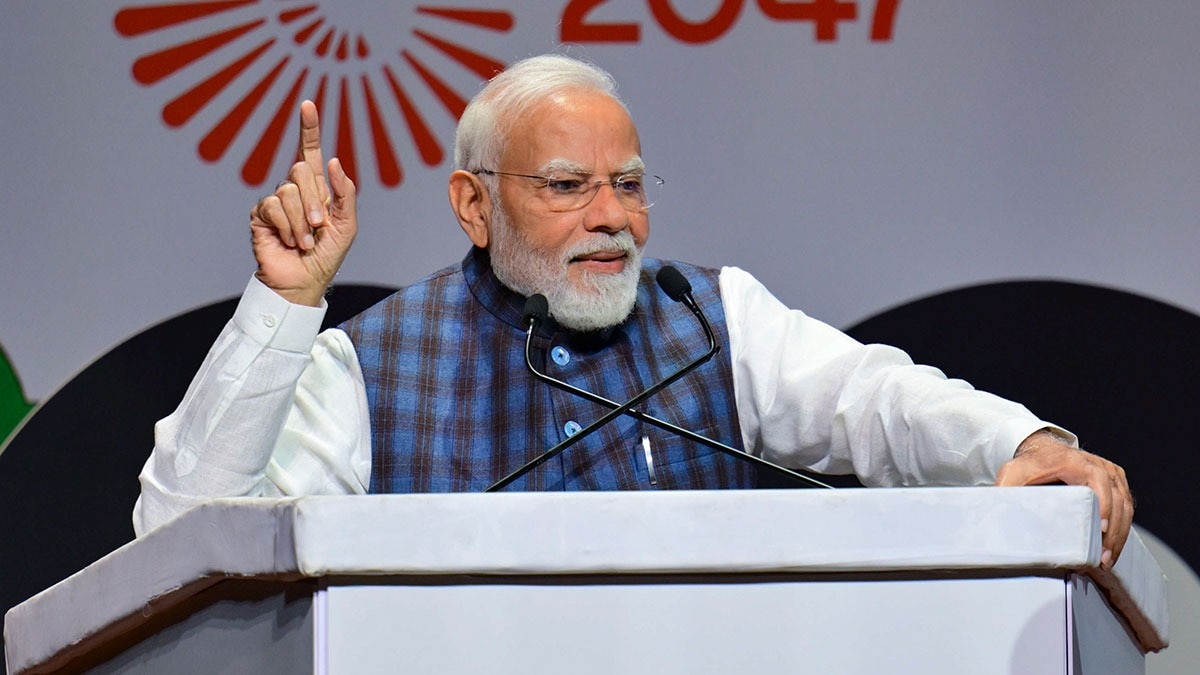
Prime Minister Narendra Modi did not expect applause and told his audience as much. Addressing the FICCI (Federation of Indian Chambers of Commerce and Industry) centenary convention in New Delhi on November 19, he ran through what his government had done for industry, and then turned to the gathering of business leaders. “I gave income-tax exemption on [income up to] Rs 12 lakh. Did you all raise employees’ salaries? Did you increase the number of employees?” he asked.Modi answered both questions himself. “No,” he said, suggesting that the industry had preferred to let the government make the first move, and then think about its own.The googly was perhaps unusual to be thrown at a chamber marking its 100th year, and it has been argued over since. The Opposition Congress called the speech a confession that the Modi government’s policies had not produced jobs. The prime minister’s own framing was of a bargain only half kept.Two days on, Reserve Bank of India (RBI) governor Sanjay Malhotra was at a financial inclusion camp run by the Bank of Maharashtra in Waksai, a Maharashtra village in Pune district’s Mawal taluka. Malhotra too had a question about who benefits. A loan of Rs 1,000 crore to a large business, he argued, helps one enterprise. Spread among small enterprises, the same money could do at least 100 times as much, and perhaps 1,000 times if it reached micro enterprises. Read together, the two speeches bare a niggling worry of the Union government and the central bank. Headline growth has held up. The harder question is how much of it is turning into investment, jobs and incomes, and how far beyond the largest companies does it travel.Modi’s case to industry rested on a list. The basic corporate tax rate has come down from 30 per cent to 22 per cent since 2014. Personal income-tax slabs have been revised, GST rates rationalised and trade agreements signed. Having done this much, he said, the government was entitled to see more investment, more hiring and better employee salaries.Industry’s usual reply is that companies invest when they see orders, and that demand has been uneven. The prime minister’s question about salary cuts into that argument. Wages are demand too. If companies hold pay down while waiting for consumption to pick up, the wait gets longer for all of them.The speech was about more than jobs. Modi warned companies against treating India’s 1.4 billion-plus consumers as a comfort zone. A market of that size, he said, should give them the scale to compete abroad. He then pointed to where they are not competing. India is a big producer of finished medicines but imports the active pharmaceutical ingredients, bulk drugs and intermediates that go into them. It exports iron ore and imports specialised steel. It has substantial bauxite reserves and still buys specialised aluminium alloys from overseas. Its share in global agricultural exports is 2-2.5 per cent.The examples have something in common. In each, the missing piece is the technically demanding stage between raw material and finished product, which is also where much of the value is added. Filling it takes technology, patient capital and skilled people. It also takes suppliers. Large manufacturers can finance their own expansion, but the foundries, tool rooms and chemical units that feed them are mostly small firms that need to borrow.This is where Malhotra’s remarks connect with Modi’s. The governor’s numbers were illustrative and he presented them that way. His point was that banks should look at how widely their credit is spread and not just how much of it is there.Micro, small and medium enterprises (MSMEs) account for 31.1 per cent of the GDP and close to half of Indian exports, going by the Economic Survey 2025-26; yet fewer than four in 10 borrow from the formal system.Bankers have an answer too. One large loan means one appraisal, one set of audited accounts and one package of collateral. The same money divided among thousands of small borrowers means thousands of files, many with thin records and little to pledge. Lending against GST filings and digital payment records is meant to change that calculation, and so are credit guarantees.Small firms have a complaint of their own that rarely features in speeches on credit. Many wait months to be paid by the large companies they supply, and borrow at high rates to cover the gap. Prompt payment would not need a bank at all.Malhotra also spoke to the account holders at the camp. More than 600 million accounts had been opened under the financial inclusion drive, he noted, but an account is only the first step. People need to use it, to be able to borrow at a reasonable rate, and to transact online without being cheated. He warned the gathering about fraudulent investment schemes and asked them to be careful with digital banking.Both appeals come at a critical moment. Renewed geopolitical uncertainty in West Asia and around the Strait of Hormuz has kept energy supply and shipping risks in focus. Even when crude oil price retreats from its peaks, freight and insurance costs come down more slowly, and India imports most of its energy.Inflation is the more immediate problem. Consumer prices rose 6.09 per cent in October, above the RBI’s upper tolerance limit of 6 per cent. Food inflation was 8.94 per cent. The RBI had already raised the repo rate by 25 basis points to 5.5 per cent at its October review and moved to a stance of calibrated tightening. That decision was taken before the October number came out. The RBI’s Monetary Policy Committee (MPC) will have it in hand when it meets on December 2-4.The situation leaves the RBI governor in a delicate position. He is asking banks to lend more to small businesses while heading a committee that may have to make borrowing costlier. Small borrowers already pay the highest rates and are usually the first to feel a hike. Banks have their own constraint: credit grew 15.9 per cent last fiscal while deposits grew 13.4 per cent, and lenders short of deposits tend to become choosier, not more adventurous.The finance ministry faces a version of the same problem. Pre-Budget consultations for 2027-28 have begun, starting with economists, and the brief is a familiar one: keep public capital expenditure going and keep fiscal consolidation on track. Yet government spending on infrastructure can draw in private investment. It cannot take the place of it.That is the context in which the two speeches are best read. The government believes it has done its part through tax cuts and reforms, and now wants industry to respond. The RBI believes the banking system reaches too few borrowers and wants lenders to widen their net. Industry and banks both have reasons for their caution that cannot be resolved overnight.The MPC meets next week and the Union Budget follows early next year. Corporate results and the RBI’s lending data over the next few quarters will show whether companies are hiring and paying more, and whether small firms are getting a larger share of bank credit. Those numbers, more than the speeches, will answer the questions Modi and Malhotra have asked.Subscribe to India Today Magazine- Ends
The growth-reach gap: Why PM Modi's nudge must get industry moving
Full Article
Original Source
Read the full article at Indiatoday →KhanList aggregates and links to publicly available news content. We do not host full articles from third-party sources. Always verify important information with original sources.