
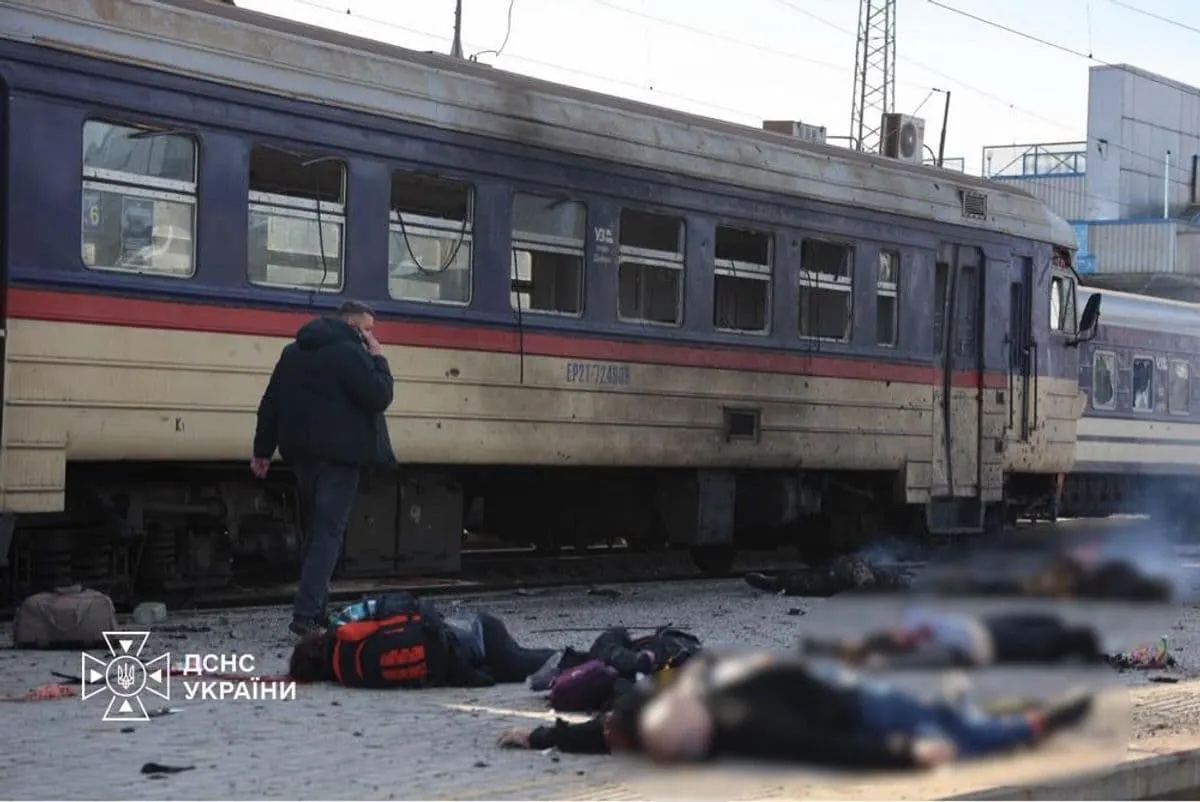
There’s some pretty grim news, but news that we must face. This summer and fall have seen a noticeable and continuing increase in the number of Ukrainian civilians being deliberately targeted and killed by Russian bombing. It is becoming more and more common to have mass casualty events on a weekly basis, and Russian ranged systems are being used to hunt out trains, buses, apartment buildings, etc. This needs to be understood and discussed more often. The Ukrainians are being targeted as a people now as a strategy of war. That this is not being admitted in Europe or the USA as it should be is astonishing. Europeans need to acknowledge that what is happening to Ukrainians could easily happen to them – and yet too often they speak as if this war is something that can easily be settled by some deal with this murderous regime. For the USA, the issue is more of admitting culpability as a nation. This rising slaughter is directly related to US policy. Two other stories worthy of note are the Oleshky ceasefire and evacuation and the announcement that the US might/could/really wants to sell hundreds and hundreds of Patriot missiles to Ukraine. One shows how the war has supercharged Ukrainian identity and the other how the Ukrainian government is still being abused. The slaughter October 29 was a sunny, autumn day in Dnipro. Then, in the late morning, the beauty of the day was shattered. The Ukrainian military reported that four jet-powered, Russian attack drones were in the area. They were able to shoot down three of the attackers but one made it through Ukrainian defenses. The result was a slaughter on the platform of the main Dnipro train station. Fourteen people were obliterated right away, and a fifteenth later died in hospital. About as many people were injured, some very seriously. Nor was this attack the only deliberate slaughter of Ukrainian civilians on October 29. On that day, 27 Ukrainian civilians were killed across the country, and a further 128 were injured. It was just another day full of atrocity in an atrocity-laden month in Ukraine. And it points out how attacking and killing civilians is now a growing part of Russian war strategy. When I wrote at the start of the month that “war crimes” were a growing part of Russian strategy, it was not by mistake. As the Russian military struggles mightily on the battlefield (I will have an update on that next week once we have confirmed Russian military casualties for October), attacking the Ukrainian people will become more and more central to the Russian way of war. While we await the grim figure for Ukrainian civilian casualties for October 2026 as a whole, it is clear that 2026 is shaping up to be the worst year for Ukrainian civilian deaths caused by the Russian military since 2022, the year of Russian full-scale invasion. The numbers are sobering and need to be faced. The UN, which on the whole has been a protector of Russian global influence in this war, has at least been keeping track of civilian deaths in Ukraine. In October it released a report on the situation as it stood through the end of September. At that point, 2570 Ukrainians had been killed by the Russians (most by Russian long-range strike) which is already more than the Russians killed in all but 2022. And 2022 has to stand alone as this was the year the full scale invasion started and the year in which the Russian army occupied the largest percentage of Ukraine that it ever would. Here is a chart from the UN report. It should also be understood that these direct deaths of civilians will be compounded by many indirect deaths, as Russia attempts to freeze Ukrainian civilians this winter and deny then power and the necessities of life. People, often the very old or very young, the weak or the handicapped, will perish because they do not have the strength or the ability to help themselves. This slaughter is a result of Russia’s strategic decision. It is an attempt to break Ukrainian will by killing non-combatants. It is also a primal scream of rage at the Ukrainian people for not bowing down in front of the Russian military and Vladimir Putin. So, four years into the war and civilian slaughter is now a growing part of Russia’s deliberate strategy. You would think that this would bring a strategic response from European states, in particular. What Russia is doing to Ukraine it could easily do to any European states – and in some ways it has already threatened to do similar things to the states of Central/Eastern Europe. Yet, for much of Europe this growth of casualties is shrugged off as part of the war – no big deal. Even political responses to the deaths are weirdly discordant and in some ways will encourage Russia to keep doing what it is doing. For instance, French President Emmanuel Macron released this statement right after the Dnipro attack. It is the most extraordinarily contradictory statement, and one that practically encourages the Russians to keep attacking Ukrainian civilians. If, as the third paragraph alleges, it is “intolerable” for the Russians to continue to bet on targeting (killing) civilians, why then is the fourth paragraph about enticing the Russians to the negotiating table? That can happen only through offering them awards. If I were Putin and read this, I would read it as a sign that my attacking of Ukrainian civilians was a strategic success. Of course, compared with the US government, Macron is a paragon of defiance and moral clarity. Neither the US president nor the Secretary of State has bothered to condemn the Dnipro attack, indeed Trump spent the week talking about how he was tired of people telling him to sanction Russia. The day after the Dnipro attack, Trump complained that “People, stupid people, wanted me to put sanctions on Russia,” adding that Putin laughed at such restrictions. We are learning a very harsh lesson these days. War crimes get you rewards, they get you pleas to come to the negotiating table, they even get you the president of the USA making excuses on your behalf. When I wrote last year that the future of war looked to be a combination of ranged fire and war crimes, some called it alarmist. Sadly, it was probably too optimistic. The evacuation of Oleshky and Ukrainian identity The Russian-occupied Ukrainian town of Oleshky has been the site of a humanitarian disaster. Oleshky sits on the east bank of the Dnipro River, in Kherson oblast, not far from Kherson city itself (which is on the west bank). Oleshky’s location has sadly meant that it has been under Russian occupation since 2022. In the last year things have deteriorated noticeably in the town. It has been starved of food, medicines, power and even water by the Russian occupiers, leaving the population in the most dire straits. Therefore it is a very good thing that an agreement was reached to evacuate civilians from that area. If you want a very detailed story on the evacuation, you could start with this long story from the Kyiv Independent. So far it has been reported that 15 buses, which could carry a combined 750 passengers, have left Oleshky. Interestingly, the evacuees could choose whether to go to Ukraine or to end up in Russia (remember according to Putin this is Russia and the people have always wanted to be Russian). So far they have overwhelmingly opted for Ukraine—11 busloads to 4. It is a sign of one thing. This war has helped create an even more powerful sense of Ukrainian identity that Russia will not be able to erase, no matter how many war crimes it commits. This area was considered one of the most “pro-Russian” in Ukraine before 2022, and yet its inhabitants are overwhelmingly choosing to live in a Ukraine that they know Russia is bombarding daily. This war has taken the most Russian-speaking areas of Ukraine and made them so fundamentally Ukrainian that the population will now chooses to risk its lives to maintain that indentity. This is worth keeping in mind when western analysts keep saying that these areas, and their people, need to be transferred to permanent Russian control. The deal itself, of course, has a number of strategic advantages for Russia. It allows the Russian government to cover Melania Trump in glory. Putin himself went out of his way to praise her for her efforts. It is thus a way to win some international plaudits and stroke Trump’s ego. More importantly for Russia, it allows the Russian military a few free days to resupply and reinforce an area that the Ukrainians have been isolating as part of their mid-range strike campaign. For Ukraine the advantages are already ending up being more profound. 500 Patriot missiles for Ukraine – in 2030 On October 30, the US State Department caught many people by surprise when it released this announcement that seemed to indicate that large number of Patriot interceptor missiles (the kind most needed to shoot down Russian ballistic missiles) would be sold to Europe to pass on to Ukraine. The announcement was full of details such as the sale amount being $2.1 billion, that it would involve 500 interceptors and that these would be of the most advanced, PAC-3, type. The announcement even made it seem that the USA now cared about Ukrainians and looked upon Ukraine as a “partner.” There was some serious virtue signaling in the announcement, most obviously in this line: This proposed sale will support the foreign policy and national security objectives of the United States by improving the security of a partner country that is a force for political and economic stability in Europe. Immediately there were some people looking at this as a positive sign, that the US might be willing to actually help Ukraine. I ended up throwing up a little in my throat. Of course this will never happen—this announcement is entirely political. It was made four days before the US midterm elections just as Trump and the GOP are getting hammered for being Putin lackeys. The polling on this is brutal for the administration, and they know it. They had to think of something that they could do to try and counter that narrative with the vote looming, so they came up with this dramatic sounding statement of nothingness. The deal is a political charade and needs to be seen as such. As a political charade, it worked tolerably well. There were headlines across the US media announcing that the deal had been approved – headlines being, really, all the administration wants. If it fools a few idiots or gullible fools, it would have done its trick. There is one thing I can guarantee to you. This deal will never see the light of day. Indeed it does not really exist and never will. First, hours after the announcement it became apparent that the first missiles would not be able to reach Ukraine until 2030 (they are all to be new construction). If MAGA is still in power in 2030, (President JD Vance anyone?) then these missiles will never be delivered. The Trump administration and MAGA is planning on the destruction of Ukraine as a viable state by then. This is why they have deliberately starved Ukraine of air defense to this point; to leave the Ukrainians as vulnerable as possible to Russian attacks this winter and the next few years. If the Democrats are back in power, then they will almost certainly not sell these systems at the brutal and exorbitant mark-up costs that the Trump administration is demanding. The Democrats will hopefully make the smart and strategic choice to aid Ukraine. At least one thing has improved. The reporting, after an initial rush of excitement, took on a more skeptical note more quickly than in the past. The press is learning a little. It is just too bad that it has taken the most extraordinary of lies to get them there. Phillips O’Brien is a professor of strategic studies at the University of St. Andrew. This article, first published on Phillips’s Newsletter, is republished with permission.
The growing slaughter of Ukrainian civilians
Full Article
Original Source
Read the full article at Asiatimes →KhanList aggregates and links to publicly available news content. We do not host full articles from third-party sources. Always verify important information with original sources.