
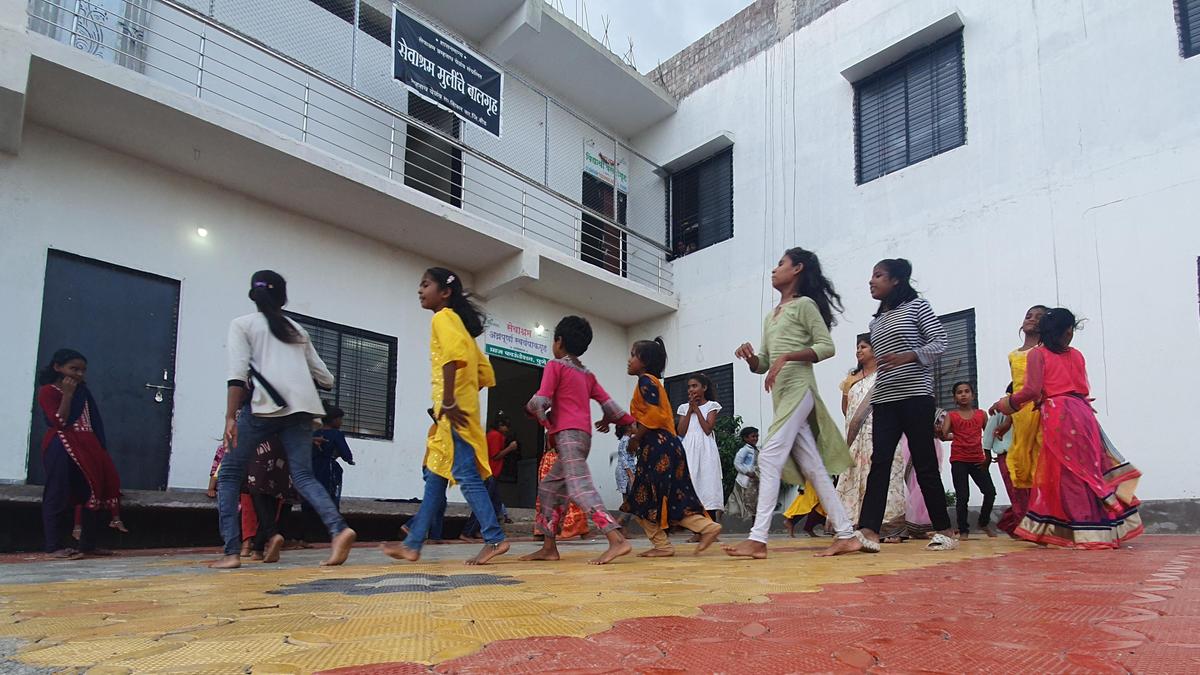
Some names of Tamasha performers and their children have been changed to protect their privacy.Weighed down by six-kilogram ghungroos (ankle bells), 14-year-old Avani trudges reluctantly from the makeshift green room towards a brightly lit stage in Maharashtra’s Beed district. Amid the roar of whistles and cheers, the Tamasha dancer flicks her wrist, stamps her feet and sways to the beat of the dholki (a percussion instrument). The harsh floodlights obscure the faces in the audience, yet she senses their piercing gaze through the folds of her nine-yard sari.Avani is one of many girls from Maharashtra’s Kolhati community who are pushed into the tradition of Tamasha, a form of folk theatre and dance-drama which is now entangled with the exploitation of women and girls. The custom leaves women financially vulnerable and reduces them to commodities. Many children of Tamasha performers are denied access to education. Although community members and activists are working towards providing these children with education and safe shelter, the cost of preserving this cultural tradition is borne by its custodians who continue to face stigma and exploitation.Avani, the daughter of a Tamasha dancer, was only 11 years old when she was brought to the Sevashram residential school at Bramhanath Yelamb village in Shirur Kasar taluka (tehsil) of Maharashtra’s Beed district. The school serves as a rescue centre for the children of women performing Tamasha.“About a year ago, Avani’s mother’s partner visited the school. He took Avani to attend a marriage ceremony in the family. I opposed the move, but Avani is a teenager and her custody was ultimately handed over to a representative of her family,” says Suresh Rajhans, the social activist who started the school in 2011.Rajhans believes that Avani has most likely met the fate of other girls in her community. Beyond performing on stage, these girls are expected to follow the ritual of chira utaravne (defloration) in which their virginity is sold to the highest bidder. The price ranges from a few hundreds to lakhs of rupees. Regardless of age, the man who performs the ritual instantly becomes her malak or owner.Under this arrangement, the malak is expected to provide for the girl financially and meet her needs outside marriage. The malak is generally a political bigwig, government official, rich landlord, or wealthy businessman. While maintaining his own family life, he retains the right to visit the performer whenever he wishes.Community comes callingTamasha is an ancient traditional folk theatre that blends music, dance, drama, and satire. It was originally performed by marginalised communities, including Mang (listed as a Scheduled Caste by the Ministry of Social Justice and Empowerment) and Kolhati.Kolhatis are an indigenous nomadic and semi-nomadic community officially classified as a Nomadic Tribe in Maharashtra. Historically, the members of the community travelled from village to village and performed street acrobatics, music, and drama during festivals.Within this tradition, women are primarily known for performing Lavani — a combination of song and dance that originated in Maharashtra in the 18th and 19th centuries — wearing brightly coloured nine-yard saris called lugade.Tamasha artistes usually perform in groups. These groups range from small troupes of six to 10 people to larger ones with as many as 150 members. They work for eight months a year, from Dussehra to May. During this time, they travel almost every day to perform at village festivals across Maharashtra. The performances are booked and paid for in advance. The best female dancers can earn up to ₹50,000 a month and are usually the sole breadwinners in their families.These groups are headed by a Tamasha malak, usually a wealthy person, male or female, who brings the performers together. The Tamasha malak has complete authority over the earnings and bookings of the group.In the community, sons often drift towards crime because families pay less attention to them, while daughters are viewed as family wealth. The community is described as matriarchal, with women leading households and serving as the primary breadwinners. Their beauty and dancing skills take priority over education as Tamasha is their main source of income.According to Rajhans, at least 10,000 children of Tamasha artistes are out of school. At Sevashram, Rajhans currently shelters 100 children of Tamasha dancers and performers, including orphans. Veda, a 16-year-old Class X student at Sevashram school,lives in constant fear that one day a relative of hers may suddenly arrive to pull her back into the Tamasha world.She is reserved when discussing her life and future. “I want to study, that is for sure, but...” she trails off, looking down. Too young to carry the heavy weight of her community’s reality, she has absorbed its worst fears, and her quiet acceptance turns to tears. She loves dancing, but is ready to give up her hobby entirely to pursue education. She says that she wants a normal life with proper education, a job, and a family where she no longer has to hide or leave home when visitors come to meet her mother, a Tamasha artiste. She wonders what what life with both parents would be like. Children play on in the courtyard of the Sevashram residential school in Bramhanath Yelamb village of Maharashtra’s Beed district. | Photo Credit: Radheshyam Jadhav Rooted in tradition“In the Kolhati community, women typically do not marry. Those who secure a malak cannot be certain of his long-term support, while those with casual partners frequently switch companions. Life is completely unstable, and a single woman cannot survive this harsh world,” says Rema, a Tamasha dancer in her mid-30s, who lives in Jamkhed town in Ahilyanagar district, Maharashtra. She has danced on stage since her teens, carrying on her mother’s legacy. Over the years, she has left some partners, while others have left her. She has a son with one of them. Instead of giving him his father’s name, she chose to give him her own name. “I am both his father and his mother,” she says.Such complex family dynamics are common within the community. Sometimes, two children born to the same mother may follow different religions. For instance, Rajhans says, when Nadeem arrived at the Sevashram school, everyone was surprised to learn that he was Amar’s brother. “Their mother had a Hindu partner and she had a son named Amar with him; then he left her. Struggling to survive as a single mother, she later found a Muslim companion, with whom she had a son named Nadeem. Today, Amar is completing professional training after finishing Class XI, while Nadeem is in Class XI,” says Rajhans.He adds that both Nadeem and Amar studied at the Sevashram residential school’s branch in Chhatrapati Sambhajinagar, formerly known as Aurangabad. Sevashram has two branches in Maharashtra and receives funding from donors.These mixed identities go beyond religion. In another incident, Rajhans recalls Rushi’s struggle to be recognised as belonging to a Nomadic Tribe. “After finishing secondary education at a school in Shirur, while applying for college, Rushi was denied a scholarship meant for Nomadic Tribe students. The administrative records had listed him under the so-called upper caste, assigning his caste identity to his mother’s former partner.”In the community, a majority of children get their middle name from their mother, notes Mayuri Rajhans, who helps her husband Suresh Rajhans run the school. Mayuri shares the story of an elderly woman who dropped off a six-year-old boy claiming to be her grandson, never to return. “By the time administrative records needed to be created, the grandmother had passed away. When the school traced his mother to a Tamasha troupe, the malak reported that she had left long ago and her whereabouts were unknown. The mother never visited the boy, so Suresh gave the child his name and surname. Now in Class X, the boy still yearns to see his mother,” she says.Forgotten childrenAbout 56 kilometres from Bramhanath Yelamb, the sound of ghungroos grows louder in Jamkhed. The town is historically and culturally connected to the ecosystem of Tamasha, Lavani, and local performance spaces known as Kala Kendras or Sangeet Baris.Sangeet Bari is an intimate form of traditional Maharashtrian folk art centred on music and dance. Unlike large-scale Tamasha theatrical plays, Sangeet Bari is performed by small, female-led troupes of six to 10 artistes within specialised indoor theatres or private settings.Sangeet Baris offer a more reliable income, making them the preferred choice for many performers. In these venues, dancers perform film songs or traditional Lavan numbers in response to audience requests known as farmaish.Competition among audience members is fierce, with cash thrown at the dancers to persuade them to perform a particular song. Performers frequently collect these tips through subtle gestures, such as holding banknotes with their lips or making brief physical contact.While there is no limit to how much a performer can earn at a Sangeet Bari, access to these venues is heavily gatekept.“The season starts now and we are getting ready to perform,” says one of the teenagers watching a Bollywood number on her phone, sitting on a bench at a chowk in the congested lanes of Kanhopatra Nagar in the heart of Jamkhed.This locality of Tamasha dancers and artistes is named after Kanhopatra, a 15th-century Marathi saint-poet and revered figure within the Warkari sect in Maharashtra. Born to a wealthy courtesan and dancer, she refused to follow in her mother’s footsteps and devoted her life to composing devotional poetry in praise of Lord Vitthal. The girls were unaware of their locality’s history. None of them had ever attended school, nor did they intend to. “Enticed by the limelight and quick money, these young girls get distracted from education,” says Uma Meena Kale, now in her 40s and the daughter of a Kolhati Tamasha dancer. “No need to change my name in the story. You can use as it is,” she clarifies as she goes to meet dancers in Kanhopatra Nagar.Uma’s mother married a government official from Jalna town in Marathwada, who was smitten with her. “He was already married and had children. My mother was happy that somebody was ready to marry her and not just become her partner. She had two children, my sister and me, with him; we never stayed with him,” she says.Uma says that her father stayed with the family he chose before marrying her mother. “My sister and I chose education over Tamasha. Our father died recently, but our mother was not even aware of his death for three months. I only found out when my father’s first wife called to tell me he had died. We never spoke again. We don’t even know what his family looks like,” she adds.Uma notes that many children in her community belong to the wealthy and powerful men, but they are never given their legitimate status. Even worse, Uma says, they are barred from attending their fathers’ funerals.Uma completed a Master of Social Work degree from Yashwantrao Chavan Maharashtra Open University in Nashik and is married to Arun Hirbai Jadhav, a political activist who is also the son of a Kolhati Tamasha dancer.“All my life I have suffered humiliation, being called a child of many fathers. I would not have educated myself to become an advocate if one incident had not happened when I was in Class X,” he says.Arun recalls that the police threatened to file serious charges against him after he met with an accident while riding a bike with his younger sister as pillion. “The policeman said that I could escape all charges if my sister was ready to sleep with him. I felt so humiliated, realising that my mother, my sister, and I have no value in this world, and that was the turning point,” says Arun, sitting in his office in Jamkhed.He serves as a councillor of the Jamkhed Municipal Council and is the State spokesperson of Vanchit Bahujan Aghadi, a political outfit led by Prakash Ambedkar in Maharashtra.Arun and his siblings never knew who their father was. “I never asked my mother about it. She herself is a victim of this vicious tradition and culture. It is easy to blame the woman, but only she knows what she has to go through,” he says. Kanhopatra Nagar, the locality of Tamasha artistes in Jamkhed, is named after Kanhopatra, a 15th-century Marathi saint. | Photo Credit: Radheshyam Jadhav Breaking the cycleTo help break this cycle of oppression, Arun and Uma established Nivara Balgruha, a residential hostel at Moha Phata near Jamkhed, in 2015. It provides shelter for children of Tamasha artistes and those from marginalised communities, with 85 children currently residing there.“Now, more and more young people in the community are becoming engineers; some have joined government services too,” says Arun. Children at the playground of Nivara Balgruha, a residential hostel at Moha Phata near Jamkhed | Photo Credit: Radheshyam Jadhav As Arun and Uma expand residential facilities and vocational training for marginalised youth, Jamkhed remains fiercely attached to a dance tradition it views as the heartbeat of Maharashtra’s culture. The town decks up for the annual Nag Panchami festival, which cannot officially begin until dancers strap on their ghungroos.Folklore dictates that without the rhythmic chime of these belled anklets, the rain will not bless the parched earth.“People say we are the custodians of culture and folk art. But nothing has changed for us on the ground,” says Rakhma, 42, a dancer in Jamkhed, noting that as traditional Tamasha fades, private dance parties featuring Bollywood numbers are surging.“Today, women from various castes and religions join the dancing profession for easy money, but for us, it is an art. We revere our ghungroos before wearing them, yet we have been the targets of exploitation. Bollywood heroines gain fame and fortune performing Lavani on screen, but what do we get?” she asks, noting that many young girls now lead ordinary lives during the day, concealing their identities as Sangeet Bari dancers at night.Rakhma recounts a chilling episode that showed her the grim reality of Tamasha dancers. “After a gruelling all-night private performance for a local landlord, an exhausted young dancer once asked the landlord for a glass of water. In response, he urinated in a glass and forced her to drink it,” she says.Rakhma has tried to keep her daughter from the profession and hopes she will have a better future. “I educated my daughter. She is an engineer now and proudly carries my name. She will choose who she wants to marry or whether to marry at all. If people care so much about preserving tradition and culture, they should ask their own daughters to carry it forward. Our children will not do it anymore,” Rakhma asserts.(Edited by Amarjot Kaur)
The grief of ghungroos
Full Article
Original Source
Read the full article at Thehindu →KhanList aggregates and links to publicly available news content. We do not host full articles from third-party sources. Always verify important information with original sources.