
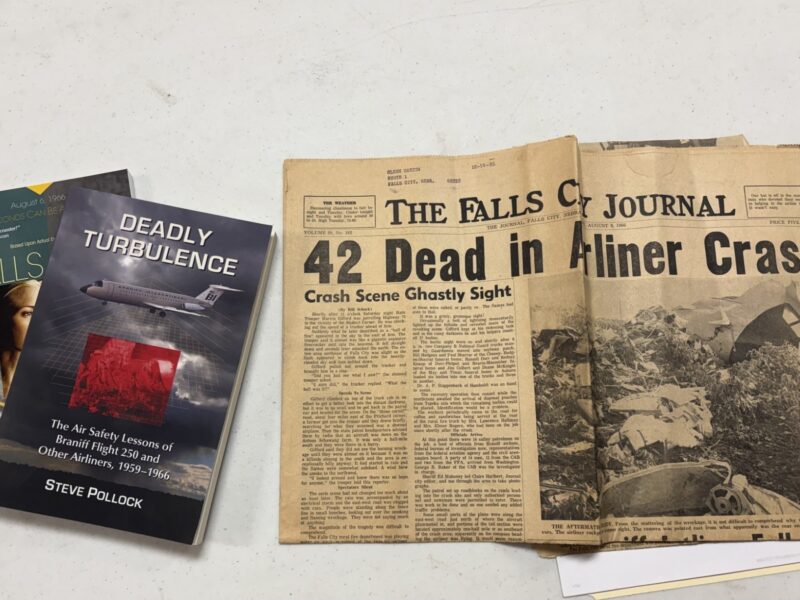
FALLS CITY, Neb. (CN) — It was supposed to be a short hop from Kansas City to Omaha.It was 1966, and one imagines the passengers dressed in suits and skirts in those early glamorous days of air travel. They were likely buckled up for the turbulent flight.The pilots of Braniff Flight 250 knew they would have to contend with storms, but they didn’t know how bad conditions would be. In the cockpit, the onboard radar showed what appeared to be a gap in the storm. The pilot steered toward it.It was a tragic mistake.Massive winds ripped the starboard wing and the tail from the aircraft. It entered a spin, plunging into a bean field in the rolling hills of Richardson County in southeast Nebraska.It went straight down, with an accident report showing no horizontal displacement. The incident killed all 38 passengers and four crewmembers on board.The crash of Flight 250 is not widely remembered by the general public today. But plane enthusiasts sure know it: It was a significant crash in the early decades of passenger air travel, a test case that budding pilots and aviation professionals still study.It was the first crash investigation to use a cockpit voice recorder, and one of the last before the National Transportation Safety Board was created in 1967. British Aircraft Corporation, the plane’s manufacturer, hired Ted Fujita, the meteorologist best known for creating the Fujita scale to measure tornadoes, helping set a new standard for how wind and weather factors are analyzed after crashes.A group of men stands among the wreckage of Braniff Flight 250 after the Aug. 6, 1966, crash that killed all on board near Falls City, Nebraska. (Falls City Journal via Courthouse News)Flight 250 has been the subject of a fiction and nonfiction book. As is fitting for anything 1960s-related, it’s also mentioned in an episode of “Mad Men.”Steve Pollock, who wrote the 2014 nonfiction book “Deadly Turbulence” about the crash, stressed that real people died in the tragedy. And yet he says some good came out of it, in terms of a “really incredible kind of gargantuan effort to figure out what happened and how to prevent it going forward.”Lessons learned from crashes like these have helped make flying a remarkably safe form of travel, Pollock said.“We treat an airplane these days like getting on a somewhat dirty elevator,” he said. “It’s statistically, at this point, probably safer than an elevator.”“There is a reason for that,” he added. “There are human lives, and death that is very much a part of that story."The crash of Flight 250 also remains a big deal for some in Falls City, a modest Nebraska city of around 4,000 near the crash site. As local volunteers tried to help and a public building was converted to a morgue, it remains a tragic chapter in the city’s history.One Falls City family still runs a memorial. Over the years, some families of the deceased crew and passengers have even gotten to know some residents, linked together by shared grief.Among them are Dan Hilliker, whose father died as a first officer on Flight 250. He first visited Falls City around the 40th anniversary in 2006.The crash, he said, had a major impact in how aviation professionals think about and navigate bad weather.“They learned from it,” he said. “It was a seminal moment for aviation.”The tragedy unfolded on Saturday, Aug. 6, 1966. Flight 250 started its day’s itinerary in New Orleans that morning and was headed for Minneapolis that night. Along the way were several stops, including what would turn out to be its last in Kansas City, Missouri.In Kansas City, Captain Donald Pauly and First Officer James Hilliker learned that storms that were buffeting Iowa and Nebraska. Lightning flickered to the north.Nonetheless, the pilots likely felt pressure to set off anyway, said Bob Krist, an instructor at University of Nebraska Omaha’s Aviation Institute.“It’s a revenue-producing flight,” said Krist, whose students study Flight 250 and its lessons. There’s a lot of pressure for a plane to take off, and it was “even worse in those days,” he explained. The attitude was that “you need to get these people from point A to point B, and if you don’t, it’s bad on you.”The plane involved in the deadly 1966 crash, pictured here in Dallas just weeks earlier. (Jon Proctor/Wikipedia via Courthouse News)On the runway, air traffic controllers made another fateful error: They directed the plane to fly to Omaha at 5,000 feet rather than the planned 20,000 feet. There was conflicting air traffic at 20,000, but flying lower made them more vulnerable to the storm.“The lower you are, the tougher it is" to get good communication, Krist said. “Even today.” Flying low in a storm is also more dangerous in general, since pilots have less distance to recover if something goes wrong.The plane took off at 10:55 p.m.Almost immediately, it ran into turbulence. Hilliker wanted to change course, but flying low in bad weather, they got minimal controller response. Less than 20 minutes after takeoff, at 11:12 p.m., Flight 250 crashed.On the ground in nearby Falls City, Nebraska, locals noticed a fireball. As the Falls City Journal reported the following Monday, “the flash appeared to climb back into the heavily clouded sky.”Susan Sipple had just turned 21. She and her husband were driving from Lincoln to her parents’ farm in Falls City. They didn’t see the flash but heard a radio news bulletin.Sipple’s father Robert Zimmerman was a founding member of the volunteer Falls City Rural Fire Department. When Sipple and her husband got to the family home, he had left to respond to the scene.Before dawn, Sipple and her mother Margaret took her father coffee and sandwiches.Robert Zimmerman sat in the backseat and ate. His raincoat, wet from the storm, smelled like death.Although Sipple did not see the gory aftermath, she remembers her father’s vivid descriptions. Artifacts of the deceased were strewn about: gold watches, rings, luggage and clothing.To hear him tell it, “it was really a gruesome sight,” Sipple recalled in an interview at the Collection Museum in downtown Falls City, where one of Zimmerman’s firefighter uniforms is now displayed.“It was slick and smelled terrible,” she said, “like smoke and jet fuel.”Susan Sipple next to one of her father's uniforms at the Collection Museum in Falls City, Nebraska. Her father, who served in the rural volunteer fire department, was among the first responders at the crash site. (Andrew J. Nelson/Courthouse News)In Bloomington, Minnesota, the family of First Officer Hilliker found out what happened when a small group of uniformed pilots visited their home. His oldest son Dan Hilliker, then 15, remembers waking up to find his uncle next to his bed.“I was devastated,” he said in a telephone interview from Colorado. “I stood up on my bed and took a swing at him, for real. I was just out of sorts.”Zimmerman, who died in 2023, always believed Captain Pauly and First Officer James Hilliker did everything they could to save the plane. An image from that night would never leave him, Sipple said: a pilot’s hand, still gripping the controls.As a longtime farmer, Zimmerman was used to matters of life and death, she said. Even so, after the crash, “he probably took life a little more seriously.”As journalists, FAA investigators and Braniff International workers descended on Falls City, its then around 5,500 inhabitants swung into action.The city’s Prichard Auditorium was converted to a morgue. “I don’t think there was any other place in town that would have had the capacity,” said Norma Thompson, a board member of the Richardson County Historical Society, who at the time did 4-H activities at Prichard.The official cause of the accident was structural failure caused by the storm.Reforms and lessons after the tragedy would make a similar situation much safer today. Commercial planes almost always fly much higher than 5,000 feet, and a crew would not be expected to fly such a grueling schedule. Krist also attributes the crash to an antique on-board radar and misunderstandings by the pilots of how to interpret it.“They were never taught to read the radar system the way we learned today,” he said — “or the way we learned from that mistake.” He says the pilot and first officer mistakenly thought the radar showed a gap in the storm when really there wasn’t one.Pollock, who literally wrote the book on the Flight 250 crash, agrees the pilots weren’t the cause of the crash.He also agrees the radar was a big factor. “They were running into a horizontal tornado,” he said, but “the radar was so primitive” they didn’t know it.Prichard Auditorium in Falls City, Nebraska, served as a makeshift morgue for victims of Flight 250. (Andrew J. Nelson/Courthouse News)Antone “Tony” Schwang lived just across the county road from the crash site. His home became something of a command post, said Elaine Schwang, who is married to one of Tony Schwang’s nephews and now lives there.“It was just devastating to the community,” Elaine Schwang said. “We didn’t know the people on board, but we knew their stories.”Tony Schwang and his family decided they couldn’t stay in the house, she explained as she sat for an interview in the house’s kitchen.“It was just too much trauma,” she said, “knowing that had happened across the road.”Dan Hilliker, now 75, pursued aviation but did not stick with it. He worked for a while as a baggage handler for Braniff International before starting a career in medical sales. He’s since retired.He still thinks about his father. His grandson James, now 10, is named after him. Hilliker says his father, who grew up in the Great Depression, stayed humble even as he found a glamorous job flying planes.“He was a guy who always talked over the fence to neighbors,” Hilliker said. “He knew everybody, and he was very, very well liked.”Hilliker visited the crash site for the first time in 2006, during a work trip to Nebraska.He went to the offices of the Falls City Journal, where he met Bill Schock, the reporter who covered the crash and who at that point owned the paper. Schock shared photos from the scene with him. Hilliker, overcome with emotion, had to excuse himself.Schock took him to the crash site. “All these people were coming out of the woodwork who wanted to talk to me,” Hilliker said. One local farmer gifted him a piece of the aircraft’s wing.Hilliker was moved by the fact that just like him, locals in Falls City seemed to have been deeply affected by the crash. “I was just so surprised that anybody gave a shit 40 years later,” he said. “I was overwhelmed with gratitude.”He visited twice that year. Ten years later, for the 50th anniversary, he brought relatives, including his grandson James. This year, he ordered a bouquet for Elaine Schwang and her husband, to thank them for their kindness.A memorial to the passengers and crew of Braniff Flight 250, which crashed here on Aug. 6, 1966. (Andrew J. Nelson/Courthouse News)Subscribe to our free newslettersOur weekly newsletter Closing Arguments offers the latest about ongoing trials, major litigation and rulings in courthouses around the U.S. and the world, while the monthly Under the Lights dishes the legal dirt from Hollywood, sports, Big Tech and the arts.Additional Reads
The grief and lessons of a Nebraska plane crash
Full Article
Original Source
Read the full article at Courthousenews →KhanList aggregates and links to publicly available news content. We do not host full articles from third-party sources. Always verify important information with original sources.