
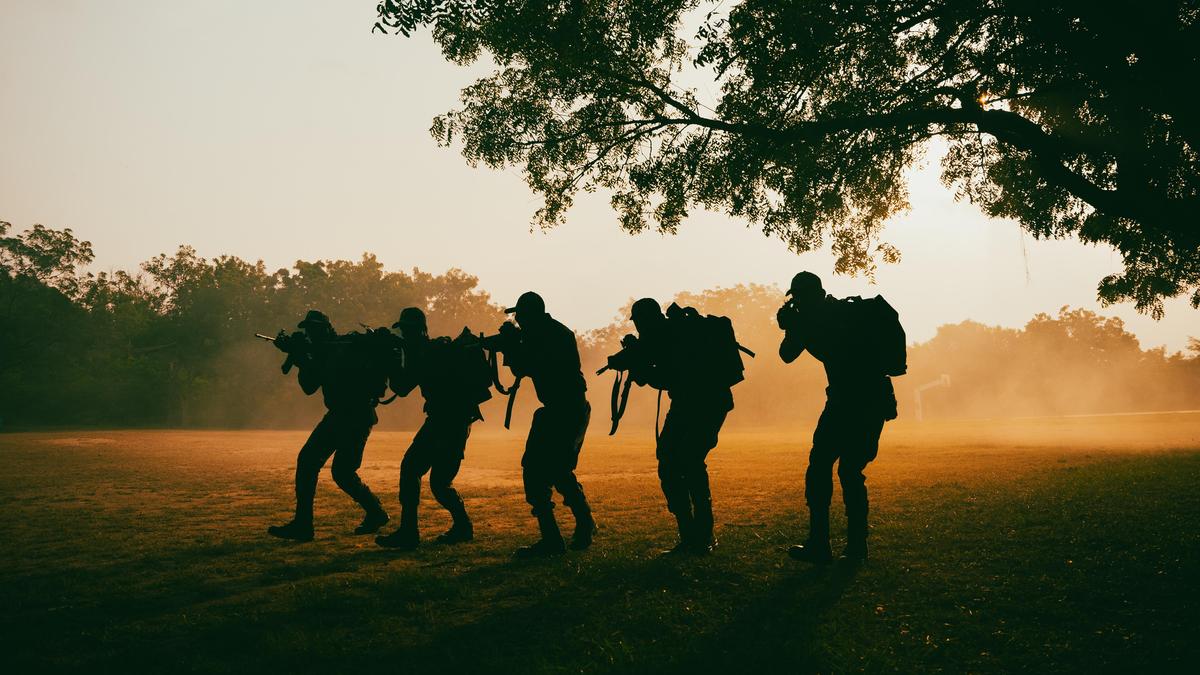
The bullet struck N.V. Satya Srinivas Rao in the chest. His bulletproof jacket stopped it, but the impact knocked his rifle from his hands and sent him to the ground.Then came the second shot. This time, the bullet found a gap in the jacket. It entered Rao’s abdomen from the left side, tore through his body and exited on the other side.It was November 30, 1992. Rao, then 26 and barely a year into the Andhra Pradesh Police, had entered a house in Baddepalli in erstwhile Karimnagar district with three other Greyhounds personnel. They were hunting a group of Naxals belonging to the Chandra Pulla Reddy group. Five bodies already lay scattered around the house.Rao noticed Sardar, the commander of the dalam. Injured but still alive, the Naxal had positioned himself behind the bodies of his fallen comrades, using them as sandbags. He raised his weapon and fired at Rao.The young cop fought for his life for nearly 25 days before being discharged from the Nizam’s Institute of Medical Sciences in Hyderabad on Christmas day.“I was the first man to enter that house, and took a bullet. The training at Greyhounds made us fearless,” he says. “The scars remind me of that day and how we fought the Naxals. It was a second birth for me.”The birth of a hunterThe Greyhounds was born out of a realisation that conventional policing was proving inadequate against the growing influence and armed strength of the Maoists. The then Andhra Pradesh government wanted a force that could take the fight into the forests and match the insurgents on their own terrain.In 1989, IPS officer K.S. Vyas created the Greyhounds to combat the Maoist insurgency. Within a few years, the striking force had evolved into one of the country’s most specialised counter-insurgency units, operating deep inside forests and developing tactics specifically suited to jungle warfare. It also became a model for other States seeking to create specialised units to fight insurgencies in difficult terrain. Odisha raised its Special Operations Group, Maharashtra its C-60, West Bengal its Counter-Insurgency Force and Chhattisgarh its District Reserve Guard. Even the CRPF’s elite Commando Battalion for Resolute Action (CoBRA), drew from the Greyhounds’ model.“We are fearless. We never miss our target and have the highest success rate in the country,” says DGP (Operations) Anil Kumar, who currently heads the Greyhounds.This is Kumar’s third stint with the elite force. He previously served as an ASP and later as a Group Commandant (Operations).“In Andhra Pradesh and Telangana, I have fought against Naxals and faction groups. In Afghanistan, I was stationed in Kabul during the Taliban’s march to power,” he says.When DIG Vyas took charge on June 15, 1989, the Greyhounds was a 350-member force, with nearly 90% of its personnel being constables. Vyas headed the unit until March 30, 1990. Over the years, its strength grew to over 2,000 at its peak. Today, following Union Home Minister Amit Shah’s declaration in May that the country was Naxal-free, the force has 650 personnel, an officer says. Greyhounds personnel during a training exercise in Telangana | Photo Credit: Special Arrangement In the erstwhile Andhra Pradesh, the Greyhounds had 41 units, each comprising 35 personnel, including a DSP, an inspector and three sub-inspectors. There is no separate recruitment for the force. It is a deputation-based unit, with personnel volunteering from the Special Police, Armed Reserve and Civil Police.Those seeking a posting with the Greyhounds are screened for physical fitness, mental resilience and the determination required for the job. Personnel deputed to the force receive 60% of their basic pay and dearness allowance for the duration of their posting.Another officer associated with the unit since its inception said Vyas handpicked Narayan Singh Bhati, a former DIG of the erstwhile Special Security Bureau, now known as the Sashastra Seema Bal, to build the Greyhounds’ training programme.Bhati, an authority on jungle warfare, designed its training modules and remained associated with the force as a consultant for nearly four decades. He was awarded the Padma Shri for his services and died in June 2023 at the age of 92.“Our motto is ‘strike first, strike hard’,” says Kumar even as he claims not a single innocent person has been killed by a Greyhounds bullet in the unit’s history.“We can proudly say that even though the outlawed force took shelter in tribal hamlets and used villagers as human shields, we never killed anyone by mistake. We identify the target first and strike only if required,” he adds.A person carrying a weapon and wearing an olive-green uniform was never, by itself, enough to be a target, the 1996-batch IPS officer asserts. “What if that person is a hunter or a village resident? We identify and confirm only when someone is carrying an SLR, AK or .303 rifle.”Naxals, he says, often move around in civilian clothes, making identification even more critical.Recalling an operation at Manala in Nizamabad in March 2005, Kumar says the Greyhounds entered the area on a tip-off that a dalam was moving through the region. The operation came barely months after peace talks with the Maoists had broken down.Despite an extensive search, the force could not locate the rebels. Then, an officer spotted a glint of metal on top of a hill. Suspecting it could be a steel plate, the team moved towards the spot, and his instinct proved right. Ten rebels were killed and a female cadre was arrested.“She was later killed by Naxals after coming out on bail over suspicions that she was an informer,” says Kumar, who was the Group Commandant (Operations) at the time.For Kumar, the operation was a lesson in how seemingly small observations can determine the outcome of a mission: “It was the officers’ keen observation that helped the operation succeed. Every operation depends on efficiency, observation skills and leadership.”An attachment with the Greyhounds is mandatory for IPS officers undergoing training at the National Police Academy (NPA), while officers allotted to the Telugu States have a separate posting with the force. Greyhounds personnel during a training exercise in Telangana | Photo Credit: Special Arrangement Yet, in more than three decades, the Greyhounds has remained an almost exclusively male force. Not once has a woman headed it, nor has a single woman served in any of its operational units.Cost of the warThe Greyhounds carried out numerous operations over the years, neutralising hundreds of rebels across Andhra Pradesh and Telangana. There were also instances when its teams crossed into neighbouring Maharashtra and Chhattisgarh to strike targets operating from across State borders.But the striking force had another backbone: intelligence. At the heart of the Greyhounds’ success was the Special Intelligence Branch (SIB), another specialised unit that emerged alongside the force to track the movement and activities of the rebels.Since its inception, the Greyhounds has neutralised 693 rebels in undivided Andhra Pradesh and seized 1,250 firearms, Kumar says. Following the formation of Telangana on June 2, 2014, the force has killed 92 Naxals and recovered 360 weapons, he adds.But the fight against the Red Army came at a heavy cost. The Greyhounds lost over 60 men over the years, including six after the formation of Telangana.One of its biggest setbacks came on June 29, 2008, when Maoists ambushed a team on the Balimela reservoir in Odisha, killing 37 people, including 32 commandos.The Greyhounds team had crossed into Odisha in pursuit of Maoists who had taken shelter there. Unable to locate them, the commandos were returning when Maoists, who had laid an ambush around the reservoir, opened fire on their boat. The attack sank the boat and became one of the darkest chapters in the force’s history.“Balimela was an opportunity ambush. We received information that Greyhounds personnel were crossing the river, mobilised quickly and launched the attack. It was a successful operation,” says a former central committee (CC) member of CPI (Maoist). Barely four years after the force was formed, the man who designed it was killed by the enemy it was created to fight. Greyhounds personnel during a training exercise in Telangana | Photo Credit: Special Arrangement Vyas was jogging at Hyderabad’s LB Stadium on January 27, 1993, when five members of the CPI (ML) People’s War Group shot him dead in a surprise attack. He was among three IPS officers killed in A.P. by the rebels, along with G. Pardesi Naidu in November 1993 and C. Umesh Chandra in September 1999.“At that time, Vyas was working actively and aggressively against the revolutionary movement, and so, the party decided to take action against him. By then, it was already known that the police had killed intellectuals and rights activists working in various fields in support of the movement in Telangana. It was as part of the Telangana party’s decision, taken under such circumstances, to eliminate cruel officials,” the former CC member says.‘Naxal-free’ junglesThe decline of Maoist activity in Telangana had become so pronounced that B. Shivadhar Reddy, then DGP (Head of Police Force), declared the State “totally free of Maoist armed formations”.Shivadhar Reddy, now State Security Adviser, says that during his tenure as Additional Director General (Intelligence), DG (Intelligence) and later as DGP, from December 2023 to April 30 this year, as many as 817 rebels, including four CC members and 22 state committee members, surrendered while 138 were arrested. Police also seized 325 weapons, including 56 AK-47s.He attributes the turnaround to a strategy of encouraging surrenders under a policy announced by Chief Minister A. Revanth Reddy. “It was a strategic decision, and due to the efforts of SIB, the party soon became headless, leaderless and rudderless.”Shivadhar Reddy says encounters or arrests could turn rebels into martyrs or heroes in the eyes of sections of society. “But surrender made them zeroes and demoralised their own cadre,” he points out. With the Maoist threat receding, the Greyhounds and the SIB are preparing for a different challenge in the remote hills that once served as insurgent strongholds.Reddy said intelligence inputs would be used to detect marijuana cultivation as roads and development reach those areas.“We are building roads and development will follow. We do not want a situation like on the Andhra-Odisha Border (AOB), where marijuana cultivation is rampant and could, over the years, evolve into a violent crime syndicate. We will use the SIB’s intelligence to identify such activity and then deploy the Greyhounds. They will ensure that there is no cultivation,” he points out. Greyhounds personnel during a training exercise in Telangana | Photo Credit: Special Arrangement For Rao, however, the Greyhounds’ history remains personal. Now Commandant of the Mamnoor Battalion and due for retirement next March, he still remembers Vyas visiting him at the hospital in January 1993, weeks after he was shot.“Kya, Srinivas, darre kya (Were you scared, Srinivas)?” Vyas had asked him. “No, sir,” Rao replied. Vyas responded, “Good. Meeru anta puli pillalu, ayya (You are all tiger cubs)!”Two days later, Rao learnt that Vyas had been shot dead while jogging.
The Greyhounds’ last leap
Full Article
Original Source
Read the full article at Thehindu →KhanList aggregates and links to publicly available news content. We do not host full articles from third-party sources. Always verify important information with original sources.