
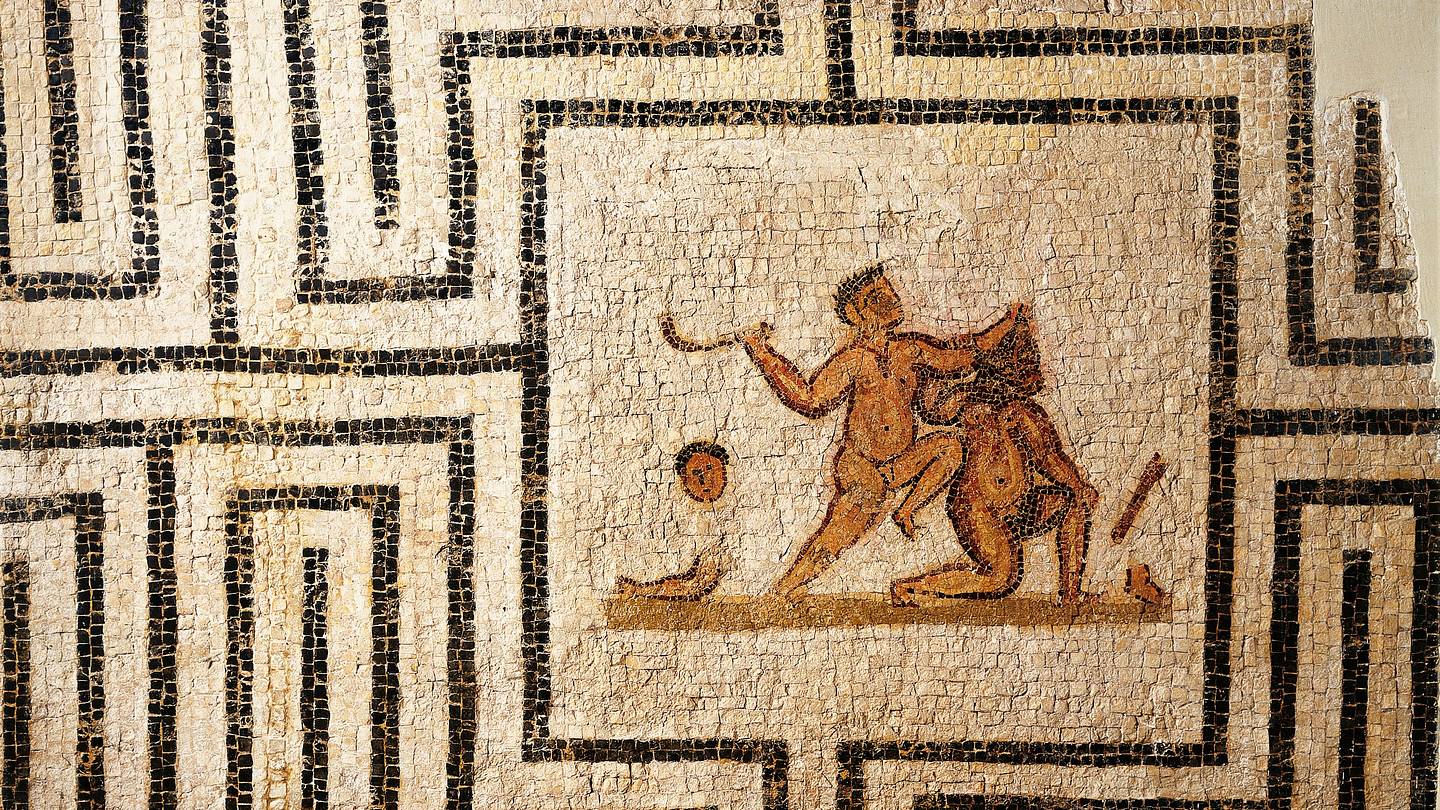
Within the crumbling ruins of the ancient palace of Knossos on the Greek island of Crete, a labyrinth is said to have once existed.No evidence of the labyrinth has been found, but the Greek myth that tells its story has immortalized it forever in the realm of the imagination. Like many foundational stories, this one has been told and retold in many forms, weaving itself into the cultural landscape and inspiring everyone from Sigmund Freud and Plato to Suzanne Collins, author of the Hunger Games series.The labyrinth mythMinoan palace of Knossos, Greece | NurPhoto/GettyImagesThe story is a grim one. In the most well-known version, King Minos of Crete refuses to sacrifice a white bull as promised to the god Poseidon, who then curses the king’s wife, Pasiphae, with desire for the bull. Out of this union comes a flesh-eating creature called the Minotaur, who has a man’s body and a bull’s head. He is then imprisoned beneath Knossos in a labyrinth built by the architect Daedalus, who is later trapped there with his own son, Icarus.Meanwhile, King Minos’s son had previously been murdered by King Aegeus of Athens, leading to a war that culminated in Athens’ defeat. Unsatisfied with victory, King Minos orders seven boys and seven girls from Athens to be sent into the labyrinth as tributes each year (or every nine years, depending on the story), where they are killed by the Minotaur.In one famous version of the story, the hero Theseus is sent into the maze, but manages to survive after King Minos’s daughter, Ariadne, gives him a thread to hold onto, which helps him find his way. He ultimately kills the Minotaur and emerges victorious. (But his story doesn’t end there; he later abandons Ariadne, who ultimately marries the god Dionysus.)How the story of the labyrinth and the hero Theseus inspired Suzanne CollinsTheseus depicted in the labyrinth, seeking the Minotaur | Sepia Times/GettyImagesIn a 2008 interview with SLJ, Collins explained how this myth helped her come up with The Hunger Games and its protagonist, Katniss Everdeen. “It’s very much based on the myth of Theseus and the Minotaur, which I read when I was eight years old,” she said when asked about her inspiration for the series. “I was a huge fan of Greek and Roman mythology. As punishment for displeasing Crete, Athens periodically had to send seven youths and seven maidens to Crete, where they were thrown into the labyrinth and devoured by the Minotaur, which is a monster that’s half man and half bull. Even when I was a little kid, the story took my breath away, because it was so cruel, and Crete was so ruthless.”The helplessness and tragedy inherent in the story resonated with Collins, who used Theseus—who volunteers to go instead of another tribute in some versions of the myth—as the basis for Katniss. “...The cycle doesn’t end until Theseus volunteers to go, and he kills the Minotaur,” Collins added. “In her own way, Katniss [the heroine of The Hunger Games] is a futuristic Theseus.”Not wanting to set her story in a labyrinth, she instead decided to write what she called an “updated version of the Roman gladiator games.” The idea fully took shape after a night of surfing between reality TV shows and real footage of the Iraq War. “One night, I was lying in bed, and I was channel surfing between reality TV programs and actual war coverage,” she continued. “On one channel, there’s a group of young people competing for I don’t even know; and on the next, there’s a group of young people fighting in an actual war. I was really tired, and the lines between these stories started to blur in a very unsettling way. That’s the moment when Katniss’s story came to me.”'The Hunger Games' brings the Greek labyrinth myth to life for a new eraLionsgate's "The Hunger Games: Sunrise On The Reaping" New York Premiere - Jennifer Lawrence, Josh Hutcherson | John Nacion/GettyImagesThe Hunger Games was published in 2008, and the initial trilogy consisted of three books. Collins has also published two follow-up novels, The Ballad of Songbirds and Snakes and Sunrise on the Reaping. A film adaptation of the latter is scheduled for release on November 20, 2026. Each book explores the brutality and consequences of the Hunger Games, a competition that forces twelve districts to send tributes into a televised competition, where they must fight to the death. While there is no Minotaur in Collins’s story, the Capitol city—with its monstrous greed and endless hunger for violent entertainment—can be seen as the closest parallel to Crete, and King Minos, whose grief morphs into a vicious decision to order the deaths of innocent children year after year, clearly has similarities to President Snow. The closest thing to the Minotaur, meanwhile, could be the actual violence that occurs within the arena, orchestrated by careless higher-ups who leave the tributes with no choice but to destroy each other.
The Greek Myth That Inspired the Hunger Games
Full Article
Original Source
Read the full article at Mentalfloss →KhanList aggregates and links to publicly available news content. We do not host full articles from third-party sources. Always verify important information with original sources.