
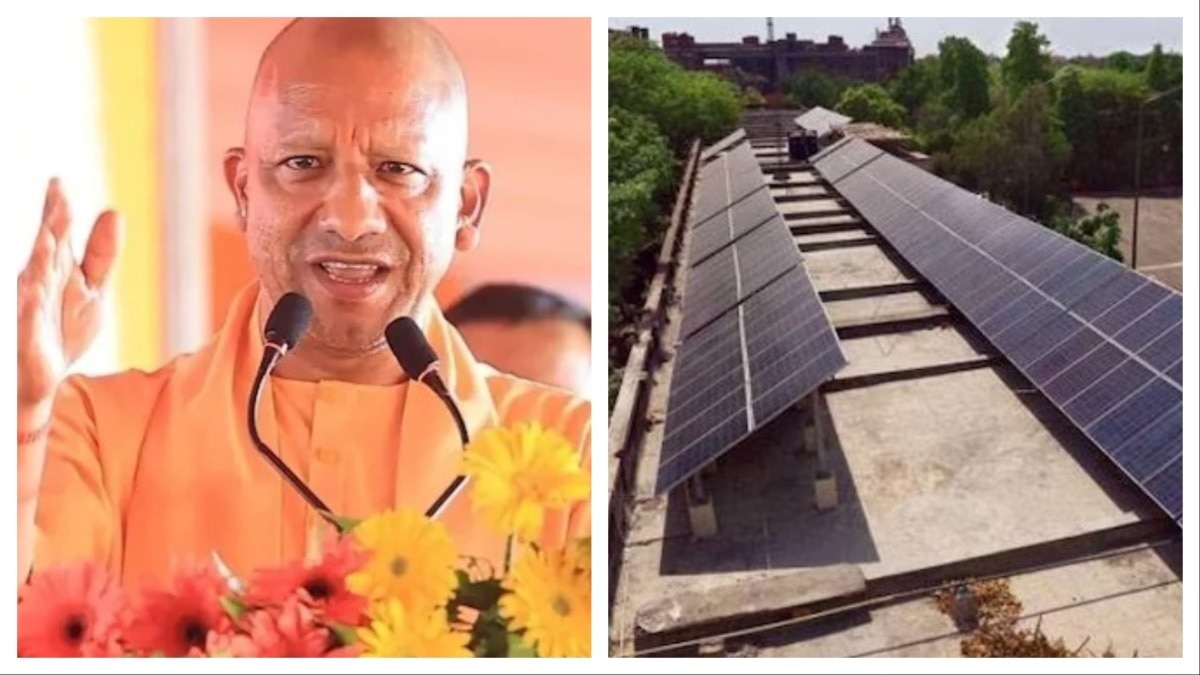
Around 2023, a friend of my brother—who runs a solar distribution company in Lucknow—pitched us the idea of installing rooftop solar panels. My father, a meticulous old-timer, did what any rational patriarch would do: he pulled out a calculator. The total cost was Rs 2.4 lakh. After factoring in the central and state subsidies (which brought the price down to roughly Rs 1.4 lakh), he calculated that saving even Rs 1,500 to Rs 2,000 a month on electricity would mean breaking even in three to four years."If we break even by three to four years, it’s a great idea. But we should not take 10 years, because then the idea gets defeated," he reasoned.Today, our electricity bills are a fraction of what they were, and we are on the cusp of that break-even point. My father was right. But what we experienced as a smart family investment is actually playing out on a monumental, transformative scale across Uttar Pradesh.Under Chief Minister Yogi Adityanath, Uttar Pradesh has quietly engineered a renewable energy revolution. By mid-2026, Lucknow has surged past Gujarat’s Surat to become India’s undisputed rooftop solar capital, crossing a staggering 1,02,000 installations. The state itself now accounts for over 20 percent of the nation’s monthly solar installations. The question is no longer whether UP is adopting solar, but how it managed to execute this miracle in a state historically bogged down by infrastructural and bureaucratic lethargy.The answer lies in a governance model that treated solar adoption not as a passive government scheme, but as an aggressive, performance-managed consumer campaign. The Yogi government adopted a strategy of "decentralised implementation, centralised monitoring." At the ground level, proactive administrators turned Lucknow into a laboratory for behavioural economics. They didn't just wait for people to read about solar in the newspapers; they met them where they were. When the state rolled out compulsory smart meters, officials immediately followed up with those same households to pitch solar panels.They mobilised over 700 Resident Welfare Associations, roped in school children to influence their parents and crucially, the Lucknow Municipal Corporation offered a 10 percent rebate on property tax for adopters.Furthermore, the state supercharged the vendor ecosystem. By organising seminars at institutions like IIT Kanpur and managing vendors through daily WhatsApp tracking, UP scaled its solar vendor network from a mere 600 to an aggressive 6,000. These vendors became the foot soldiers of the revolution, knocking on doors and closing deals.But administrative hustle only works if the underlying math makes sense—a reality my father understood intuitively. The financial architecture of the PM Surya Ghar Muft Bijli Yojana, supercharged by the state’s additional subsidy of up to Rs 30,000, turned solar into a no-brainer.For a 3 kW system, subsidies cover over Rs 1 lakh of the cost. Couple this with a concessional 6 percent bank loan and the payback period shrinks to exactly what my father predicted: three to four years. For a system that lasts 25 years, that translates into ‘muft bijli’ (free electricity) for two decades. Well if not ‘totally muft/free’, then definitely far less than someone who uses the same amount of electricity, but doesn’t have these solar panels.This compelling economics has completely democratised solar energy in Lucknow. It isn't just wealthy lawyers in Gomti Nagar running three ACs on near zero bills; it is the paan vendor on Hazrat Ganj or Aminabad who bought a portable Rs 3,000 panel because renting a battery for his stall cost him Rs. 30 a day. Solar is no longer an elite environmental statement but a pragmatic tool for livelihood and financial freedom.However, to claim the mission is accomplished would be premature. The Yogi administration must now address the blind spots. While residential rooftops are blazing, commercial adoption is lagging because UP utilises a net feed system for businesses rather than the lucrative net metering given to homes, destroying the financial incentive for shops and factories.There is also a stark geographical disparity. Lucknow has over a lakh installations, while districts like Shravasti have less than a thousand. The Lucknow model relies on urban density and vendor networks that simply do not exist in the state's poorer, rural pockets yet.Despite these challenges, Uttar Pradesh’s solar trajectory under Yogi Adityanath is undeniable. By seamlessly blending central subsidies with ruthless local execution, the state has rewritten the narrative of its own governance.It has proven that when policy aligns with the pragmatic math of the common man, even the scorching UP sun can be wired into the grid to power a silent, shining revolution.- EndsPublished On: Jul 17, 2026 16:57 IST
The great solar awakening: How Yogi Adityanath's UP wired the Sun into the grid
Full Article
Original Source
Read the full article at Indiatoday →KhanList aggregates and links to publicly available news content. We do not host full articles from third-party sources. Always verify important information with original sources.