
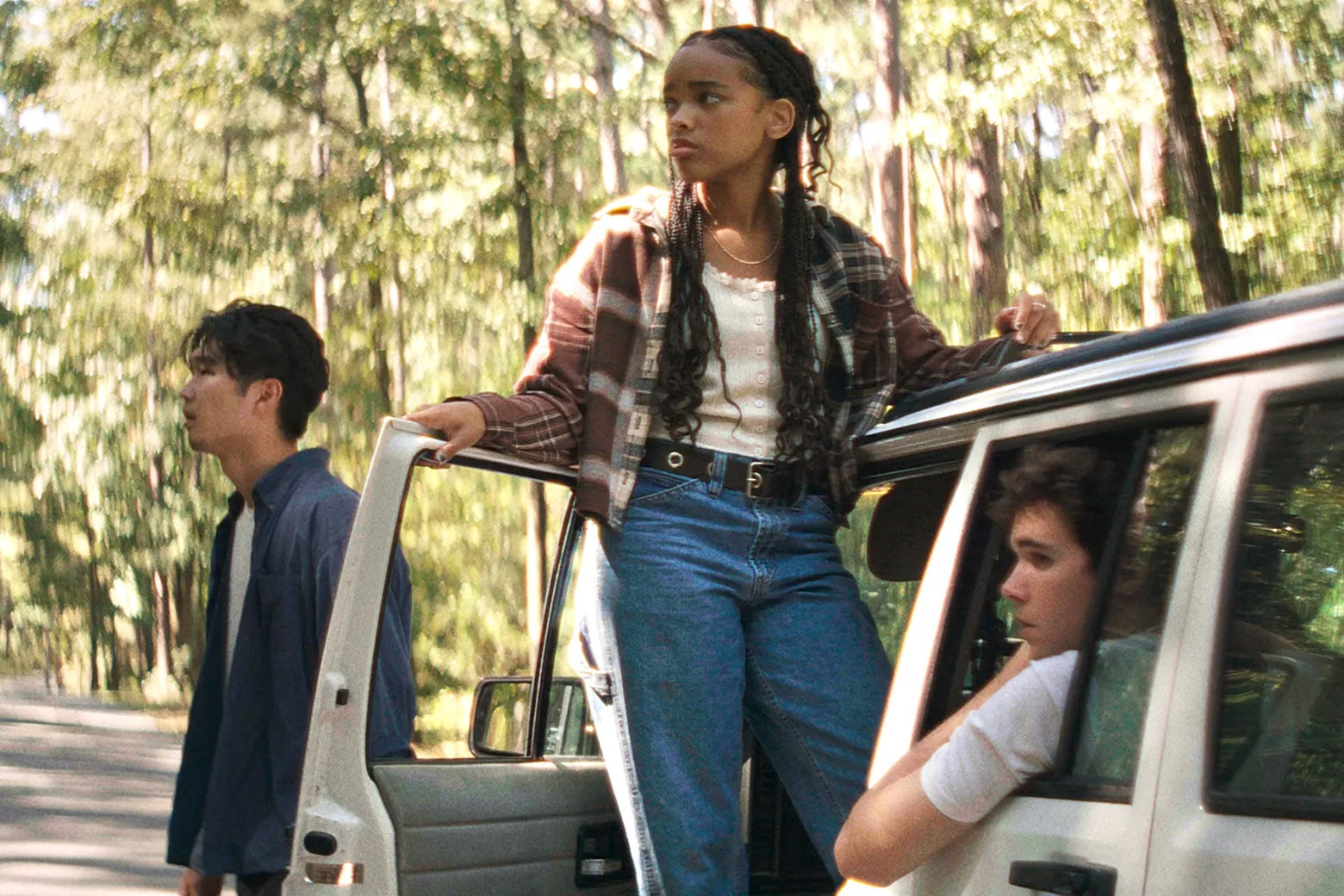
Movies It’s a Familiar Kind of Road Movie—and Then It Takes a Left Turn Neon’s latest should be the successor to Backrooms and Obsession. By Enter your email to receive alerts for this author. Sign in or create an account to better manage your email preferences. Unsubscribe from email alerts Are you sure you want to unsubscribe from email alerts for Sam Adams? Sept 03, 202611:48 AM Neon Sign up for the Slatest to get the most insightful analysis, criticism, and advice out there, delivered to your inbox daily. Sometimes, it takes an audience to tell you how you feel. The small handful of people I saw the nifty minimalist horror movie It Ends with wasn’t enough to feel the energy in the room. But as we were waiting to leave, someone cracked a joke about us getting stuck in the elevator, the way the movie’s characters get stuck on an endless road that they are powerless to escape. That’s when I realized I was too shaken up to laugh, and so was everyone else. The premise of Alexander Ullom’s debut is so simple it takes longer to explain than it does for the movie to establish it. Four old friends, three of them recent college graduates, take an unfamiliar turn while they’re out for a drive and find themselves on a road through the forest that seems to go on forever. There are no turnoffs, no exits, and going back the way they came brings them to a place where the road simply stops. At first, they’re panicked about starving or running out of gas, but as the hours and days accumulate, it becomes clear that neither they nor their car needs fuel. They don’t even need to sleep. So there’s nothing to keep them from hurtling onward indefinitely, just an asphalt ribbon that never goes anywhere, but never stops going. That might, I know, sound pretty boring, which probably accounts for why It Ends ended up in the Letterboxd Video Store nine months after its premiere at SXSW. But after a week or so on the platform, it became clear that this wasn’t just another festival-circuit castoff, a promising but minor first film with a no-name cast that might one day be a footnote on someone’s Wikipedia page. Despite the fact that the movie had already been released online—and knowing that meant it had probably already been bootlegged—Neon picked it up for theatrical distribution, and though it hasn’t done anything like the theatrical business of Curry Barker’s Obsession or Kane Parsons’ Backrooms, it’s got some of the same appeal. Like Barker’s movie, Ullom’s isn’t afraid to take its time, establishing genuine characters rather than rushing a bunch of efficiently designed types into a recognizable scenario; like Parsons’, it gets at something familiar but unnamable about the modern world, particularly for people too young to have known another one. Ullom, who is 28, finished his last semester of college just as the pandemic was ramping up, which meant the world he’d spent his life preparing his life to enter suddenly seemed to no longer exist. The quarantines had subsided by the time he started making It Ends, but the movie has the cloistered feel of a COVID-era production, with four characters trapped in a mobile bubble and the others who do eventually appear never coming closer than the dreaded six feet. The foursome—James (Phinehas Yoon), Day (Akira Jackson), Fisher (Noah Toth), and Tyler (Mitchell Cole)—make the most of their enforced and indefinite intimacy, coming up with games to play and even crafting memes about their bizarre experience, on the off chance they ever return to a world with internet to post them on. They could stop the car and look around, but there’s something lurking out there in the trees, something more awful than the prospect of the world’s least eventful road trip, and so they just keep going, and going, and going. The movie introduces a few complications along the way, but it sticks commendably, and wisely, close to its original idea. There’s no mysterious corporation or malevolent spirit behind the characters’ predicament; this is simply the situation they find themselves in, a reality to which they have no choice but to adapt. Their relationships with each other shift over time—and there is, eventually, quite a lot of it—as does their understanding of the situation they’re facing. (The movie in fact took more than two years to make, over multiple shoots, as Ullom secured funding from, among other sources, an online poker buddy and a magician.) But it’s a matter of reconciling themselves to the path rather than fooling themselves into thinking they can make a new one. This is all there is. Ullom doesn’t give his actors big monologues to pass the time, or write them sharp and witty observations. The characters are about as articulate as the average person in their early 20s, which is to say they have more self-knowledge than means to express it, and when they do come to a revelation, it’s framed in simple, matter-of-fact terms. He’s made a hangout movie, but it’s about the kind of hanging out where everyone’s a little bored and no one can decide what they want to do. People whose early 20s are already a fuzzy memory may pine for the particular sweetness of that unstructured time: Imagine actually having nothing to do! But for these kids—and they do feel like kids, despite the fact that they’re young adults—nothingness is already a way of life. There’s never been an end of the road, a place where you might one day get to stop and simply be. And now, perhaps, there never will be. It Ends creeps up on you, works its way into your bones. It feels for stretches like little is happening, and you’re lulled by its rhythms, the steady drone of tires on infinite asphalt. But then something small will develop, and it feels like the Earth has shifted on its axis. It might not be until it’s over that you realize how deeply it’s gotten to you. But if you’re driving home, I bet you steer clear of any wooded lanes. Movies Travel Horror Gen Z
The Great New Movie That Shook My Audience to Its Core
Full Article
Original Source
Read the full article at Slate →KhanList aggregates and links to publicly available news content. We do not host full articles from third-party sources. Always verify important information with original sources.