
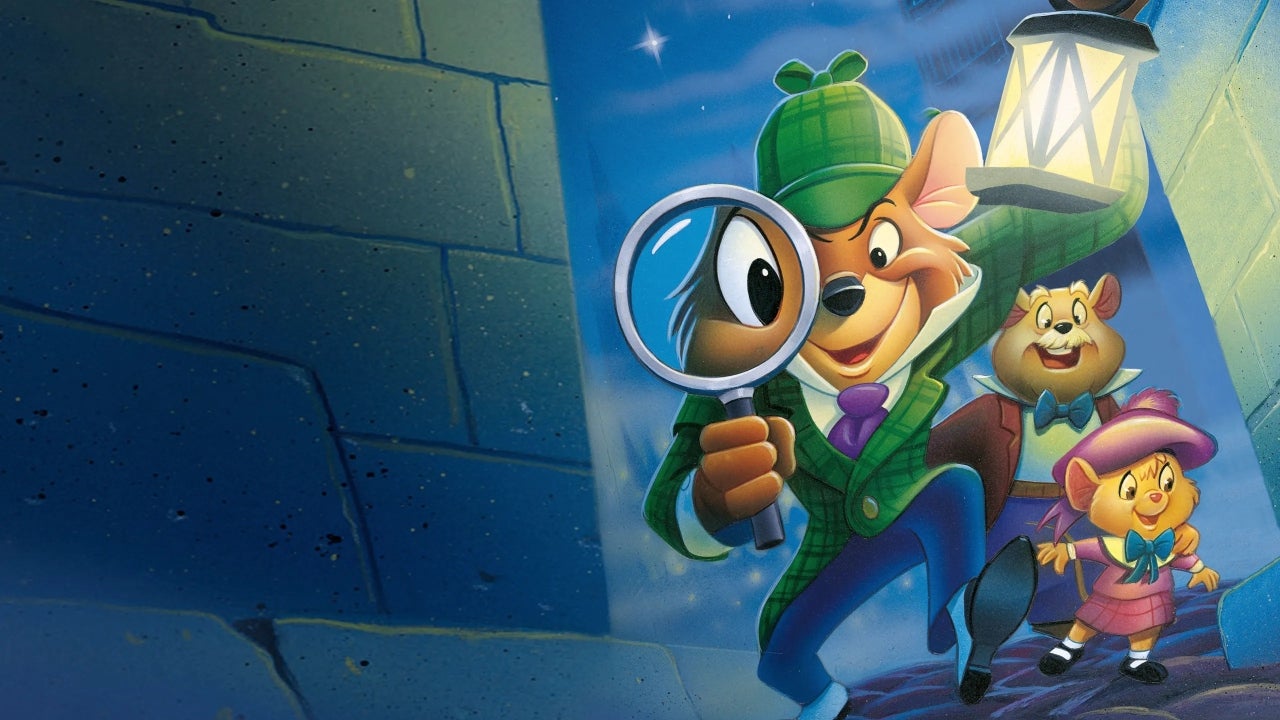
This year marks the 40th anniversary of Disney’s “The Great Mouse Detective,” which ushered in the next golden age of Disney Animation. To celebrate the anniversary — and detail the hardships that went into the movie’s production — directors Ron Clements and John Musker will be on hand at LightBox Expo on Friday from 4 to 5 p.m.If you’ve never been to LightBox Expo, held annually at the Pasadena Convention Center, it’s described as “the ultimate gathering of artists who work in the entertainment industry bringing your favorite films, animation, games, TV shows and illustrations to life.” It’s a wonderful place for students to mingle with industry professionals, browse booths hosted by some of their favorite artists and see panels devoted to their most anticipated new films. (Brad Bird will be there Saturday to talk about the lighting of his upcoming sci-fi noir “Ray Gunn.”) And one of the hottest panels this year will be the “Great Mouse Detective” hour. Clements and Musker are genuine animation legends; together, they went on to direct “The Little Mermaid,” “Aladdin,” “Hercules,” “Treasure Planet,” “The Princess and the Frog” and “Moana” for Disney. Clements recently released his outstanding new memoir, for which Musker provided the foreword and select illustrations. Today, they are regarded as one of the most influential directorial teams in modern animation. But that wasn’t always the case. At the time Clements and Musker were working on “The Great Mouse Detective” (or, as they still call it, “Basil of Baker Street”), Disney was in the middle of making “The Black Cauldron.” Meant as a return to the classical animation of the studio’s first golden age — it was even intended for “Sleeping Beauty”-style 70 mm exhibition — “Basil of Baker Street,” as it was then known, became, as Clements put it, “a life raft for people that were suffering on ‘The Black Cauldron.’” Musker was a director on “The Black Cauldron,” while Clements was on the story team. The new film was for, as Clements put it, “‘Cauldron’ exiles.” Clements was a big “Sherlock Holmes” fan. As a teenager, he’d even made an animated film starring the character. He envisioned “Basil of Baker Street,” which follows a mouse who lives in Sherlock’s flat, is also a keen detective and uncovers a vast conspiracy. He came across Eve Titus’ books while working on “The Rescuers” and thought they offered “a cool way to combine Disney and Sherlock Holmes, which somehow to me felt like they fit together.” At the time, of course, Disney was already making a mouse detective movie (“The Rescuers”), so Clements put a pin in the idea. “A few years later, they were looking for new ideas and I brought it up,” Clements said. In the middle of “The Black Cauldron,” Musker said, he was at odds with the other directors (“Who were middle management people who were directing in someways for the time”). The other directors suggested that he go off and make “Basil of Baker Street” instead, with Ron Miller, then the head of the studio and Walt Disney’s son-in-law, producing. They worked on the movie for two years with a very small crew, nearly in secret — until, of course, there was a major management shake-up at the studio. To make an incredibly long story short, Disney was regrouping after a greenmail attempt by corporate raiders who wanted to carve up the company and sell off its remaining assets. Frank Wells and Michael Eisner were brought in to run the company, Jeffrey Katzenberg oversaw the film division, and Roy Disney, who had previously left the company, returned to lead animation. Even though they had been working on the movie for two years, they had to re-pitch it to Eisner, Wells and Katzenberg. “It was a little scary, because it could all, in the wink of an eye, just, We don’t want to do it. Forget it, and it all go away. But fortunately, that did not happen,” said Musker. “Michael liked the movie but he wanted it done in half the amount of time and half the amount of money that we thought it would be,” said Clements. “But they did that.” Burny Mattinson, who was already one of the directors on the project (and who worked at Disney until his death in 2023), replaced Miller as the movie’s director. (Eisner and Katzenberg didn’t even know that Miller was a producer on the movie.) According to Clements, when Roy called Mattinson to tell him about his new role, he also said that “it was a good thing they greenlit it because if they hadn’t, they were planning to shut down the whole department.” Among those animators on the small “Basil of Baker Street” team were Glen Keane, who would go on to become one of the stars of the Disney Renaissance that immediately followed, animating Ariel in “The Little Mermaid,” Marahute (the giant golden eagle) in “The Rescuers Down Under,” the Beast in “Beauty and the Beast” and Aladdin in “Aladdin.” He also did Tarzan in “Tarzan,” working out of the studio’s Paris studio, and Long John Silver in “Treasure Planet.” For “The Great Mouse Detective,” Keane animated Professor Ratigan, the Moriarty-style villain voiced by Vincent Price. It was Keane who turned the character from a tall, lithe villain into a big, boisterous baddie. Ratigan’s final look, Clements said, was based in part on Miller, “a big mesomorph guy” who was a former football player. Musker said it was the beginning of their practice of basing villains on former bosses. At the time, Price was already in his 70s. Clements remembered him looking a little frail — until Price started to perform, of course. “Like a lot of actors, he transformed when he was at the microphone, and there wasn’t any trace of fright,” Clements said. The team worked out of a warehouse in Glendale, across from the Walt Disney Imagineering campus. The low-slung, ramshackle building, not much more than a trailer, would eventually house the Animation Research Library (ARL), the real-life Disney vault. “It was a warehouse and we were all shifted to half the building, which had been finished. The other half was still under construction. It was raining hard the day we moved in. Everybody felt melancholy. But the good thing about ‘Great Mouse’ was it was a very young crew and an enthusiastic crew,” said Clements. “I think it was fun for the animators to do a lighter, more cartoony movie. The atmosphere in that warehouse, in spite of the scariness of it, and knowing that animation was on very thin ground, the morale was good. It was a fun film and people seemed like they cared a lot.” Musker added: “I think it was a little bit of that sink-or-swim mentality. We were put in this warehouse and we had to show what we could do. There was a camaraderie that came out of that.” Instead of two years to complete the animation, the crew had “about a year.” In order to get the running time down to an acceptable length that Eisner would approve and that the crew could physically accomplish, a large chunk of the movie was jettisoned, which meant throwing out a song by Henry Mancini and the only set pieces that take place during the day. (The moody nighttime atmosphere of “The Great Mouse Detective” is one of the things that sets it apart from other, sunnier Disney fare.) They also deleted a sequence where Basil interrogates a stool pigeon and it’s a literal pigeon. Still, they got the running time down and the movie done. But right before they had finished the movie, there was an edict – the movie’s name would be changed from “Basil of Baker Street” to “The Great Mouse Detective.” Clements suspects that the name change happened because, around that time, “Young Sherlock Holmes,” which was produced by Steven Spielberg and directed by Barry Levinson, had opened and tanked. “Jeffrey went into a panic. It’s like, We can’t let anybody know this has anything to do with Sherlock Holmes, which was which I think was basically the idea of the movie,” Clements said. “They were selling the idea that this really doesn’t have anything to do with Sherlock Holmes.” “If you see the ads, you’ll see like he’s not wearing a deer stalker hat. He doesn’t have a magnifying glass. All the tropes of Holmes are not there deliberately, all the way to the title change,” said Musker. Clements and Musker were livid about the last-minute title change. Ed Gombert, a story manager on the movie, wrote a hilarious memo on official letterhead following the title change that all of the classic Disney animated movies would be getting incredibly literal new titles (see it below) – things like “Two Dogs Fall in Love,” “The Wooden Boy Who Became Real” and, hilariously, “Aristocats.” Disney Another Disney executive, Peter Schneider (“Jeffrey’s running dog and our immediate boss”), thought Musker had written the memo. “I thought, Oh, this is so funny. Michael and Jeffrey have to know about this. I xeroxed it and I put it in interoffice mail and I sent it off to each of them anonymously. I just sent it to them so that would see how people were ridiculing that name,” said Musker. When he found out how mad Schneider was (because it had his name on it), Musker had to secretly retrieve the memo from Katzenberg and Eisner’s desk. Later, Schneider called everybody into his office (“It was like ‘Stalag 17,’” said Musker) and demanded to know who wrote the memo and if somebody confessed, that person would be fired. Nobody talked and Katzenberg finally talked Schneider off the ledge. The L.A. Times would run a story about the memo and quote the faux titles that Gombert had come up with. Years later the memo would become a category on “Jeopardy.” Each of the fake names would be an answer. “We pictured smoke coming out of Peter Schneider’s ears – the more iterations, the more life this thing had beyond the original thing,” said Musker. When “The Great Mouse Detective” came out, it was a modest hit. Clements estimates that it cost about half as much as the bloated, agonizing production of “The Black Cauldron” and earned more at the box office. More importantly, it served as the unofficial start of what is now often referred to as the Disney Renaissance, a period of great creative and commercial success for Disney Animation whose effects are still being felt today. While Clements and Musker are too modest to take credit for kicking off the modern golden age of Disney Animation, Clements said, “I think it helped build a bridge during this very fragile period.” As for what you can expect from the LightBox Expo presentation, Musker said, “We’re going to cover in shorthand form the origin of the movie, the change in management, the reason for doing the movie, the tonal shift in the movie” – If you love “The Great Mouse Detective” or still call it “Basil of Baker Street” and want to make sure you hear these stories from two of the medium’s most celebrated and prolific creators, make sure you get to the Pasadena Convention Center on Friday afternoon. The game’s afoot!
‘The Great Mouse Detective’: Ron Clements and John Musker Talk Disney Classic Ahead of LightBox Expo
Full Article
Original Source
Read the full article at Thewrap →KhanList aggregates and links to publicly available news content. We do not host full articles from third-party sources. Always verify important information with original sources.