
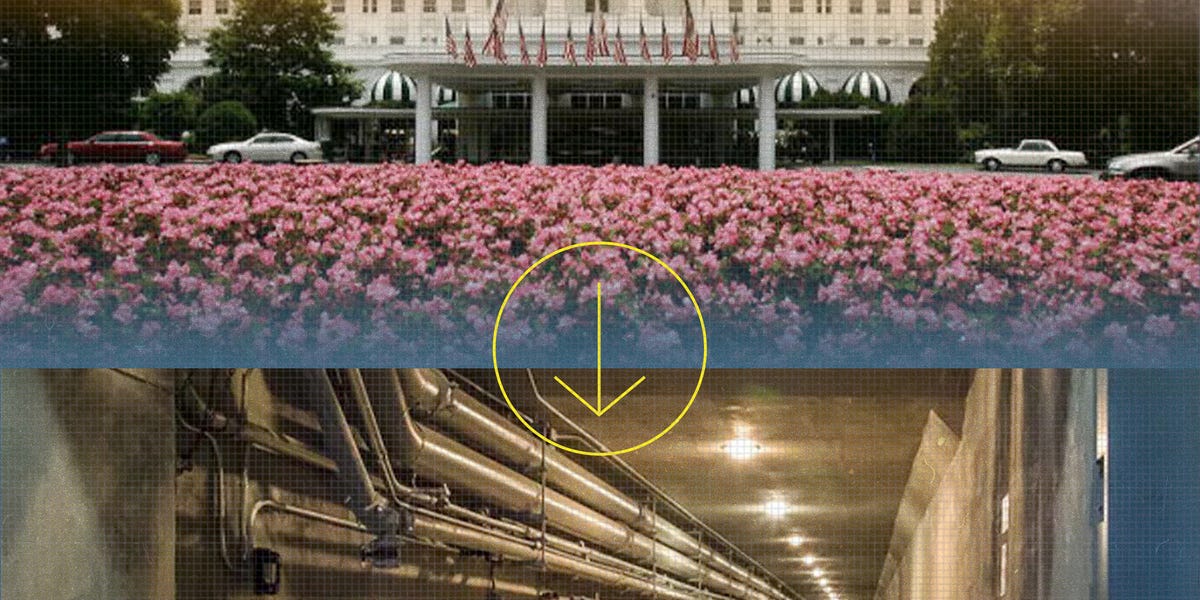
14 min readTHE EMPLOYEES OF the Greenbrier knew how to keep secrets. At the grand old luxury resort in White Sulphur Springs, West Virginia, discretion was part of the job. So a sudden meeting in the president’s office meant something must have changed. This time, silence wouldn’t be enough.On the morning of May 29, 1992, about 20 front-of-house staff members gathered to meet with Ted Kleisner. They had rarely sat in the same room until that morning. That was the point. Soon enough, they’d all be answering the same question.The resort’s resident historian, Dr. Robert Conte, had a hunch about what was coming. Conte knew the Greenbrier’s official history better than anyone: the presidents who’d stayed there, the foreign dignitaries who’d passed through, the celebrities who’d treasured its seclusion. His job was to tell that story to guests. But there was another Greenbrier story that wasn’t part of the tour.For decades, rumors had spread through White Sulphur Springs about something hidden beneath the Greenbrier. There were corridors that were off limits, construction projects that seemed too large for a hotel expansion, workers who entered parts of the resort where guests never went. But lately the whispers had gotten a little louder, and reporters had started showing up.Now Kleisner stood before his people and said the quiet part out loud.“Today we are going to acknowledge a secret 35-year partnership with the United States government,” he told the group. Later that day, The Washington Post would publish a story revealing what the Greenbrier had concealed for more than three decades: a 112,544-square-foot nuclear bunker built to house members of the U.S. Congress in the event of an attack on Washington, D.C.Then Kleisner picked up a videotape and slid it into a VCR.The man who appeared on the screen stood behind a podium, his face blurred even as his secret was now public. He still worked at the Greenbrier. His identity still had to be protected. “Since the early 1950s,” he said, “the CSX Corporation and its predecessor organizations have been engaged in an extraordinary partnership with the federal government to assist in the preservation of our constitutional framework. This association has been one of this nation’s most closely guarded secrets. Your possession of this videotape means that an event has occurred which has resulted in the public disclosure of this confidential relationship.”While the anonymous man’s words sounded bureaucratic, the reality being described was unthinkable: survival after annihilation. Under the Greenbrier’s beautiful ballrooms and cavernous conference halls, the United States had built a second seat of government—dormitories, blast doors, air filters, communications systems, and decontamination chambers—designed to keep Congress functioning at the end of America.The Post article was coming out. Guests would have questions, and the people in Kleisner’s office would have to answer them. After 35 years, the Greenbrier was about to lose the one thing that had made the bunker work: Nobody on the outside was supposed to know it existed.APThe Greenbrier has dominated the landscape of White Sulphur Springs, West Virginia, since the 18th century. During the Cold War, it quietly became something much more than a resort.THE TRUTH IS, the bunker had never really been invisible. Almost as soon as work started in 1958, rumors began spreading among construction workers, hotel employees, and residents of White Sulphur Springs. Some people knew because they’d been cleared. Others guessed, because the scale of the project was hard to miss. “It was like an open secret,” Conte says.Yet the Greenbrier community shared a culture of discretion so strong that it kept an enormous underground facility effectively concealed for decades. As Trish Parker, a lifelong resident of Greenbrier County, told Emily Matchar of Smithsonian Magazine in 2024, “People wondered about it to their husband, their wife, their brother—but they weren’t going to wonder about it to anyone else. They just didn’t talk about it to outsiders.”For those with top-secret clearances, the threat of prison kept the secret in place. Conte says the cleared employees were primarily engineers and maintenance workers, which was part of the logic of putting the bunker under an operating resort: “You could do the ongoing maintenance and hide it within the maintenance of the larger facility,” he says. They had signed nondisclosure agreements, and the penalties were explicit. “It said how long you would be in prison, and what the fine was,” Conte recalls. “They weren’t kidding.”Approximately 100 Greenbrier employees had top-secret security clearances. Most were plumbers, mechanics, electricians, or other engineering staff whose work brought them into contact with the bunker. About 20 were senior managers, including the resort’s president and chief financial officer. But even inside the Greenbrier, knowledge of the bunker was tightly compartmentalized. Kleisner, who arrived in 1980 as the resort’s director of operations, had not yet been read in.“Why did we order 10,000 gallons? This is a problem.” He started to suspect something strange when an invoice crossed his desk for 10,000 gallons of diesel fuel—far more than the resort’s vehicles could plausibly use. When Kleisner pressed the chief engineer to explain where that much fuel would go, the engineer could not give him a straight answer. The resort had no tank that could hold it. “Why did we order 10,000 gallons?” Kleisner recalls asking. “This is a problem.”Kleisner then brought his concerns to Greenbrier president Bill Pitt, but he received no explanation—only a request that he wait outside the hotel’s entrance the following morning. At 7 a.m., a black sedan pulled up. Two men got out; one showed Kleisner his credentials. “I remember grabbing onto them and trying to read them,” Kleisner says. “And he said, ‘Don’t worry about it. It’s not who I am. It’s not who I work for. Just get in the back.’”Now that Kleisner’s due diligence was raising inconvenient questions, he needed to be clued in. The men worked for Forsythe Associates, which provided television signals and repair services for the Greenbrier. That was the cover. To keep the bunker ready indefinitely, the government needed a permanent human presence as invisible as the facility itself.To guests and locals, the Forsythe men looked like ordinary TV technicians pushing carts of equipment through the hotel. In reality, they were mostly former military communications specialists and intelligence officers dressed as tradesmen. They did service the resort’s TVs, but they also tested the bunker’s air filtration systems, rotated food stocks, and kept the communications arrays ready to reach the outside world if nuclear war erupted. That morning, the Forsythe men took Kleisner to a sensitive compartmented information facility, or SCIF, and formally read him into the top-secret project.Kleisner would keep that secret for 12 years. If the bunker ever became public, its usefulness would end. Which raises the question: Why would the U.S. government put Congress’s nuclear shelter beneath a famous luxury resort full of guests?Courtesy The GreenbrierThe West Virginia Wing of the Greenbrier Hotel.THE GREENBRIER’S RELATIONSHIP with power long predated the bunker’s existence. After decades of financial instability in the late 19th century, the resort was purchased in 1910 by the Chesapeake and Ohio Railway, which owned the rail network connecting White Sulphur Springs to Washington, D.C. Under C&O’s management, the resort quickly recovered its profitability and high-society cachet. Presidents, industrialists, and political families came for golf and privacy.The Greenbrier was selected as the site for the congressional bunker in the mid-1950s, under President Dwight D. Eisenhower. In 1955, the President’s Office of Defense Mobilization developed a “federal relocation arc” of sites where different branches of the federal government could shelter in the event of a nuclear war.The relocation arc was built around the idea that emergency sites had to be far enough from Washington to avoid radioactive fallout after a nuclear attack, but close enough for members of Congress to reach quickly during an evacuation. The Greenbrier fit. Compared to other nearby sites in the Allegheny Mountains, its terrain and geology were better suited to bunker construction. The mountains around the resort also offered a measure of protection from fallout and, given the limits of missile guidance at the time, made a direct bomb strike more difficult.The Greenbrier had another advantage: transportation. It sat on a Chesapeake & Ohio rail line that connected to Washington, which was important because Congress members at the time still had to travel in specially designed railway cars during an evacuation. And because the Greenbrier was private property rather than a military base, it met Senate Majority Leader Lyndon B. Johnson’s requirement that Congress’s emergency refuge remain physically independent of the executive branch even in the event of an all-out thermonuclear war.The Greenbrier also had a history of government service. After the U.S. entered World War II, the federal government used the resort to temporarily hold Axis diplomats awaiting postwar repatriation; this meant the staff had to pass FBI background checks while serving guests who, in some cases, were suspected of spying. In 1942, the government converted the hotel into Ashford General Hospital, where thousands of American soldiers were treated. Eisenhower spent time there during the Ashford years and returned after the war. By the 1950s, the Greenbrier had proven that it could handle federal business quietly.“Don’t worry about it. It’s not who I am. It’s not who I work for. Just get in the back.”CONSTRUCTION OF THE nuclear shelter at the Greenbrier was authorized through a secret arrangement between the Architect of the Capitol, J. George Stewart, and C&O Railway president Walter J. Tuohy, signed on March 28, 1956, by Eisenhower and congressional leaders. After further negotiations, C&O and the government signed a contract in 1958 laying out the financial and logistical terms. The project, initially code-named Project X, would appear publicly as a hotel expansion: the Greenbrier’s new West Virginia Wing. Underneath it, workers would build the bunker.One 17,000-square-foot section of the new wing would serve a dual role: In peacetime, it was an exhibit hall for business conferences. In nuclear war, it would become a deliberative chamber for Congress.The cover story was useful, but the construction itself was hard to disguise. After all, as Conte points out, in 1959 The Charleston Gazette ran an article titled “Greenbrier Rumor Denied: No Presidential Hideout Planned.” Workers noticed the excavation, the quantity of concrete, the unusual elevators, and the suspicious number of urinals—more than 100—being installed beneath the resort. The bunker was wrapped in steel-reinforced concrete walls up to five feet thick, then shielded by earth and rock. It was hard to hide the amount of raw material entering and leaving the site. The Greenbrier’s president found it necessary to write a special announcement explaining that all the drilling was just “test borings” to determine whether “subterranean conditions” were right for the West Virginia Wing.The bunker’s largest blast door, built by the Mosler Safe Company of Hamilton, Ohio, stood 15 feet tall and weighed 28 tons. To disguise its purpose, it was marked “High Voltage.” Another blast door sat inside the hotel itself, hidden behind a movable screen covered in the Greenbrier’s iconic Dorothy Draper wallpaper. It weighed 18 tons yet was balanced so precisely that one person could swing it shut, sealing the legislative branch away from the world above.Even the waste material from construction had to be hidden in plain sight. Soil excavated from beneath the West Virginia Wing helped expand the Greenbrier’s airport runway to 7,000 feet—large enough for commercial jetliners. The rest was used to expand one of the resort’s golf courses, turning part of the landscape above the bunker into its own cover story.Courtesy The GreenbrierThe Greenbrier’s largest blast door weighed 28 tons yet was carefully disguised as ordinary infrastructure. Like much of the facility it protected, its most important job was avoiding attention.THE GREENBRIER WASN’T an isolated oddity. It was part of a Cold War realization: Nuclear war was a governance problem just as much as a military problem. Hydrogen bombs had made atomic destruction vastly larger, and Soviet advances in missile and satellite technology suggested that warning time could collapse. The question was no longer only whether the United States could retaliate. It was whether any recognizable constitutional government could continue afterward.As “shelter mania,” in the words of historian Fred Kaplan, took hold across the country, the Eisenhower administration expanded continuity-of-government planning, which included relocation sites, emergency communications, and a series of top-secret Presidential Emergency Action Documents (PEADs), whose contents remain largely classified to this day.Some of Eisenhower’s PEADs were a paradox. They included wide-ranging suspension of the ordinary rule of law, yet they also required the survival of the basic institutions that gave the American government its constitutional form. The nuclear bunker at the Greenbrier was the legislative branch’s piece of that problem.GETTING CONGRESS FROM the Capitol to its subterranean bomb shelter would never be simple. The plan’s details depended on whether Congress was in session when the bombs started falling. If legislators were scattered around the country, letters with evacuation instructions were waiting in FBI field offices to be delivered to each of their homes before they were whisked away to nearby airports and flown to the Greenbrier’s airport.If Congress was in session when nuclear war broke out, members would be moved from Washington by specially designed railcars or high-speed motorcade, arriving at the Greenbrier about six hours later. At the bunker, lawmakers would be driven through a blast door into the decontamination area. In a series of tiled chambers, the nation’s leadership would strip, drop potentially radiation-tainted clothing into lead-lined disposal bins, and undergo scrubbing in high-pressure showers. Their clothing would be incinerated and replaced by military fatigues.Inside, the bunker was designed as a self-contained underground government. It had 18 dormitories, industrial kitchens stocked with months of food, a power plant, three 25,000-gallon water tanks, a communications center, and a television studio from which congressional leaders could broadcast messages to survivors on the surface. Hidden antennas and mountaintop towers connected it to the outside world.The ventilation system mattered as much as the blast doors. It connected to chemical, biological, and radiological filtration equipment and drew fresh air through underground shafts from an intake hidden in a plain wooden shack near the resort’s tennis courts. Everything was designed around the same grim assumption: For 90 days after the surface became dangerous, the machinery of government would keep working underground.“It had to have been from someone cleared at the top-secret level.”FOR YEARS, THE plan had a flaw large enough to break it. The original 1958 blueprints provided space for the 535 members of Congress and a crew of support staff—but not for spouses and children. In theory, lawmakers would abandon their families and enter the bunker. In practice, many might have refused. As former House Speaker Tip O’Neill told The Washington Post’s Ted Gup in 1992, fleeing to safety while leaving his family behind was absurd. A continuity plan that required abandoning their families was politically and psychologically unrealistic.So in 1973, the government undertook a major expansion of the Greenbrier’s bunker. The project created Colonial Hall and the Eisenhower Parlors, large multifunctional spaces that—much like the original West Virginia Wing—served a public purpose for the resort while masking a subterranean extension. Beneath them, engineers carved out additional dormitories for legislators’ families. The bunker was reengineered to accommodate approximately two family members per legislator, effectively doubling its occupancy. At least in theory, continuity of government was no longer at risk of being sabotaged by lawmakers too scrupulous to abandon their families in a crisis.THE GREENBRIER BUNKER remained operational until May 31, 1992, when Ted Gup’s article in The Washington Post Magazine described the officially nonexistent facility in enough detail to make the continued denial impossible. Writing while the bunker was still classified, Gup produced a portrait so complete that the article read almost like a tour from the inside. He reported the bunker’s exact square footage, vividly described its blast doors and blueprints, and walked readers through all of its main rooms. He also identified Forsythe Associates as the bunker’s cover operation and named Paul “Fritz” Bugas, the facility’s superintendent, as well as Bugas’s predecessor, John Londis.Gup wrote that his reporting was based on interviews with dozens of current and former hotel employees, contractors, and security officers. Many locals told Gup that they’d long known about the bunker. One former mayor of White Sulphur Springs even noted that it was “common knowledge here.” More importantly, several Greenbrier security staff members told Gup they’d been inside.But the article’s accuracy seemed to go beyond local rumor or even staff memory. Gup also cited unnamed former government officials who personally visited the bunker and had direct knowledge of its operations during the Cuban Missile Crisis. This wasn’t a story built only from local whispers; someone with access had blown its cover.Exactly who those inside sources were may never be known. But the historical context suggests one possible motive. By 1992, the Cold War was ending, and the “peace dividend”—the money expected to be freed up by military drawdown—had become a political issue. Many bases were closing as the government looked for ways to cut defense spending. A secret facility like the Greenbrier, however, was harder to close through ordinary budget channels.Getty ImagesThe bunker’s communications center was the nerve center of a subterranean Congress. From here, lawmakers could receive intelligence, coordinate with federal agencies, and address a nation recovering from catastrophe.Conte offers one theory, which he says came from a onetime Washington Post colleague of Gup’s: People who wanted the bunker shut down couldn’t easily do it through normal channels because the information was too compartmentalized. “The best way to do it,” Conte says, “is to leak it through the press.”Kleisner reached a similar conclusion. When Gup came to the Greenbrier while reporting the article, “he knew the code name,” says Kleisner. “You’d have to be at the top-secret level, cleared to know all that. So it had to have been from someone cleared at the top-secret level.” Within days of Gup’s article dropping, Defense Department teams arrived at the Greenbrier and began taking apart, destroying, or removing sensitive equipment and data that superintendent Bugas’s team hadn’t trashed. While the response began quickly, the dismantling took three years.On July 31, 1995, an official decommissioning ceremony marked the formal end of the bunker’s three-decade mission—a mission it was never asked to carry out. That same year, the resort pivoted from secrecy to spectacle and opened the bunker for guided public tours.For the people who had maintained the secret, the transition was personal. One of the best known was Fritz Bugas, a former Army intelligence officer, who died in July 2025 at age 96. His official title was Eastern Regional Manager of Forsythe Associates, though, as the inside joke went, there was no Western Regional Manager. In practice, Bugas helped run the bunker’s day-to-day operations. After Gup’s article, he had to move from a classified role into a public one.Eventually Bugas became one of the Greenbrier bunker’s most knowledgeable tour guides. For guests, he was a living bridge between the resort’s luxurious public history and the Cold War engineering buried beneath its floors. He once helped keep the bunker invisible, and now he explained it to anyone with a ticket.For those who managed a nuclear shelter, the transition to explaining it to the public was slower.“Trying to stuff the manure back in the horse is hard,” Kleisner says. “Declassification is not a moment in time.” ONCE THE BUNKER was decommissioned, one of the first people Kleisner gave a tour to was the novelist Tom Clancy. Kleisner told him the bunker had always relied on secrecy and that Greenbrier officials assumed the Soviets never knew about it. Clancy dismissed the idea outright. “Washington is a sieve,” Kleisner remembers him saying. “Nothing is a secret. The Russians aren’t dummies—they probably didn’t want the facility to be a target because it wasn’t protecting specific individuals, but the tripartite system of government. And if we don’t have the legislative branch with the ability to convene, even under the worst of circumstances, our constitutional republic can fall apart.”If Washington was destroyed, Clancy speculated, the Soviets might rather confront a government they knew than whatever could replace it, like a military dictatorship.Kleisner never learned whether the Soviets knew about the bunker. But Clancy’s theory found subtle support in a memorable exchange with Mikhail Gorbachev, who visited the Greenbrier after the bunker’s deactivation. Kleisner asked the former Soviet premier directly whether Moscow had known about the facility. Gorbachev did not answer. Instead, he walked to the window, looked out at the Greenbrier’s sweeping lawns and mountains, and said, “You know, this area reminds me of where I grew up, the beauty of the mountains. Now, why would anyone want to destroy something this beautiful?”Kleisner knew some people would take it as an evasive answer. He heard Gorbachev speaking from the heart.If Clancy was right, then the bunker’s true protection was never reinforced concrete walls, blast doors, or the secrecy maintained for three decades by a devoted staff and covert federal personnel. It was usefulness. A functioning constitutional government was worth more to Moscow intact than destroyed. And, if Gorbachev was to be believed, the Greenbrier had one more defense: It was simply too beautiful to blow up.Shawn Gorman is Deputy Editor of News for Popular Mechanics. Before joining Pop Mech, he specialized in academic reading for educational testing. His diverse academic background also includes time spent as a lecturer and librarian at institutions such as the University of Kentucky, SUNY, and Harvard University. Shawn holds a Ph.D. in Modern Foreign Languages and Literatures from Boston University, an M.A. from The Ohio State University, and a B.A. in History from the University of Oregon. His favorite subjects to explore include computer science, physics, math, and biology. He lives on a medium-sized cat ranch in Easton, Pennsylvania, with his wife and two daughters.
The Government Built a Doomsday Bunker Beneath a Luxury Hotel. For 35 Years, Almost No One Knew It Was There.
Full Article
Original Source
Read the full article at Popularmechanics →KhanList aggregates and links to publicly available news content. We do not host full articles from third-party sources. Always verify important information with original sources.