
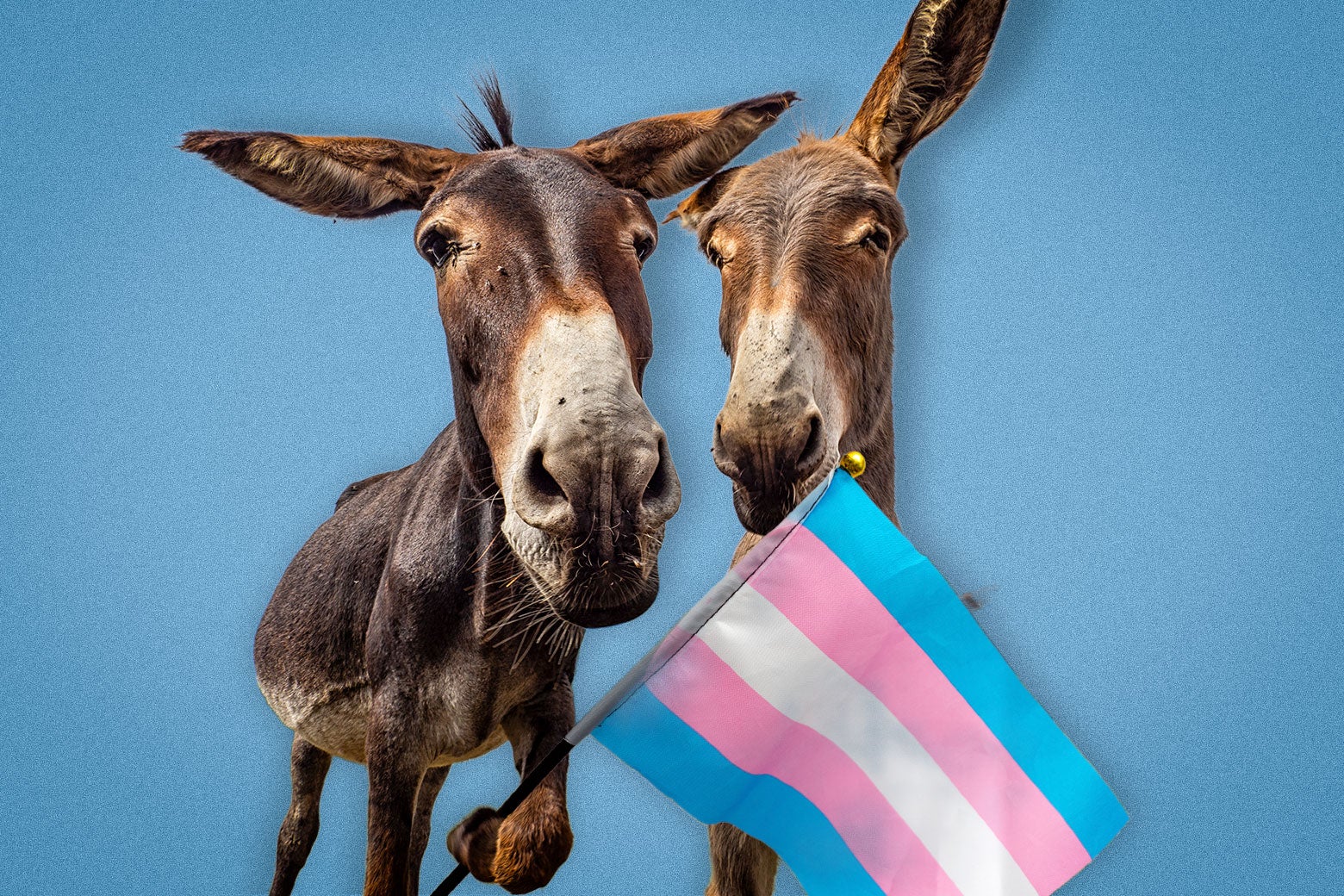
Outward The Elephant in the Room Trans people are not an “issue” to be debated. It’s time Dems acknowledge what is. Photo illustration by Slate. Photos by Getty Images Plus. Sign up for the Slatest to get the most insightful analysis, criticism, and advice out there, delivered to your inbox daily. In the first general-election ad of his failed campaign against state Rep. James Talarico, Texas Attorney General Ken Paxton opened with a tight shot on a burly construction worker. “This is Texas,” intones the narrator. “This,” he says over a clip of Talarico defending trans student athletes, “is not.” “This is Texas”: A plate of hot brisket, sensually sliced. “This is not”: Talarico announcing a “non-meat campaign” to fight climate change. For anyone still unclear as to the implication, it ends on Talarico’s face and these onscreen words: “Radical Talarico: Too Low-T for Texas.” The attacks didn’t stop there. “I’ve got to say, if you were making a list of 1,000 adjectives to describe this guy, masculine would not be one of them,” Texas Sen. Ted Cruz told Fox News. White House deputy chief of staff Stephen Miller called Talarico Democrats’ “first transgender senate candidate.” Last Tuesday, Texans elected him to the Senate anyway. Talarico is not a transgender man, but the GOP’s obsessive focus on his gender identity, body, and sexuality is familiar to anyone who’s ever been accused of not being a “real” man. It’s also inextricably entwined with the party’s attacks on transgender Americans, including trans men. Men like me. This midterm cycle, the GOP gender police ran more than $180 million in anti-trans attack ads, often mocking the masculinity of cisgender Democrats like Talarico over their past support of trans constituents, hoping to reanimate a beleaguered electorate over so-called culture-war issues. But in poll after poll, Americans, fed up with the economy, gas prices, an unpopular war, and blatant corruption, ranked those issues at the bottom of their concerns. In candidate races, the GOP’s gender strategy largely failed and occasionally even backfired. (Some conservative parents in Texas complained that anti-Talarico ads were exposing their kids to trans existence.) Unfortunately, the party’s gender ideology still won on the ballot, with anti-trans measures passing in Arizona, Washington, Nebraska, and Colorado. Clearly, this is a hinge moment for gender liberation in this country. After two years of nonstop rhetorical scapegoating and legislative attacks, the blue tsunami has created an opportunity for Democrats to change the national conversation. Democrats, like Talarico, who won in part by defending an expansive idea of masculinity are now faced with a choice. They can benefit from trans people’s struggle to challenge the gender status quo while leaving us to fight our own battles, or they can recognize the GOP gender war for what it is: an attack on every American—trans or not. Michigan’s Abdul El-Sayed recognized this. Like Talarico, he was hammered with attacks targeting both his masculinity and his past support for trans rights. But his vision of what makes a man—and a patriot—includes fighting for trans people. He told the Washington Sun that “small men” make masculinity about “punching down,” and that he saw manhood as “lifting [up] people around you.” To that end, when pushed, in a hostile 60 Minutes interview with Ross Douthat in the final days of his campaign, to answer for his support of trans people, he recontextualized the “debate” about trans people as a conversation about defending the Constitution. “Rights are rights are rights are rights,” he told Douthat. “I don’t need people to understand why I pray the way I pray,” he said, aligning himself with his trans countryfolk. “The minute you assent to government taking anybody’s rights … you are assenting to government taking everybody’s rights.” And in Montana, macho smokejumper Sam Forstag answered attacks on his support for trans girls in sports and masculine authenticity (“Phony Forstag”) by doubling down on regional values: Government, he told voters, has “no business” getting involved in their personal lives. As El-Sayed and Forstag demonstrate, defending trans people begins with simply refusing the othering and debasing language of their opponents, and seeing us as human beings. Americans, just like everyone else. But will Democrats really fight for us this time? On election night, I was reminded of another historic win for the party—and one that left LGBTQ+ people behind. In 2008, three years before I began my medical transition, I watched the election returns from a bar near where I lived in Oakland. Barack Obama’s victory made for an electrifying night, but one marred for so many of us in California by the passing of Proposition 8 after a bitter campaign. It was a dislocating, lonely feeling: As the nation rightly celebrated the election of our first Black president—a president who would take nearly four more years to fully and publicly embrace marriage equality, the most mainstream of all LGBTQ+ civil rights initiatives—it was clear that my neighbors did not see my relationship, or those of others in my community, as worthy of their respect or protection. We were an “issue.” To them, I imagined, we weren’t really people at all. The path to gay marriage was a long and difficult one, and too often Democrats accommodated opponents along the way. Today it’s trans people who are the “issue” on the ballot, and politicians, pollsters, and even the media continue to cede the framing of trans lives to the very same religious and political forces who once targeted marriage equality (and the same forces currently working to regulate women’s bodies with abortion bans). This is true even for Democrats like Talarico. Back in June, he told MS NOW that he “welcomes this debate about what it means to be a man,” adding that he didn’t think either Paxton or Cruz was “in a position to tell anybody what a real man is.” His own definition was pointed, and far broader than his opponent’s: “Real men serve others. Weak men serve themselves.” But on the trail, Talarico’s defense of his own gender didn’t always extend back to us. Over the course of his campaign, he walked back opposition to trans youth sports bans, saying that he’d oppose trans girls’ participation if it “risks safety or fairness,” and stated that he’d “absolutely” vote for a national ban on surgery for trans minors (an exceedingly rare intervention). His lurch right was disappointing, even as he made clear that he wasn’t abandoning trans people entirely, telling Rachel Maddow he wouldn’t win “by selling people out.” Concerningly, other winning Democrats disavowed trans constituents altogether, co-signing the dehumanizing language of those determined to recast trans Americans as bogeymen embodying an “ideology.” After being painted as a supporter of trans rights by his opponent, Iowa moderate Josh Turek ran an October ad opposing trans women competing in women’s sports. In South Carolina, Annie Andrews, a pediatrician, reacted to Donald Trump calling her an anti-trans slur by appearing in an ad in a lab coat saying she doesn’t support “biological men playing women’s sports” or “gender surgery for minors.” Like Talarico, she had her gender targeted using the language and tactics deployed against trans people, and she responded on the same terms, conceding their premise. Andrews even invoked her medical background while using the GOP’s pseudoscientific language (biological men is not a clinical term; it’s a political one). Democrats like these, who win by “selling out” constituents, should raise alarms for everyone. Some centrists argue that moderation is what won in those deep-red states—that Democrats had to hedge on the “culture war” in South Carolina and Texas to have a chance of breaking the GOP stranglehold. But the very idea that trans people are an “issue” to be horse-traded is a moral and imaginative failing and, it seems, not even a necessary one. In Indiana, J.D. Ford, a champion of trans youth, defeated Republican Rep. Victoria Spartz in a district Trump won by nearly 17 points, even after she ran attack ads featuring him in a “Protect Trans Kids” shirt. In Texas, state Rep. Vikki Goodwin—who’d voted against every anti-trans bill that reached the House floor during her tenure—shared a ballot with Talarico. She was elected the state’s lieutenant governor. Democrats can do better, and now they have the power to. Incoming lawmakers must start with damage control. The Trump administration has stopped letting trans Americans update sex markers on their passports, targeted hospitals that serve trans youth, banned trans troops, and essentially defined trans people out of existence. (Trump decreed on his first day in office that the nation’s official policy is to “recognize two sexes, male and female,” and that they are “not changeable.”) As independent trans journalist Erin Reed has noted, Dems can use the power of the purse to hinder investigations into hospitals and schools and prevent new federal anti-trans policies from becoming law. But they can go further too. The ACLU’s Chase Strangio, the first openly trans lawyer to argue before the Supreme Court, told me that he hopes advocates defend civil rights by not only restoring “eroded legal protections at the state and federal levels” but imagining more-expansive protections against material harm. For trans people, he said, “a cross-movement commitment to restoring voting rights, healthcare, and basic human dignity is essential.” In states where they’ve gained power, Democrats can pass protections to enshrine our basic human rights—the same protections afforded to everyone else. This time, a growing contingent of trans officials will have a seat at the table. Last Tuesday, Allison Montgomery became Alabama’s first trans legislator, flipping a district Trump won three times even after the state Republican Party made her gender a campaign issue. She promised to work “especially hard for those who hate me”—a clarity on democracy we should expect from all our leaders. Trans people across the nation were elected by their neighbors: Bentley Hudgins in Georgia, Jaelynn Scott in Washington state, Joanna Whaley in Michigan, and Dina Nina Martinez-Rutherford in Wisconsin. (Trans lawmakers Leigh Finke in Minnesota, Zooey Zephyr of Montana, and Sarah McBride and DeShanna Neal of Delaware were all reelected.) Most ran on the same “issues” as other winning Dems: the affordability crisis, stagnant wages, and broken healthcare. Their electorates chose them as the best people for the job—not as an ideology or a litmus test. Thanks to those voters, this new class of Democrats doesn’t need to imagine our humanity—we’re here, serving alongside them. So what do Democrats owe trans Americans? Exactly the same things they owe the American people overall: dignity, basic human rights, and a vision for the future that includes everybody. Whether Talarico and others keep their promise not to “sell us out” depends on whether they follow El-Sayed’s lead or continue to let this administration define how we talk about gender in this country. The stakes extend far beyond us. Invasive laws aimed at trans children could also subject cis girls to genital examinations, and the GOP has worked aggressively to limit cis women’s access to abortion, birth control, and the clinics that provide them. Missouri Republicans even made the connection explicit this cycle, bundling an abortion ban with a ban on gender-affirming care for minors on a single ballot initiative—the only statewide anti-trans measure voters rejected this cycle. The GOP’s urge to legislate, regulate, and moralize about our most personal freedom—our bodily autonomy—is an assault on liberty itself. The war on gender is fundamentally un-American. Gender variance is core to the national project and shows up in every corner of our history, dating back to the nation’s founding. That includes Texas, the 1917 birthplace of Reed Erickson, an heir to a lead-smelting fortune and a trans man who used his wealth to help fund the field of gender-affirming care in this country—the same care that Paxton worked aggressively to criminalize in the state. The man who funded pioneering midcentury trans medicine is, it turns out, as Texan as hot brisket, as a burly construction worker, as the seminarian Texans just sent to the U.S. Senate. This is America—our America—too. Democrats just won the power to protect it. Come January, they must fight for us all. Democrats Gender Politics Republicans Texas Transgender LGBTQ+ 2026 Midterms
The GOP’s War on Gender Is an Attack on All of Us. Now Democrats Can Finally Fight Back.
Full Article
Original Source
Read the full article at Slate →KhanList aggregates and links to publicly available news content. We do not host full articles from third-party sources. Always verify important information with original sources.