
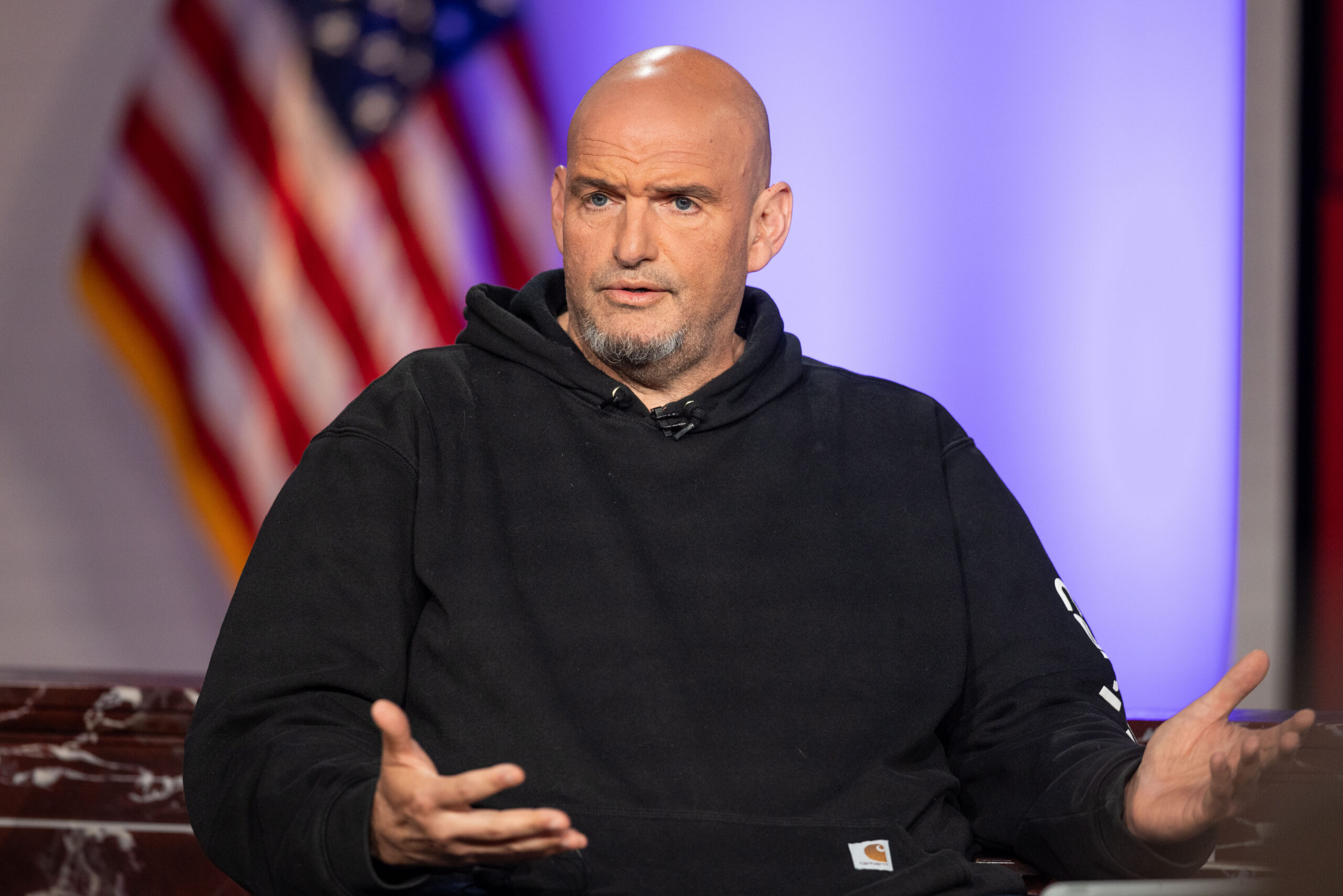
Politics In the Senate, Democrats could win a majority and still end up losing. Photo by Scott Eisen/Getty Images With just over two months until the midterms, there is good reason to believe polling that suggests Democrats will win control of the House of Representatives. President Trump’s approval ratings are in the tank, the least popular war in our nation’s recent history drags on, and voters are stressed about affordability and the economy generally. Perhaps most importantly, the map (and history) favors a Democratic rejoinder to the GOP’s sweeping victories during the last go-round in 2024. And as November heaves into view, Democratic capture of the Senate—an idea that seemed implausible at the beginning of this year—is also firmly in play. In Maine, Texas, Alaska, and Ohio, four Republican Senate seats are at risk of being flipped (this is in addition to the cementing of Democratic leads in the formerly purplish, now apparently solid blue states of North Carolina and Georgia). Michigan is a potential weak point in the armor, since the seat in question is currently held by a (retiring) Democrat, but Abdul El-Sayed, the relatively untested Democrat running to replace him, is holding his own against veteran Republican Mike Rogers. Democrats would need to win four of the five really close races—Maine, Texas, Alaska, Ohio, and Michigan—to take control of the Senate. That would put the math in the upper chamber at 51 Democrats to 49 Republicans. A bare majority. Enough to stall Trump’s agenda and paralyze the GOP, at least until 2028. Right? There is, as it turns out, an interesting wrinkle. If Democrats win with a razor-thin majority, there might be one man capable of denying them actual control: John Fetterman, the Democratic senator from Pennsylvania. Fetterman has been at odds with the burgeoning class of progressives who have upended the Democratic establishment over the past two years. His zealous support for Israel and his open distaste for his left-wing confreres create a real possibility that, should the Democrats flip the Senate by a single seat, he would stand in the way of progressive legislation and scuttle efforts to go after President Donald Trump. Trump has found in Fetterman an unlikely ally on some of the most important issues of his second term. Fetterman has been a fervent supporter of the Iran War, for example, and a constant critic of his Democratic colleagues on foreign policy. The freshman senator from Pennsylvania has appeared on Fox News 56 times since the beginning of 2026, mostly to talk up Israel, lambast Islamist terror, and decry progressive Democrats. Nor is this support limited to TV hits: Fetterman has voted for Trump-favored initiatives, and Trump nominees, more frequently than any other Senate Democrat. And Fetterman has been a frequent “nay” vote on Democratic war powers resolutions. He was the sole Democrat to vote against the first war powers resolution after the Iran war began, which failed 47-53 in March 2026. Over the next five months, the Senate would take up the question at least a dozen more times, with Fetterman voting with Republicans against restricting the war nearly every time, including a May 13 vote he single-handedly defeated, 49-50. (An exception came in June, when four Republican defections let a resolution pass the Senate 50-48 despite Fetterman's opposition, a largely symbolic rebuke that nonetheless marked the first time such a measure cleared both chambers.) By late July, with the tally past a dozen attempts, Fetterman was still the Democratic holdout. He voted with Republicans again on July 23 (47-49) and July 30 (49-50) to defeat two more. Democrats don’t even control the Senate right now, yet Fetterman has single-handedly sunk Iran war powers votes at least four separate times since February. In a Senate under narrow Democratic control, Fetterman’s support for Trump’s wars could continue to kill his party’s efforts to wind these up. On the topic of Israel, Fetterman’s outspoken support for the nation and its ongoing wars in Gaza, Lebanon, and Iran has put him at odds with many Democrats, who are increasingly questioning the entire basis of the U.S.-Israel relationship. When Fetterman speaks on Israel, he sounds like a bona fide neocon, trumpeting talking points about how Israel is “our special ally” and that the nation-state is “the only democracy” in the Middle East. The situation has become such a flash point that Fetterman told NBC News in mid-July that it was his “red line” and that he would switch political parties if Democrats “officially become the anti-Israel party.” Of course, it’s difficult to imagine a scenario where the Democratic Party “officially” announces that it is anti-Israel. What is far more likely is that certain new members of Congress will offer ever louder and more strident critiques as opinion polls show cratering support for a country increasing numbers of voters perceive as using American tax dollars to fuel violence and destruction across the Middle East. A Pew Research Center poll conducted May 4–17 found that adults under 30 view Palestinians far more favorably than Israelis, 58 percent to 32 percent. That gap is driven largely by young Democrats, 72 percent of whom view Palestinians favorably (just 26 percent say the same of Israelis). Subscribe Today Get daily emails in your inbox The shifting ideological tides within his own party make Fetterman a lonely figure. It’s a major reason why he continues to appear on Fox News, an outlet that once derided the senator’s casual appearance but has a newfound affinity for the hoodie-wearing politician, whose consistent championing of Israel has turned him into a weekly guest. It’s the oldest trick in the capital’s playbook: Seemingly sincere, principled opposition melts away the second the political winds change. The other side becomes the same side, at which point it’s all gravy, baby. After his humble beginning as a Bernie-bro-style populist, Fetterman has merrily morphed into a DINO (Democrat in Name Only). But he has found a new fanbase. According to a Philadelphia Inquirer/New York Times/Siena University poll of Pennsylvania voters published Tuesday, Republicans are warming up to Fetterman. The senator’s break with his own party has made him more popular among Pennsylvania Republicans than the state’s GOP senator, Dave McCormick (73 percent of Republicans view Fetterman favorably, compared to just 63 percent for McCormick). Some of the voters in his own party, on the other hand, have turned cold: only 22 percent of Democrats view Fetterman favorably, with 69 percent holding an unfavorable opinion of him overall. Two-thirds of Pennsylvania Democrats say Fetterman sides with Trump too often, and roughly half say he’s been too supportive of Israel, a split verdict that has left his overall favorability at 46 percent, down slightly from 48 percent in a comparable 2024 survey. (All this has fueled talk of Fetterman perhaps switching parties, pulling what you might call a “reverse Arlen Specter.”) Democrats will likely win North Carolina. They are extremely competitive in Maine, Texas, Alaska, Ohio, and Michigan (although Abdul El-Sayed is struggling to balance his progressive, insurgent messaging with a more establishment electorate). But even if things go swimmingly in the midterms, Democrats could wake up in January with a majority in name but not in fact—all thanks to John Fetterman.
The GOP’s John Fetterman Wildcard
Full Article
Original Source
Read the full article at Theamericanconservative →KhanList aggregates and links to publicly available news content. We do not host full articles from third-party sources. Always verify important information with original sources.