
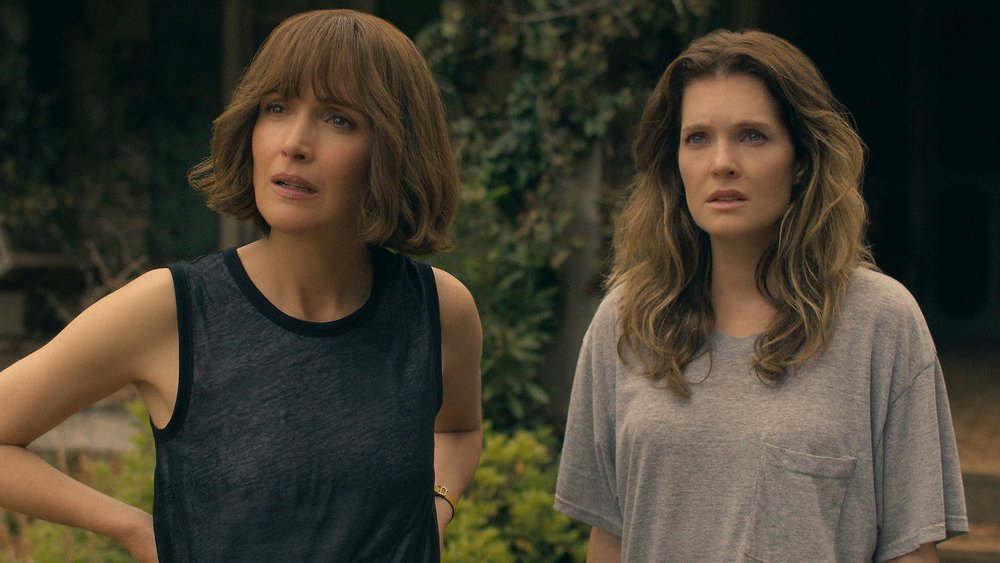
‘The Good Daughter’ Stars Rose Byrne and Meghann Fahy on Playing Sisters With Secrets and That Twisty Killer Ending Courtesy of Peacock SPOILER ALERT: This interview contains major spoilers from “The Good Daughter,” now streaming on Peacock. For Sam and Charlie Quinn, the estranged sisters played by Rose Byrne and Meghann Fahy in “The Good Daughter,” the truth was always going to set them free. Adapted by author Karin Slaughter from her own bestselling novel of the same name, the six-episode Peacock series gradually unravels a Southern Gothic family mystery. More than 20 years earlier, two masked gunmen broke into the Quinns’ rural Georgia home, murdering their mother, Gamma (Olivia Williams), and leaving both sisters with life-altering injuries. Rather than bonding them, the tragedy and a subsequent web of secrets drove the girls apart, culminating in a bitter falling-out a decade ago despite their shared career path. While Sam built a lucrative career in patent law in New York City, Charlie followed in her father Rusty’s (Brendan Gleeson) footsteps to practice criminal defense law in their shady fictional hometown of Pikeville. But when Charlie witnesses a tragic school shooting that leaves principal Douglas Pinkman (Kovar McClure) and a young student dead, Sam is pulled back to her old stomping grounds after Rusty is badly injured taking the suspect’s case. Forced to step in for her father despite not having very much experience as a defense attorney, Sam reluctantly agrees to represent Kelly Wilson (Shayna Benardo), the pregnant teen who allegedly confessed to killing her principal and a much younger student. Over the course of the season, with the help of Charlie and her estranged husband Ben (Michael Dorman), Sam discovers that Kelly was merely a pawn used by Judith (Paula Malcomson), the kind teacher who looked after Charlie following Gamma’s death. Upon discovering her husband Douglas had abused and impregnated Kelly — and expected them all to raise the child together — Judith manipulated the unstable teen into bringing a gun to school, planning to kill Douglas and blame Kelly. But when Kelly hesitated to shoot, Judith seized the weapon, executing Douglas and accidentally killing another kid in the ensuing struggle. At the same time, the shooting resurfaces old memories for both Quinn sisters. As Sam digs deeper into the past, the truth of that tragic day finally comes to light: Charlie had been sexually assaulted by Zach Culpepper — one of Rusty’s most dangerous clients who owed him thousands in legal bills — and the brutal home invasion that resulted in Gamma’s murder had been orchestrated by Mason “Huck” Huckabee (Jake McDorman), a man with whom Charlie had a one-night stand right before the school shooting in the first episode. Meghann Fahy and Rose Byrne Courtesy of Mark Hill/PEACOCK Though Charlie had forced Rusty to keep her assault a secret for decades, confronting these buried traumas finally breaks down the walls threatening Charlie’s relationship with Sam — and her marriage to Ben. “It’s always really hard when we have things that we don’t like about ourselves, or things that we haven’t confronted about ourselves,” Fahy tells Variety. “That can be a really hard thing to communicate to someone else because when you operate out of a place of hurt, you do close yourself off from the people that you actually want to be closest to. I think that is true for the sisters and the beginning of the series, and then you have the payoff of watching them come through the other side of that and come back together.” In the conversation below, conducted separately, Byrne (also an executive producer) and Fahy discuss the “corrosive” nature of family secrets, why they believe Sam and Charlie are ultimately more alike than different — and whether that cathartic finale is truly the last we’ve seen of the Quinn sisters onscreen together. What intrigued each of you about how Sam and Charlie’s shared history informs their interactions in the present day? Rose Byrne: The estrangement and the origin story of Sam returning home to face her personal truths was really intriguing. She had such fury and anger, which she speaks about in the show and in the book a lot, but [I was interested in] her coming to terms with her anger toward her father and his decisions that led them to this tragedy they find themselves in. I thought the nature of truth was also really interesting — [with] one person’s perspective then shifting to another and the tension of that, and the great suspenseful nature of the story. That genre has always been really fun to me, and something I hadn’t done for a long time, so it was fun to revisit those tropes. Meghann Fahy: Ultimately, the thing that really attracted me to the show is that, when you zoom out, it really is the story of confronting your grief and your trauma and the things that keep us at an arm’s length from the people that we love. It tells a story of coming out on the other side of that stronger and living more of a connected existence, and then drawing the people that you love closer to you as a result of having really faced yourself. The show plays with the idea that the sisters have different memories of the day their mother was killed — and there has been a sense of guilt and resentment under all of their interactions ever since. Why do you think Sam chose to leave Pikeville as soon as possible while Charlie decided to stay — and almost became trapped — in their hometown? Byrne: Sam’s driven very much by her mother and her mother’s words of, “You have to leave. This town is corrupt. It’s rigged. It’s run by these people and you’ve got to get out.” Her sense of really pushing the daughters to leave to a bigger world, to a better place, to more opportunities, particularly as young women — I think that is her drive. The voice in her head is her mother’s voice, and she’s very much like her mother. She’s extremely bright; she’s very ambitious. I think the only way through life is to leave and to go somewhere where she can see like-minded people and be less oppressed and repressed in this town, which can be pretty challenging and pretty backward. Fahy: I don’t think Charlie wanted to leave her dad. I think that she wanted to follow in his footsteps in terms of doing the work that she had seen him do for their whole lives, and there’s something really interesting about that because Charlie and Sam obviously suffered in a big way as a result of what he did for a living and how that affected the family. There was something about Charlie that wanted to stay to rewrite the story or to take control of elements of the story that she didn’t feel that she had. And for her, the path to doing that was staying where it all happened. Meghann Fahy and Brendan Gleeson Courtesy of Mark Hill/PEACOCK Meghann, Charlie notably only told her father about being raped on the day of Gamma’s killing. Did that secret inform your performance at all? Were there any little details that you added in to allude to that traumatic part of her history? Fahy: Karin did a really good job of weaving that in. A lot of Charlie’s behavior, especially as it applies to her husband, Ben — at the beginning of the show, they’re not really together, but you sort of want them to be. But you understand why he is taking a step back, because the fact that she hasn’t processed any of this trauma that he doesn’t even know about is keeping him from really being with her, and it’s keeping her from really letting him in. That undercurrent is there the whole time, so I didn’t feel like I had to do anything special or extra to lace that in, because Karin did such a good job of building it in the relationships. You see Charlie suffering in her relationships, and you find out why much later, but I think if you watched the show from the beginning and you knew that, you would really be able to see that throughline in her and her behavior throughout the series. Rose, Charlie’s secret is obviously corrosive to her relationship with Sam, but why do you think Sam also struggles to be forthcoming with her own sister? Byrne: I think it’s her disappointment in her sister after what she sacrificed for her. To your point, this secret is so corrosive to their relationship because Sam doesn’t know the truth. Her sister’s behavior is so triggering for Sam and so disappointing and so crushing when their mother had set this example of leaving and escaping, and I think her lack of compassion for her sister really is a great flaw in the character. Obviously, once she finds out the truth, she understands the whole perspective and also her anger. But that is another very specific trait in Sam that is really roadblocking her ability to have compassion and accept that her sister is not her. Courtesy of Mark Hill/PEACOCK Whether they were together or apart, Rusty clearly continued to have a hold on both of his daughters — so much so that they followed him into the same profession. Why do you think both of the Quinn daughters ended up practicing law, considering how their lives were left changed for the worst by their father’s insistence on representing criminals in Pikeville? Fahy: The girls were raised in a house that was very intellectually driven. The scenes where you see Gamma teaching them, the way that she spoke to them — I always think it’s so funny when they’re in the store, and she’s giving Sam a lesson on how to really land saying “Fuck!,” and using her breath and stuff like that. That part of how they were raised is something that they both actually really like. Byrne: Sam’s law is patent law, so it’s so dry; it’s so unemotional, and it is so specific. I think she adores how benign it can be, and she thrives in the specificity of it, in the numbers of it. Whereas Charlie’s character, she feels so tied to her father. I think the trauma bond she has with her father and the secret they share — it’s very, very hard for her to leave that, and to leave what they’ve shared together in that sense. Fahy: For all of her father’s faults, he protected her when she needed him to. He kept the secret that she asked him to. I think she respected him, and Sam doesn’t in the same way, but then ultimately comes to feel that way about him towards the end. Byrne: It’s like that great Ram Dass saying: “If you think you’re enlightened, then go and spend a weekend with your parents.” I feel like that speaks really truth to everybody who’s alive and has parents who are alive. There’s just no relationship on Earth like it, and it is so powerful. You can think all the things you want about yourself until you’re back in front of whoever consists of your family. I feel like this is a really great examination of that, particularly with Samantha. Fahy: Sam and Charlie both wanting to go into the field of law is rooted ultimately in their respect for what they saw their father achieve, regardless of how it ultimately negatively affected everyone in the family and caused their mother to be killed. And that’s so awful, but I do think that, ultimately, they really love feeling like they’re helping people. I know that’s true for Charlie at least. That’s the thing she loves the most about what she does: helping kids that she feels like don’t have anybody else who wants to in the same way that she does. Meghann, you recorded a cover of Guns N’ Roses’ “Sweet Child O’ Mine” for the fifth episode, in which Sam and Charlie grieve Rusty’s death and go looking for an old photo in one of his old properties — where they uncover evidence about Huck’s involvement in Gamma’s death. How did that cover come about? Was there a particular reason that you chose that song? Fahy: Our director, Steph Green, had found a version of the song that she really, really liked, and she knew that I sang, and she asked if I would be open to covering it. I, of course, was very excited by the idea. She wanted it to come after Episode 5 because she feels like some of the words, especially in the first verse, could be Charlie singing to Sam. I think the way that the episode ends where Charlie’s in the doorway and she’s calling for her sister the way that she did in the first episode — it’s like this callback to her being a child and standing in that same spot right before the worst thing happened. I like that the version that we did is a little bit haunting, a little bit stripped down. Courtesy of Mark Hill/PEACOCK Shortly after Rusty’s funeral, Sam, Charlie, and Ben discover that the two masked men who broke into the Quinn house decades earlier were Zack Culpepper and Huck, not Zack and his brother Daniel (as Charlie had been led to believe). Huck confesses that he had recruited Zack to attack Rusty in retaliation for Rusty defending the man accused of raping Huck’s sister. Can you each give voice to your characters’ internal dialogue after discovering that Huck had effectively caused the shooting of their mother and their own assaults? Byrne: Karin Slaughter is so interesting, because she’s so ahead of the reader. She’s so ahead of her audience with her plots, but I do feel like Sam is that role too, and she’s a little bit ahead of the audience in her mind about what’s happening and she’s piecing it all together faster than everybody else. That was something I talked about a lot with Karin, so I tried to remember that in those scenes. I think she intuitively already knows all of this, and it’s catching up in real time as we’re watching it. Fahy: What’s so interesting about the show is it’s so nuanced in terms of who did what, who is guilty of what, and who was wrong, because Charlie did accuse the wrong person [Daniel] of assaulting her — and that person was killed. So in the moment that she realizes that, she feels incredibly guilty for having essentially been responsible for someone losing their life. But also, she was a kid, and she was confused, and she only had the information that was in front of her. I think that really speaks to the way that we process trauma. Sometimes, it’s really hard to zoom out and look at things from a different point of view when all you can feel is the trauma that your body is still in fight or flight. She’s unraveling all of that, feeling the guilt of that, feeling the anger of having been intimate with Huck, who is now a part of the worst day of her life. Ultimately, I think that Charlie finding out all of this is the thing that breaks her open, that ultimately allows her to come face to face with her truth. That is part of the catalyst to her being able to share that with Ben, which is what she needed to do so that they could really be together in a real way. Byrne: They say in the birth order, the eldest daughter is such a huge responsibility in a family, especially for a young girl. So to see her sister go through this trauma again and relive it again in front of her is really harrowing and makes her so wildly furious that I feel like that is another very specific thing she’s going through. As if Charlie weren’t dealing with enough, she discovers that Judith manipulated Kelly Wilson into killing Douglas. Fahy: Judith was there the day that Charlie was assaulted in the woods. Charlie shows up to her door, and Judith takes her in. After that, Judith continues to take care of her in school. She sticks up for Charlie when she’s being bullied. For Charlie, feeling safe with anybody is a tall order. So for her to come to the realization that a person that she really trusted and felt looked after by could have done something so horrible — I think she was a cocktail of emotions, but there was a real, real sadness and heartbreak in there when Charlie realized that Judith really was the one who orchestrated the killings. Karin Slaughter actually wrote a “digital short” prequel to “The Good Daughter” called “Last Breath” in which a younger Charlie takes on a high-stakes case involving a motherless teenager. Since nothing in success is really ever limited these days, have any of you had conversations about what a second season of “The Good Daughter” could look like, or did you always envision this adaptation as a one-and-done series? Byrne: That’s so cool. I didn’t know that. Fahy: Because the novel is so beautifully written, it felt complete to me — and the show felt complete to me, too. I don’t think I ever really pictured it as being ongoing. But that being said, Charlie is one of my most cherished characters that I’ve ever been able to play, so she’ll stay with me for a long time. I would be very curious to know what she would be getting up to and what her life would be like after having gone through everything that she goes through. Byrne: We felt it was pretty contained within the pages of what we were doing, but I’ve also been around so long that now I don’t know what anywhere will lead to anywhere anymore. So “anything can happen” is really my motto now in this business, because you just never know how things will shake out. I always try to keep an open mind, but it feels like the story we were meant to tell was the one we’ve told. Meghann Fahy and Michael Dorman Mark Hill/PEACOCK Charlie mentions at the end of the finale that she and Ben are moving to Atlanta, and Sam will presumably go back to New York while maintaining a much healthier relationship with her younger sister going forward. What do you imagine their respective lives will look like after the screen cuts to black? Byrne: Maybe they go to a private island and have a mojito. I’m being silly, but I’m kind of not. They deserve a drink! They should talk about the weather for a few weeks, and keep it really light. Not the news — just the weather, what they’re going to have for dinner. That’s what I would like: for them to be a little bored, a little quiet, just relaxed. Fahy: I hope that Charlie finds real comfort and peace. Another thing that I really, really love about the character of Ben, played by Michael Dorman — we were so lucky to have him because his energy is so unique and loving and understanding. I think we don’t show a lot of relationships like Charlie and Ben where the person is given space to figure themselves out, and Ben’s not punishing her for it. He’s loving her through it while also having his own boundary. To see them come back together after having given each other that space, and for him to really hold all of Charlie’s truth and say, “I’m still here,” is so hopeful and nice. We should show more of that because if you’re lucky enough to be in a really healthy relationship, that’s what you would hope would be true for anybody. So I loved that the conflict was never really between the two of them. It was just the work Charlie had to do, and he allowed her to do that. So I hope that after “The Good Daughter,” Charlie and Ben are super happy in Atlanta and that they’re just finally really enjoying each other. This interview has been edited and condensed.
‘The Good Daughter’ Stars Rose Byrne and Meghann Fahy on Playing Sisters With Secrets and That Twisty Killer Ending
Full Article
Original Source
Read the full article at Variety →KhanList aggregates and links to publicly available news content. We do not host full articles from third-party sources. Always verify important information with original sources.