
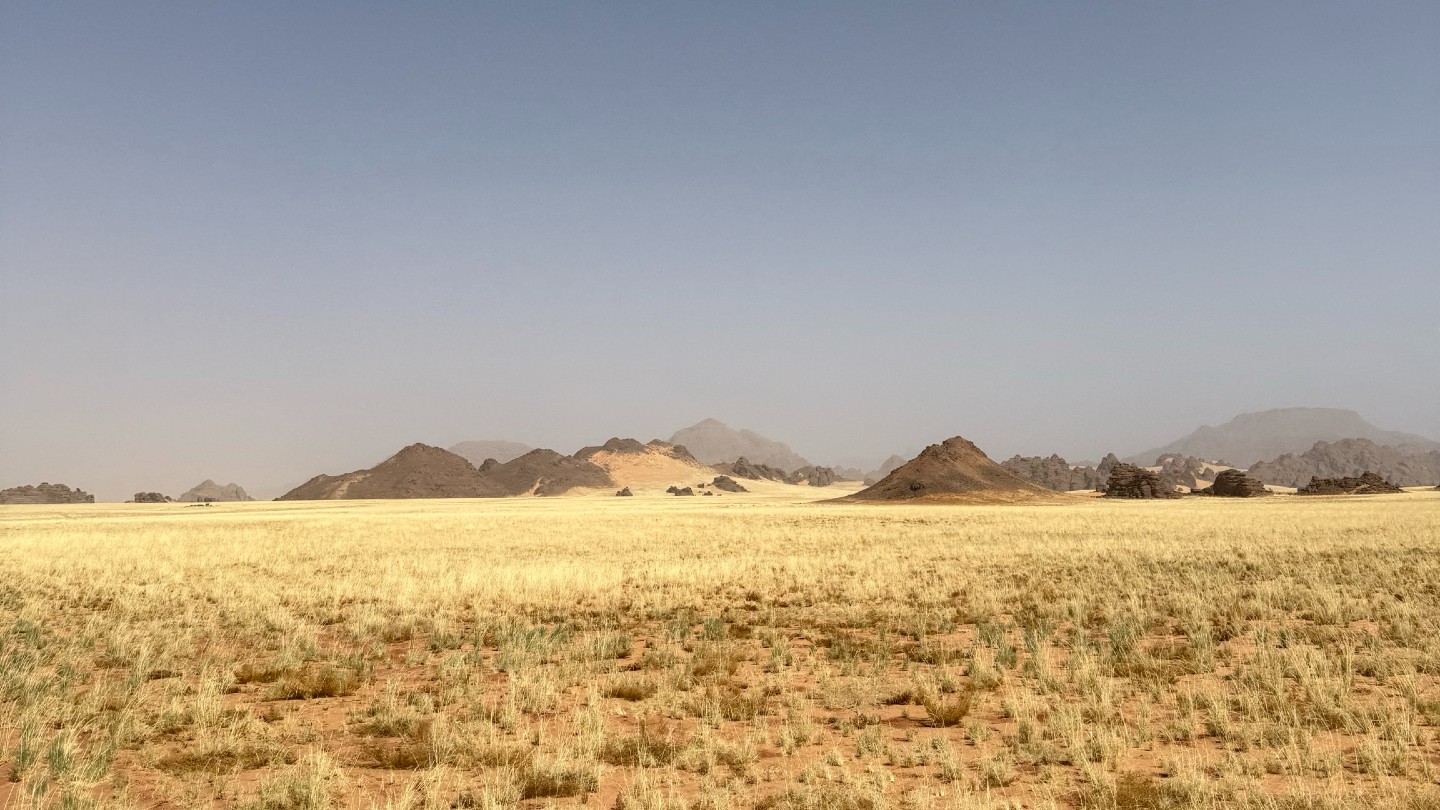
Deep inside the Tibesti mountains of northern Chad, in the central Sahara, the town of Miski sits surrounded by a succession of never-ending wadis. A couple of families live at the top of each of these valleys and in August, when the rainy season comes, the wadis become a river that washes through the mountains. When the rains go, the valleys become green and camels feed on them. A remote volcanic range characterised by rugged, bare rock, rivers of lava and volcanoes that climb to 3,000 metres, the Tibesti, which runs through northern Chad across the border into southern Libya, is sometimes called the roof of the Sahara. These mountains are home to the Tubu, an indigenous community whose territory also includes a part of southern Libya, northern Niger and northwestern Sudan. And the valleys that surround the town of Miski contain vast deposits of a precious metal that throughout human history has been prized almost above anything else: gold. New MEE newsletter: Jerusalem Dispatch Sign up to get the latest insights and analysis on Israel-Palestine, alongside Turkey Unpacked and other MEE newsletters The mountains, too, are filled with antimony, a toxic heavy metal that is putting the ecosystem of this indigenous community at severe risk and is also exported in great quantities. For decades, the gold that sits in this remote place has been one of the drivers of armed conflict between the Tubu and the Libyan then Chadian states. Now, the Tubu find themselves caught up in a web of warfare and illicit trade that stretches out from Chad into Libya, Sudan and over the sea to the United Arab Emirates, from where arms and supplies are flown to proxy armies, militias and paramilitaries. On 14 October, armed clashes broke out in Miski. The day after fighting began, the Chadian army’s general staff accused Miski’s self-defence committee - a local armed group descended from the Tubu institution of village guardianship - of breaking a peace agreement struck between them and the army last year by attacking the National Brigade for the Control of Mining Activities. The army gave the Tubu group an ultimatum: lay down your arms at once or be treated as rebels. In response, the committee accused the brigade of firing first and of opening new mining fronts in grazing lands, in violation of the Bardai peace accord signed last year. The gold ends up in Dubai…'yet we do not have a single clinic in Miski or a single paved road in the whole of the Tibesti' - Tubu commander One Tubu commander in Miski told Middle East Eye that last year Chad had exported over $1bn worth of gold and more than 15,000 tonnes of antimony, all sourced from the Tibesti mountains. Almost all this gold ends up in the UAE, in the gold market of Dubai. “And yet we do not have a single clinic in Miski or a single paved road in the whole of the Tibesti,” the commander said. “We won’t let this continue.” Since the armed clashes broke out in October, the Chadian army has moved considerable numbers of troops and armoured vehicles into the Tibesti. The situation on the ground, according to one Chadian army officer who spoke to MEE, is difficult for government troops. “We are fighting the mines and the mountains in Miski,” he said. This fighting has not stopped: scores of people have died in the clashes and the Chadian army has conducted multiple drone strikes across the mountain range. Weapons corridor Miski’s uprising appears, on the surface, to be a local fight over gold - and in a large part, it is. But it is unfolding inside a region that has become one of the most consequential, least scrutinised arms corridors in Africa: a route that, according to United Nations investigators and extensive reporting from Middle East Eye, has carried weapons, fuel and fighters from the UAE through Libya and Chad to the paramilitary Rapid Support Forces (RSF) in Sudan. How the UAE continued supporting Sudan's RSF through Haftar and Libya Read More » These weapons are part of a network of arms and mercenaries that spans swathes of north and central Africa, utilised not just in Sudan but by organised criminal groups and armed entities across the Sahel. Between October 2024 and the end of 2025, according to a UN Panel of Experts report, heavy cargo aircraft made 458 flights between military airports in the UAE or the Emirati base at Bosaso in the breakaway Somali region of Puntland and eastern Libya. Some 239 of these landed at Kufra, a town about 300km from the Sudan border that was transformed, in the months before the RSF took el-Fasher in October 2025, into a fortified logistics hub complete with new hangars and scheduled flights. Separately, as reported by MEE and confirmed by UN experts, the UAE was using Amdjarass, in eastern Chad, to land cargo planes. Senior Egyptian army sources told MEE earlier this year that the Emiratis have a military operations room inside Amdjarass airport to coordinate with the RSF. Just over 100km from the border with Darfur, the vast western region of Sudan controlled by the RSF, Amdjarass is a Zaghawa-dominated town that is the home region of Chad’s president, Mahamat Idriss Deby, and the site of a lavish state infrastructure programme that residents of Tibesti, 1,300km away and without a single paved road or a functioning hospital between them, have started to openly resent. Abu Dhabi continues to deny supplying the Rapid Support Forces. Haftar’s expanding footprint In November 2025, Chad and the UAE-backed Haftar family’s Libyan Arab Armed Forces (LAAF), de facto commanded by Khalifa Haftar’s son Saddam, formed a joint border force covering roughly 1,050km of shared frontier. The Haftars’ are not just in control of eastern Libya: leaked details of US adviser Massad Boulos’s plan to unify Libya propose Saddam Haftar as president of a government that would continue to be led by Prime Minister Abdul Hamid Dbeibah. Chad’s government has two reasons to want this partnership, and they reinforce each other. One is logistical: Chad and Haftar can cement their relationship in the eastern Libyan corridor that carries Emirati arms to the Rapid Support Forces in Sudan. The other is that a joint border force hems in the Tubu, who have supplied the armed resistance to Mahamat Deby’s government and to Haftar’s forces alike. Jalel Harchaoui, an analyst focusing on Libya and political economy, told Middle East Eye that when the deal was initially struck, the Tubu were not part of the thinking. The only connection in the remote area - Starlink (MEE) “It was to ensure better security along the route between Chad and Libya, especially with the passage via Ma’tan as-Sarra in Libya down through Chad to Amdjarass and then on to Darfur,” he said. This “security problem” included armed groups attacking the convoys headed to Darfur to supply the RSF, Harchaoui said. There was also the need to build further cooperation between Emirati allies who were not natural bedfellows. “Saddam Haftar and Mahamat Deby don’t get along, so there was a need to please the UAE by doing a joint force. And the agreement was never that the joint force would be pushed to the west, it was really to cover the northeastern corner of Chad,” Harchaoui said. That changed earlier this year, when Saddam Haftar “ran into trouble” with armed Tubu groups like the Southern Liberation Operations Room (Slor), which is led by Mohamed Wardougou, a Libyan Tubu, and often hides out in northern Niger. Haftar asked Chad to move forces to the west, arguing correctly, according to Harchaoui, “that Wardougou’s activism served as a shot in the arm for the anti-Deby Chadian group Front for Change and Concord in Chad (Fact) in northern Niger”. History of revolt This move played into the Tubu’s long record of rising against the central governments of Chad, going back to the country’s independence from France in 1960. Their most recent armed revolt, in April 2021, culminated in the death on the front line of President Idriss Deby Itno, who had decided at the age of 68 to command his forces in person. His son Mahamat succeeded him. In Libya too, the Tubu rose against Muammar Gaddafi, and after his fall in 2011, they held sway over vast stretches of southern Libya until 2021, when Haftar’s forces pushed into the areas they had controlled. The containment effort carries a human cost well beyond Tibesti. In Libya, Tubu communities describe a steady tightening around their citizenship, with human rights researchers long having flagged discriminatory practices such as treating the Tubu as second-class citizens and stopping them from obtaining passports and IDs. 'We do not want to be part of a bigger game… We just want peace and justice and foremost, transparency in mining and the development of our region' - Tubu defence committee member On 14 October, the same day gunfire broke out in Miski, Libya’s attorney general in Tripoli said he was prepared to strip the 28,000 families registered at Murzuq, in the Fezzan region of southwest Libya, of their Libyan nationality, citing alleged forgery. Because the overwhelming majority of Libya’s Tubu are registered through that one civil registry, the announcement reads as an existential threat: if carried through, most of Libya’s Tubu would become stateless. On the border between Libya and Niger, Wardougou’s Slor group has fought a running battle with Haftar’s forces, using northern Niger as a rear base. The Slor’s declared aim is to remove Haftar’s men from southern Libya. In July, photographs circulated online showing Chadian soldiers at Libya’s Wigh airbase, near the Nigerien border - evidence, the group’s leadership says, that Chad is fighting on Haftar’s behalf. On 20 October, the LAAF arrested a former Chadian minister and senior opposition figure, Hassan Soukaya, as he tried to cross from Libya into Niger, and handed him to the Chadian army. Days later, Niger’s government publicly accused the Chadian military, with alleged French support, of carrying out a drone strike on 24 October near the Salvador Pass that killed two civilians. The attack was reportedly meant to target Slor positions in Libya, but hit Nigerien territory by accident. The UAE-Israel desert axis On 19 October, Israel’s second-ever ambassador to Chad landed in N’Djamena to present her credentials to Deby. Since taking power after his father’s death in 2021, Deby has made a point of binding Chad ever closer to the UAE and Israel: diplomatic relations with Israel were restored in 2022, and the first Israeli ambassador in more than half a century - since Chad broke off ties in the 1972 - was received shortly afterwards. Despite this, in November 2023, Chad recalled its ambassador from Israel, citing “the unprecedented tide of deadly violence” inside Gaza. Chadian alignment with the UAE is not only military. As previously reported by MEE, the Emiratis offered Deby “more than a billion dollars” to “flip Chad towards supporting the RSF” after the war in Sudan began, according to former CIA analyst Cameron Hudson. Senior UAE and regional officials referred to ICC over role in Sudan atrocities Read More » That figure now looks like loose change. In May 2025, in Abu Dhabi, Chad unveiled Chad Connexion 2030, a $30bn national development strategy to remake the infrastructure of a landlocked country from the ground up. The UAE was, by a wide margin, its most important bilateral underwriter, securing $20.5bn in total backing and signing 18 contracts of its own worth over $6.2bn. Among the headline projects: an 800-km Etihad rail line to Cameroon’s port of Douala, a 50 MWp solar plant by Global South Utilities, industrial zones, Abu Dhabi Ports logistics hubs, and critical-mineral exploration permits. The partnership has tightened Chad’s dependence on UAE and has become, in effect, the economic lifeline of Deby’s administration. To the west, Chad is already at odds with its neighbour Niger, which has drawn closer to Algeria. In late October, Algeria deployed troops to Niger, the first time it had done this outside its borders since 1973. The move came days after Niger’s military government survived a coup attempt, on 28 August. Algeria’s move into Niger, according to the retired Algerian diplomat Amar Belani, is designed to counter what he described as “a destabilisation strategy actively involving the United Arab Emirates, Morocco, Israel and certain French proxies.” The current geopolitical shifts, Belani went on, together with all they entail by way of rivalry and intervention by foreign actors, mean that “new tools, such as a show of presence including at the military level, are no longer a taboo and will be utilised to draw and reinforce Algeria’s red lines.” Borderlands unrest What is forming, in other words, is not one war but two rival blocs assembling around unrest in the desert borderlands. Rape, ransom and execution: The road out of Sudan's el-Fasher Read More » On one side: the Sudanese Armed Forces (which receives backing from Egypt and Turkey), Niger, Algeria, and the Tubu in Libya and Chad. On the other: the RSF, the Haftars, the UAE, Ethiopia and the Chadian state, with the French leaning towards this camp. And the local fights and the larger one are no longer separate. A mining dispute in a town of a few thousand people tucked away deep in the remote mountains of Chad has become entangled with an arms corridor sustaining one of the world’s deadliest wars, with a succession contest inside Libya’s eastern military establishment, and a Sahelian realignment redrawing alliances from Algiers to Khartoum. “We do not want to be part of a bigger game,” one member of the Tubu defence committee in Miski told MEE. “We just want peace and justice and foremost, transparency in mining and the development of our region.” But whether it remains a local counter-insurgency or becomes the spark for something larger will depend less on what happens in the mountains of Tibesti than on decisions being made in Abu Dhabi, Benghazi and Paris.
The gold-filled mountains of Chad that hold the key to Libya's crisis and Sudan's war
Full Article
Original Source
Read the full article at Middleeasteye →KhanList aggregates and links to publicly available news content. We do not host full articles from third-party sources. Always verify important information with original sources.