
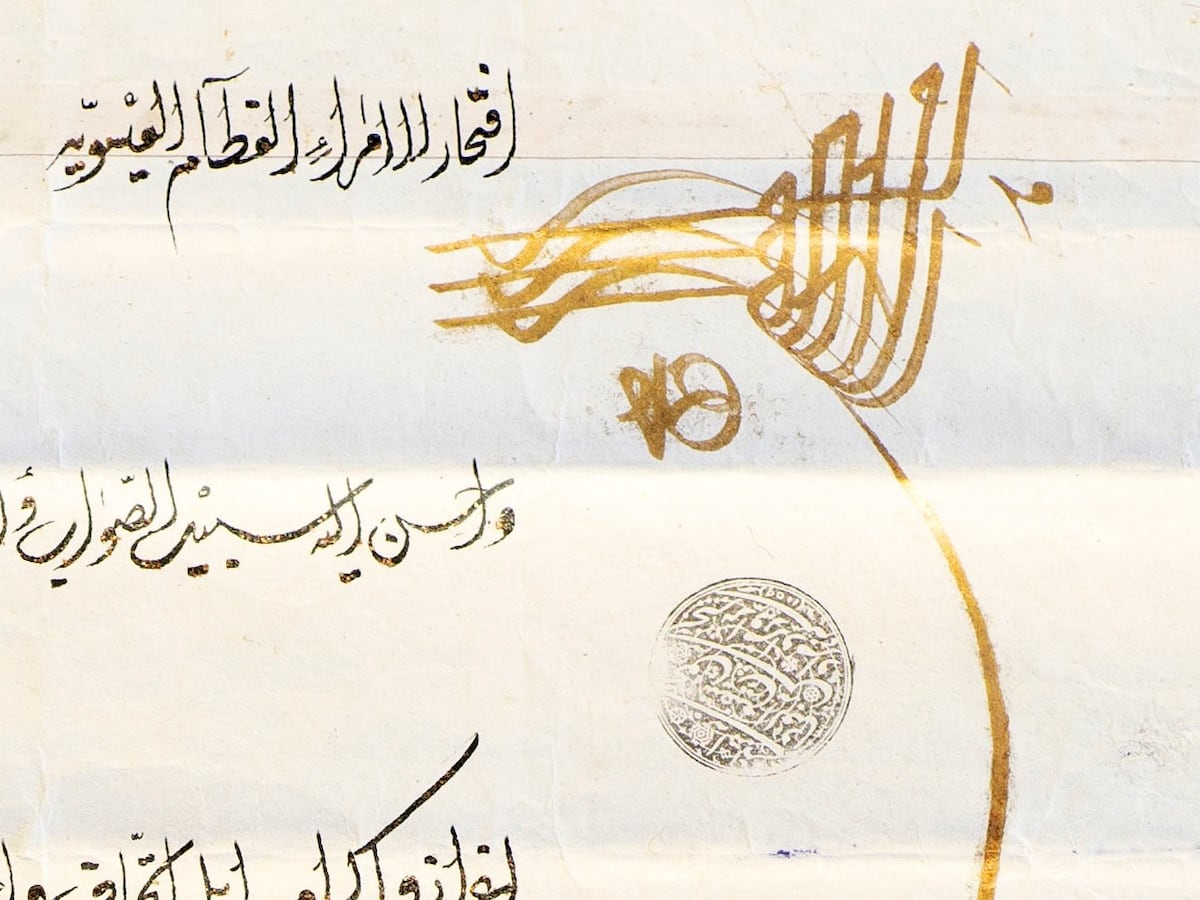
“Sir, you’ll have to move to one of the side rooms because it’s too large.” That was the warning an employee at Spain’s National Historical Archive (AHN) gave historian Rubén González Cuerva, 43, when he attempted to consult one of the letters held in its collections. It was the autumn of 2025, and the researcher, who leads a Spanish National Research Council (CSIC) project on Spanish-Muslim diplomacy, had come to examine documents that had already been studied by colleagues in 2020. As he unfolded one of them, he realized it was no ordinary piece of correspondence. The paper stretched more than eight feet in length and bore the Ottoman sultan’s signature stamped in gold.The letter, dated in Constantinople in April 1650, was sent by Mehmed IV (1642-1693) to Philip IV of Spain (1605-1665). Its contents reveal a highly unusual episode in the history of relations between the Spanish Monarchy and the Ottoman Empire: the sultan was offering the Spanish king a peace and trade agreement, similar to those already in place with other European powers. He also promised to open the gates of Istanbul to the king’s merchants. “What the sultan is offering is nothing less than a chance to change the history of the Mediterranean,” González Cuerva explains.The document provides evidence that official diplomatic communication existed between the courts of Madrid and Istanbul in the mid-17th century, more than a century before formal relations between Spain and the Islamic powers of the Mediterranean were traditionally believed to have begun. “The assumption has always been that Spain did not establish official diplomatic relations with Islamic states until the late 18th century, yet here we have an official document dating from 130 years earlier,” the historian notes.The letter also offers a glimpse into the political maneuvering that shaped the Mediterranean at the time. Venice was then at war with the Ottomans, and Spain was quietly supporting the Venetian side. Mehmed IV’s proposal may have been an attempt to break up that Christian alliance and draw the Spanish monarchy away from its partnership with the Italian republic. Although the theory can only be understood in its broader geopolitical context, the document’s very existence shows that even between rival powers there was room for negotiation.The document’s striking nature lies in more than its sheer size. The letter bears a tughra, the sultan’s imperial cipher, rendered in gold to signify his authority and lend the communication an air of grandeur. Analysis carried out during the restoration process enabled conservators to distinguish the genuine gold from other reflective elements present in the black ink. The handmade paper and calligraphy belong to a documentary tradition in which writing was not merely a vehicle for communication but also a form of artistic expression.The document had already been studied and published in 2020 by researchers Jorge Fernández-Santos and Hüseyin Serdar Tabakoğlu. The new research prompted its restoration, translation into Spanish and analysis of its material composition, while also leading to the recovery of other Arabic and Ottoman letters preserved in the archive. The work carried out by the researchers has made it possible to repair damage caused by centuries of folding, mend tears and digitize the originals to ensure their long-term preservation.Mehmed IV’s correspondence is one of the highlights of the exhibition A Recovered Treasure: Arabic and Ottoman Letters from the National Historical Archive. Organized by the Institute of History at CSIC and the National Historical Archive (AHN), the exhibition brings together documents showing how contacts between the Spanish monarchy and Muslim powers survived wars and religious divisions. Among the items on display is a 1513 letter from the qadi of Tlemcen to Cardinal Cisneros, thanking him for receiving his ambassadors, and another from 1771 sent by Lalla Fatima, wife of the Sultan of Morocco, to María Luisa of Parma, Princess of Asturias. The latter accompanied an exchange of gifts and included a request concerning Muslim women being held in Spain.“The idea that the Spanish monarchy was a Catholic monarchy and that it had no diplomatic relations with the infidels [Muslims] does not entirely correspond to reality,” argues González Cuerva. The exhibition traces this journey: from the contacts that followed the conquest of Granada in 1492, through a period of discreet diplomacy between the 16th and 17th centuries, to the normalization of relations in the 18th century.One of the most striking stories from this period is that of Ahmed Agha, an envoy of the Ottoman grand vizier Kara Dev Murad Pasha, who remained in Madrid between 1649 and 1650. As the researcher explains, “Agha managed to pass himself off as an extraordinary ambassador, a rank that granted him special privileges and allowed him to live at the Crown’s expense.” Spanish authorities were unable to detect the deception because no one had succeeded in accurately translating the letters that revealed his true status.Far from encountering a hostile court, Ahmed Agha was received with curiosity. Philip IV reportedly took amused interest in his enthusiasm for bullfighting and the theater. The envoy even befriended some of Madrid’s best-known actors and accompanied them on an excursion to El Escorial, the picturesque mountain town 31 miles northwest of Madrid where Philip II built a vast monastery and palace. “To the king, Agha came across as a likeable character,” González Cuerva recalls.War, religious rivalry and territorial disputes did not prevent the two powers from maintaining channels of communication. Preserved for centuries in the collections of Spain’s National Historical Archive, Mehmed IV’s letter offers a glimpse of a history that complicates the traditional narrative of perpetual conflict between Christian Spain and the Ottoman Empire. It shows that, despite their rivalry, the two courts continued to find ways to communicate.Sign up for our weekly newsletter to get more English-language news coverage from EL PAÍS USA Edition
The giant Ottoman Letter that challenges 130 years of Spanish diplomatic history
Full Article
Original Source
Read the full article at English →KhanList aggregates and links to publicly available news content. We do not host full articles from third-party sources. Always verify important information with original sources.