
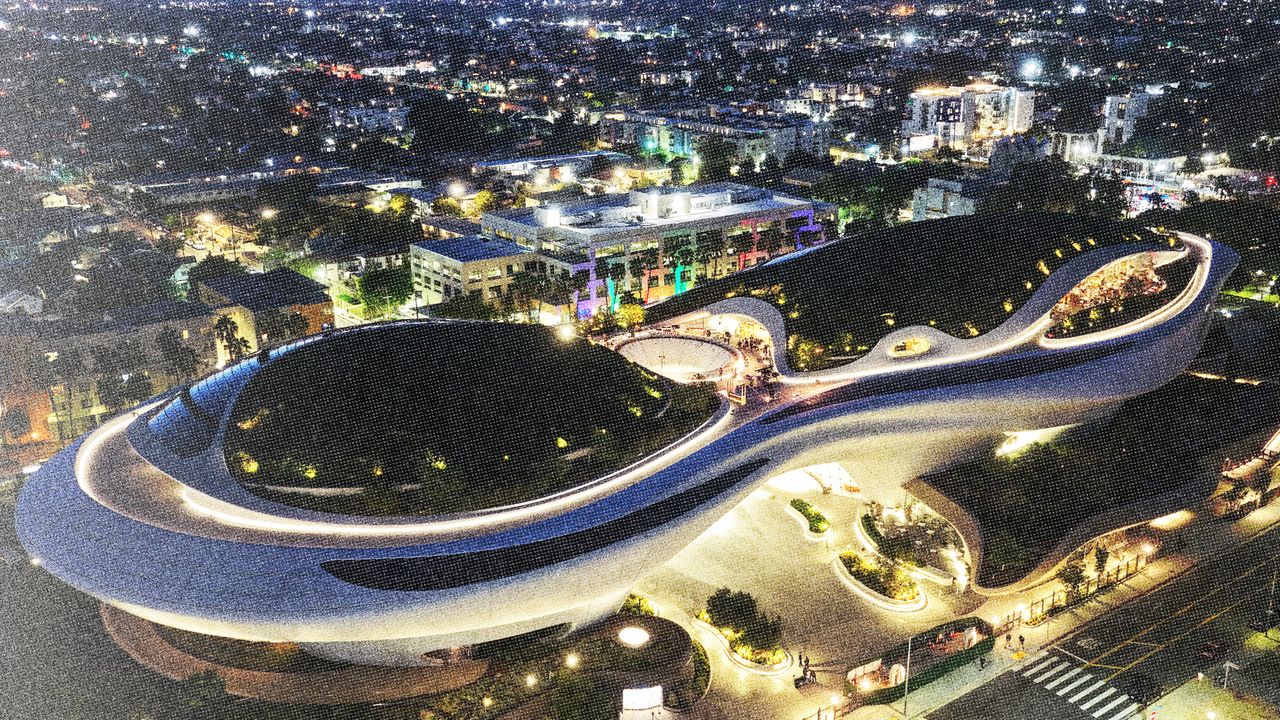
The permanent gallery at the new Lucas Museum of Narrative Art, the part you are meant to visit first, is not a bright, four-walled gallery, but a dark cave. Its first images are vivid backlit reproductions of some of the earliest ones made by humans: horses, deer, the Paleolithic bison, and human hand prints of the Altamira cavern complex in northern Spain.I knew immediately what George Lucas was up to. He is alluding to the iconic scene from Star Wars Episode V: The Empire Strikes Back where Luke Skywalker, urged by Yoda, enters a cavern (“In you must go!”), encounters a dream-like version of Darth Vader, and, with a whoosh of his light saber, cracks open Vader’s helmet-mask to reveal… Luke himself! Lucas is manifesting—in his movie and his museum—a core archetype of mythologist Joseph Campbell. In this case, the confronting of one’s Jungian “shadow.”Joseph Campbell, the author of A Skeleton Key to Finnegans Wake and The Hero with a Thousand Faces, is Lucas’s Yoda of ideas. The museum, which opened in September, is their shrine, holding a substantial collection of Lucas and his and partner Mellody Hobson’s 40,000 artworks.From murals and manga to props and costumes, the museum stages its massive cache of storytelling art in a place where half the buzz is the architectural experience. In Exposition Park just south of Downtown Los Angeles—and across the street from Lucas’s USC alma mater—the 300,000-square-foot structure is a blorpy, biomorphic mound designed by Ma Yansong of MAD architects. All edges are rounded in a futurefied Deco. Its mothership shape holds portals and flight decks. It flows and floats over a 13-acre campus of green space, where even the roof is landscaped with native grasses and wildflowers. Glass pneumatic elevator tubes zoom you up to the fourth-floor galleries. The staff wear snappy uniforms, their ticket scanners emitting “blaster” sounds. Its two theaters are wide wombs. Sleek and chic, the view from the museum’s Skywalker Grill soars over the city.All told, it’s as close to a thrill ride as a building can be. And the whole thing cost some $1 billion, all funded by Lucas and Hobson.Courtesy of the George Lucas Museum (Photo: Hufton Crow)Courtesy of the George Lucas Museum (Photo: Hufton Crow)I share Lucas’ archetype fetish. It’s what first led me, back in the 1980s, to the Star Wars saga in all its epic hokeyness. (I’ve seen each one, including the cringe-maxed prequel trilogy, all the offshoots, plus pretty much every other movie the now-82-year-old Lucas has directed or concepted). And still, he sees deep meaning in mythic pop. For him, transcultural Campbellian archetypes and their thousand-in-one quests, trials by fire, death-and-resurrections—their gods, monsters, prophesies, saviors, heroes, mentors, virgin births, and sexual awakenings—are the story-stuff of art.Because these stories permeate all narrative art, often subtextually, there’s a lot of the low- to middle-brow on view at the museum. He posits a supreme vernacular. There’s mythic gold even in adorkable visual pulp. Entire galleries are devoted, for example, to Norman Rockwell and Maxfield Parish (the latter’s golden, late-afternoon light and Lake Como settings inspired Lucas’ depiction of the garden-planet Naboo in Star Wars: Episode I – The Phantom Menace). There’s also a shit-ton of comics, magazine, children’s illustrations, and even advertising, the kind of material that’s mostly marginalized by the fine-art hierarchy of traditional museums.Legitimate greatness acts as a check on all the kitsch. That first-floor cave leads to “The History of Narrative Art: Heroes + Myths + The Sacred Exhibition.” This low-light, moody, winding environment fast-forwards through thousands of years of storytelling, joining original items from the Lucas collection with high-def reproductions and projections, including the Sistine Chapel ceiling, the Aztec Sun Stone and the interior of Hagia Sophia.The upper galleries hold the more contemporary goodies. Imagery from Westerns, samurai epics, and sci-fi—all genres that informed his movies—abound. Some are enormous and overpowering. Here also are political posters: Shepard Fairey and Ernesto Yerena Montejana’s 2010 “Immigration Reform Now,” and Richard V. Correll’s “I Want Your Social Security Dollars for US Military,” with a leering, finger-jabbing Ronald Reagan. There’s some badass lowrider art. Dominating the Manga and Anime gallery is a leggy, life-size statue by Takashi Murakami: super-cute warrior “Miss Ko².”Will the art-industrial complex take to the Lucas Museum? It arrives at a time of slumps. “The money’s not flowing,” collector-dealer Stefan Simchowitz recently told Artnet. “If you speak to the people in the business, they’re exhausted, they’re demoralized, the energy is not there because the business isn’t there either.” Anonymous critic-practitioners, such as the Diva Corp collective in Los Angeles, carp with glee at hypocrisies in the gallery ecosystem and art fairs, which are also struggling. According to The American Alliance for Museums, many major venues face falling attendance and rising costs, with 55% of them reporting fewer visitors in 2025 than in 2019, “a setback from 2024, when 49% remained below pre-pandemic levels.”Now comes the Lucas Museum, funded via its own philanthropic 501(c)(3), beholden to neither government grants nor donors and collectors. And with its niche focus on the vernacular, it is singular among establishments that prize fine-art prestige. Time to reignite the age-old conflict between high-brow and low-brow. There have even been major—and very popular—exhibitions exploring this schism. New York Museum of Modern Art’s 1991 “High and Low: Modern Art and Popular Culture” upheld the profound transgressions of comic-book genius R. Crumb alongside pop masters Roy Lichtenstein and Andy Warhol. (I saw one Warhol at the Lucas: the color screenprint “Howdy Doody,” from his “Myth” series.) And The Museum of Contemporary Art in Los Angeles had its “Helter Skelter: L.A. Art in the 1990s,” a trippy funhouse that helped catapult Mike Kelley, Paul McCarthy, Raymond Pettibone and others of their “bad boy” ilk, all of whom deal in besmirched pulp and pop.But, for the most part, museums come at this genre with blinders, excluding it either to service big-money sponsors and investors or just because they scorn it. One imagines that Lucas’ monomaniacal focus on everyday to age-old mythology might aggravate them, what with its end-run around their approved canons.Is this capital-A Art or “just” illustration? Is it a private gallery or a museum for the public? Is it an excessive monument to one man’s own taste? Perhaps speaking for many, a writer in Art Review dissed the “…dominant American ideology reflected in the country’s most commercialized artforms,” where “gendered stereotypes and sexist visual conventions abound,” as sci-fi/fantasy illustrator “…Frank Frazetta’s heroines cling to a male saviour’s leg, their preternatural proportions barely contained by bikinis.” Oh my!That review griped that the “Western Stories” gallery “consists entirely of Wild West imagery from a beloved genre that has enabled an insidious historical revision of the forced displacement of Indigenous people. The ‘Work’ gallery largely focuses on white men engaged in the dignified labour of industrialization.”I would not respect a pop-culture cathedral that sanctifies harmful stereotypes. But that’s not where Lucas stands—neither in his movies nor here. The fifth-floor Murals gallery, in fact, is filled with work extolling the proletariat, blasting gender and ethnic norms, and explicitly attacking capitalist tyranny.In 2021, the museum acquired the archive for Judy Baca’s nearly one-mile-long mural “The History of California,” often called “The Great Wall of Los Angeles. It is represented in its totality via a life-sized scrolling video that, in the artists’ version of social-realist style, depicts working-class struggles, marginalized communities, and political dissidents.Also recreated is Diego Rivera’s “Man, Controller of the Universe.” It’s a monumental amalgam of scenes showing the clash of capital and the proletariat. Transcending rote social realism, it verges on science fiction by including images of inner and outer space. Judging by the clunky but righteous anti-imperialism of the entire Star Wars franchise, Lucas likely loves this piece.Of course, there is one special interest group he is beholden to: his fans. The halls are crammed with people of all ages and many languages sporting Star Wars gear. In the “Star Wars in Motion” installation of the Cinema gallery are full-scale versions of Luke Skywalker's Landspeeder, Anakin Skywalker's podracer and General Grievous's wheel bike. (Here I overheard my Star Wars completist comrades explain to their kids the origin of each prop.)It’s difficult to imagine anyone else creating with the focus of Lucas on this scale. I shudder to think what such a place would be in the hands of, say, Elon Musk, or any of the techbrolocrats dominating politics and the economy. Still, Lucas and Hobson could expand their vision. What if a savvy curator presented ultra-contemporary artists? There are a number of young women collagists extolling and/or critiquing sexual archetypes in analog (María Berrío, Daisy Holden, Solá Sarr, Erin C. Alexander, Ashley Pottenger) or producing digital and A.I. video (Petra Cortright, Karina Bush, Erin Robinson). R. Crumb is in the Lucas with a few comix covers. And the museum has purchased his 200-drawing opus “The Book of Genesis.” How about a full-on retrospective dedicated to Crumb and his collaborator Aline Kominsky-Crumb? Is there another artist X-raying American archetypes with such vicious satire?I believe Lucas agrees with me. As he told The Los Angeles Times, “I’ve spent more than 50 years collecting the work of artists who don’t always get their due — illustrators, cartoonists, muralists, painters — because I believe their images are as vital as any other art form. They deserve to be in a museum.” Don’t myth it.
The George Lucas Museum Celebrates All Things Kitsch. Will the Art World Get on Board?
Full Article
Original Source
Read the full article at Gq →KhanList aggregates and links to publicly available news content. We do not host full articles from third-party sources. Always verify important information with original sources.