
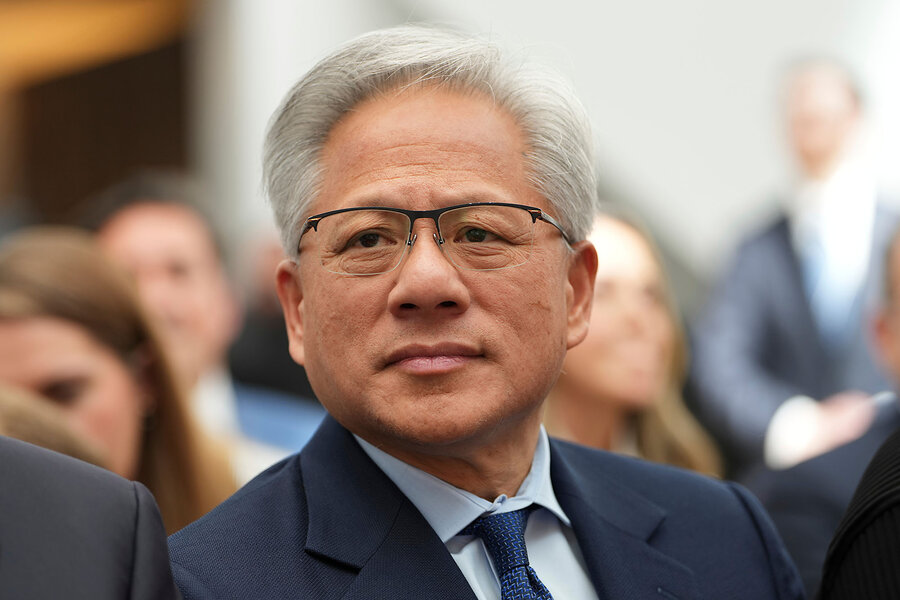
Already facing the tough task of rebuilding confidence in Nvidia after the dramatic fall of its visionary co-founder, the global technology company’s board now faces a new potential challenge: The visionary CEO wants his job back.In a post on X on Tuesday morning, Jensen Huang said he was ready to retake the job he was bounced out of last week amid revelations of at least two reported affairs. One involves a woman who U.S. intelligence officials suspect is a Chinese spy; the other is a subordinate. “I would be honored to … return as CEO,” he wrote.And while reports say the board is not considering reinstating Mr. Huang, the scandal has continued to rock the artificial intelligence world, as Nvidia’s computer chips largely power the superfast computers that run AI models. The departments of Justice and Commerce on Monday provided details of a joint investigation into Megaspeed, a Singapore-based AI company with ties to the alleged spy. The saga illustrates the perils of the celebrity CEO. They enjoy such legendary status that almost everybody knows them – think Elon Musk at Tesla and SpaceX, Mark Zuckerberg at Meta, and Sam Altman at OpenAI, the creator of ChatGPT. Such high-profile CEOs are used to getting their own way.Their extraordinary track records make them seem invaluable, but also make it difficult for boards to challenge them. Their leadership succession plans are sometimes weak, if they exist at all. The success of their companies is so great that investors, policymakers, and others credit them with that success and try to stay out of the way.The concentration of authority under Mr. Huang was remarkable. More than 60 executives reported directly to him, and the company had no publicly disclosed succession plan. His departure has exposed the difficulty of replacing a leader around whom so much of the business was organized. Alex Brandon/APOpenAI CEO Sam Altman (left) talks with Meta CEO Mark Zuckerberg at a state dinner for Chinese leader Xi Jinping in the East Room of the White House in Washington, Sept. 24, 2026. And yet, at Nvidia, what began as a scandal involving one executive has now become a test of the institution: whether Nvidia’s board can hold its leader accountable without sacrificing the innovation that made the company successful. The challenge is to sell shareholders, employees, and regulators on a new story. Investors liked the original story: A single genius breaks the rules and creates a chip technology that rules the world, improving lives and their own fortunes. The new story is more complicated, but also steady and predictable – hinging on confidence that Nvidia’s success depends on more than one man.“The reality is – of any organization of that scale and size – [that] it’s made up of engineers and thousands of people,” says Rakesh Khurana, professor of sociology and organizational behavior at Harvard University and author of the 2002 book, “Searching for a Corporate Savior: The Irrational Quest for Charismatic CEOs.” Increasingly, it’s those people, rather than any one executive, who make the breakthroughs that keep the firm progressing.The board will aim to show that the corporate culture will continue producing breakthroughs. And one way or another, it has to move on from its founder if it is going to survive, Dr. Khurana adds. “This is something many firms struggle with to make that transition.”Some leading-edge companies fail to make the transition or end up with wildly different results.“History is unambiguous on this point,” write Jeffrey Sonnenfeld, Steven Tian, and Stephen Henriques, management scholars at Yale University’s Chief Executive Leadership Institute, in a recent op-ed for Time magazine. “Legendary companies like Polaroid, Digital Equipment, and Wang Labs arguably withered because their boards could not separate the institution from the founder. Apple soared after Steve Jobs because he and his board had prepared Tim Cook to lead.” (Apple also just completed another orderly CEO transition in September, when Mr. Cook moved to executive chairman and John Ternus became chief executive.) Whether Nvidia’s board can do the same will depend on its next steps. The immediate question is whom it will appoint as its next leader.As of Monday, a petition supporting Mr. Huang’s reinstatement had more than 180,000 signatures, including from influential tech executives and thousands of self-identified Nvidia employees. President Donald Trump, whose financial holdings include Nvidia stock valued at between $13 million and $62 million as of August 2026, had encouraged Mr. Huang to return to his post. Treasury Secretary Scott Bessent has meanwhile called for a CEO from outside Nvidia and a general leadership shake-up.“We see no chance Jensen [Huang] comes back to Nvidia as CEO,” writes Dan Ives, a partner and senior managing director with Yorkville Ives investment firm, in a note to clients. “For the company, the best path forward is with a new external CEO or Colette” Kress, Nvidia’s chief financial officer and now interim CEO. “The main task at hand for interim CEO Colette Kress [is to] restore order and give the Street confidence in the Nvidia story going forward.”Her first opportunity will be Tuesday, when Nvidia reports its quarterly earnings after the market closes and Ms. Kress faces investors. Noah Berger/APCEO Tim Cook waves during the annual World Wide Developers Conference at Apple's headquarters in Cupertino, Calif., June 8, 2026. Among the possible replacements mentioned by analysts and other sector experts are Cook, former CEO of Apple; Nikesh Arora, of cybersecurity company Palo Alto Networks; Thomas Kurian, CEO of Google Cloud (under Alphabet Inc.); Rene Haas, CEO of Arm; and Ian Buck, a senior Nvidia executive. With some distance from a genius founder, companies tend to evolve.The Nvidia board will also have to begin the process of maturing the company, putting in place the structure for an orderly leadership transition and for questioning the next CEO when needed to avoid the kind of complications that led to Mr. Huang’s ouster. The change at Nvidia was brought on by a unique set of circumstances, involving not only marital infidelity but also ties to President Trump and possibly being duped by a Chinese spy. The board is reportedly pursuing an independent investigation into whether Mr. Huang was targeted by a foreign intelligence operation, as well as reports that he misled other executives, raising questions about internal trust and oversight. Nvidia has said it has no reason to believe company secrets or national security were compromised.Nevertheless, it’s part of a bigger shift in Silicon Valley, argues Dr. Khurana of Harvard. Deepen your worldviewwith Monitor Highlights.Politics with respectGet political stories with respectful analysis.There‘s a world of new ideas in everyBooks newsletter.There‘s more to life, enrich yours withCulture & Learning weekly.Follow humanity‘s discoveries withScience & Nature stories in your inbox.Gain a spiritual perspectivefrom the stories in your inbox.Want to understand the deeper impact of critical events? Learn the Monitor‘s insight.Already a subscriber? Log in to hide ads. “We’re at an interesting point of an inflection where increasingly the tech industry is moving from being an industry that, I think, for a long time saw itself not having to play with the same rules everybody else does,” he says.Just as earlier corporate giants had to move on from iconic founders such as Andrew Carnegie (Carnegie Steel), Henry Ford (Ford Motor Co.), and Bill Gates (Microsoft), Dr. Khurana says, today’s high-flying CEOs must institutionalize their companies so they can continue to thrive after their superstar founders are gone. ALREADY A SUBSCRIBER? LoginReal news can be honest, hopeful, credible, constructive.The Christian Science Monitor was founded in 1908 to lift the standard of journalism and uplift humanity. We aim to “speak the truth in love.” Our goal is not to tell you what to think, but to give you the essential knowledge and understanding to come to your own intelligent conclusions. Join us in this mission by subscribing.
The genius trap: What Jensen Huang’s fall reveals about corporate governance
Full Article
Original Source
Read the full article at Csmonitor →KhanList aggregates and links to publicly available news content. We do not host full articles from third-party sources. Always verify important information with original sources.