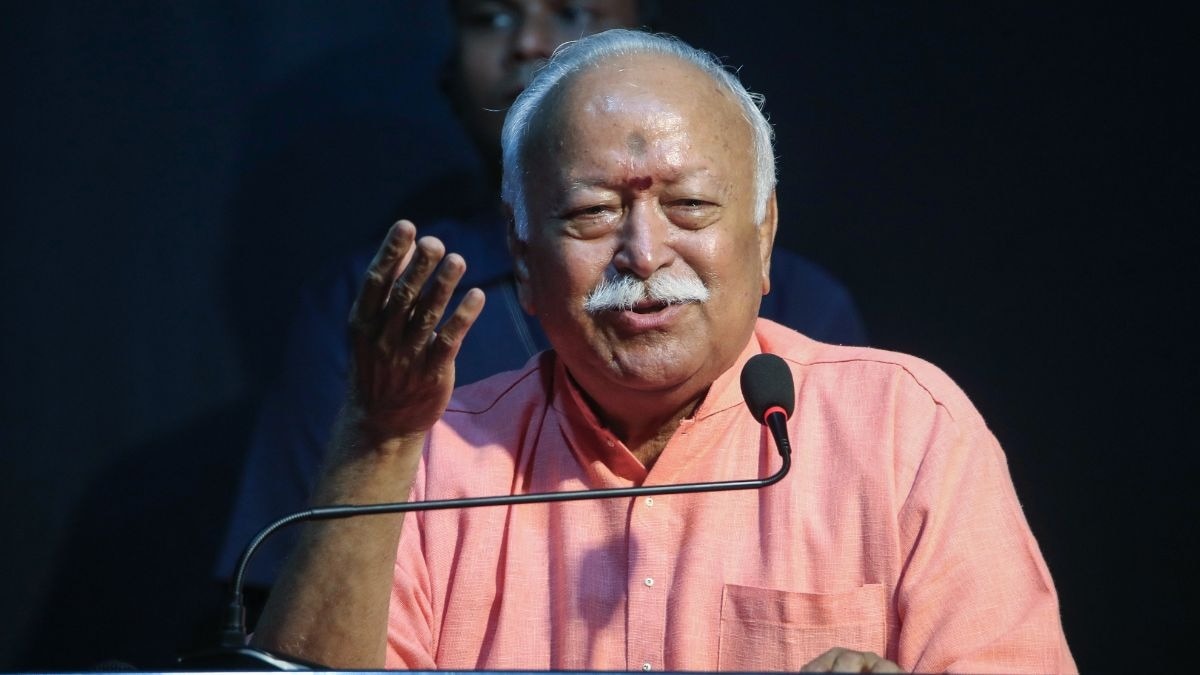
The RSS chief has said Gen Z anger is real and its protest legitimate. For the BJP and Modi regime, it means a reconnect with young Indians earned through outcomesThe Rashtriya Swayamsevak Sangh (RSS) does not do U-turns. It drifts instead. A word is swapped here, a platform chosen there, an emphasis moved so slowly that you notice it only in hindsight. That is why Sangh chief Mohan Bhagwat’s recent run of speeches to young Indians, the Gen Z, is worth reading closely, and also why the venue of the last address mattered nearly as much as its script.On August 6, at the Nita Mukesh Ambani Cultural Centre in Mumbai, and before more than 2,000 students drawn from over a hundred cities for the 15th anniversary conference of India’s International Movement to Unite Nations (IIMUM), Bhagwat said something RSS sarsanghchalaks are not often heard saying. “If you ask me to trust blindly, I’ll trust Gen Z,” he stated, calling this generation more honest than his own.Bhagwat was equally direct on the accusation that the recent crop of young protesters was working against the interests of the country. If Gen Z is agitating, he said, they “certainly aren’t anti-nationals”. What they wanted, in his account, was to be taken seriously rather than managed. “They should be heard and felt heard,” he said.Protest itself Bhagwat treated as ordinary democratic business rather than a threat. “Protest is also a way of dialogue,” he said, describing agitation as what follows when concerns go unheard through other channels. He attached one condition, which was that the purpose of it all should be to build consensus rather than to create divisions. The venue deserves as much attention as the remarks. Bhagwat did not choose a Sangh shibir or an Akhil Bharatiya Vidyarthi Parishad (ABVP) convention. IIMUN is a model UN organisation that draws school and college students of no fixed ideological address, and it has at different times put Narendra Modi and Rahul Gandhi on the same stage. This was an aspirational, urban and heavily online audience that every party in the country is currently trying to read.Bhagwat’s speech closed a sequence that ran through the previous fortnight. In Delhi on July 25, at the concluding session of the Vishwamangalya Sabha’s meeting on contemporary motherhood, he had set out the narrative shift in plain domestic terms. “When we were young, it was an era of obedience,” he said. “The new generation asks questions. We have to explain the reasoning to them.” What was required now, he added, was “not dictation, but discussion”.Two days later in Hyderabad, he turned to the generation itself, and the tone changed. Gen Z was adaptable, emotional by nature and quickly drawn to whatever struck it as visibly authentic. “They do not think with a very calm mind,” he said. He offered this as observation. A fair number of listeners heard condescension.Put the three speeches together and the arc becomes legible. The first acknowledged that the old transmission belt of authority had snapped. The second attempted to explain the people at the far end of it. The third, in Mumbai, conceded that they might actually have a point.The timing is not mysterious. Indian politics has spent months absorbing student anger over the NEET (national medical entrance) paper leak, the examination system coming under a cloud, recruitment that stalls for years, and jobs that never quite arrive. Much of that anger has come from first-time voters and the enormous population of aspirants grinding through competitive examinations. This is a cohort that grades governments on delivery, and it says so publicly and quickly, and on platforms where a narrative can turn over in an afternoon.The BJP has been adjusting to that for some time. Prime Minister Modi has promised fast-track courts for paper leak cases and a broader clean-up of the examination system, and in parallel the party has rebuilt its outreach around softer formats, such as podcasts, unstructured interviews and social media conversations, with Modi himself doing much of the work.Bhagwat’s intervention sits inside that same effort rather than apart from it, even though he is not speaking for the government and is announcing no policy. His role, as it has always been, is to set the mood within the Sangh ecosystem. Telling that ecosystem that Gen Z’s frustrations are genuine amounts to an instruction to engage rather than dismiss.What Bhagwat left out is at least as revealing. He endorsed no particular protest. He criticised no minister and no ministry. He did not point at any institution or hold it responsible for youth discontent. He warned instead against believing what circulates online without verifying it, and argued for self-imposed discipline rather than bans. And he drew a distinction between protest that strengthens democracy and protest that corrodes it, and between grievance aimed at reform and grievance aimed at confrontation. That is recognisably the old Sangh preference for social cohesion, restated for a generation that will not sit through a lecture.There is a recent precedent for the mistake Bhagwat seems determined to avoid, and it is not a comfortable one for the Sangh. When central farm laws brought hundreds of thousands of protesters to the borders of Delhi in the winter of 2020, the ecosystem around the government reached for the shortest available explanation. The protesters were Khalistani or fronting for them. They were professional agitators and foreign funded. The label moved fast through television studios and WhatsApp groups, and then it did something nobody using it had planned for. It stopped landing on the protesters and began landing on the constituency behind them.A farmer in Sangrur or Muzaffarnagar who had never been near a dharna heard himself described as a separatist on prime time. By the time the ruling ecosystem tried to construct a counter-narrative, there was no clean surface left to build one on. The laws were repealed in November 2021. The resentment stayed a good deal longer.Almost every line of Bhagwat’s Mumbai speech was engineered to prevent a repeat. The young protester was kept inside the national family as our own people, the next generation. They are not anti-national. The Sangh’s most dependable rhetorical instrument, the boundary between us and them, was deliberately holstered, and its use against the young was ruled out of order before anyone reached for it. The lesson of 2021 had been applied.The analogy only carries the BJP so far, though. Farmers were a constituency with an address. They had unions, spokespersons, a negotiating committee and a single reversible demand, and the government could repeal three laws and end the agitation in a day, however humiliating the retreat be. Gen Z offers none of that. There is arguably nobody to summon for talks, no charter to concede and no signature that repairs a broken recruitment cycle. Declining to call them anti-national removes an insult. It does not supply a remedy.It is also worth noticing where this discipline is being applied and where not. The delegitimising label was eventually retired for farmers and is being retired in advance for students—and both are constituencies the party needs and still largely holds onto. The Sangh has learned that branding a whole generation disloyal is a self-inflicted wound. It has also learned not to fall in the trap of social media campaigns from fringes and groups with vested interests. It has learned only to be careful about which groups it aims the brand at. The test will not be what Bhagwat says from a stage in Mumbai. It will be what a BJP spokesman says on television on a bad news night, and whether anyone in the ecosystem is corrected when the old reflex returns.For the BJP, however, Gen Z sympathy raises the stakes. Once the ideological parent has said in public that the young are right to be angry, the political wing loses the easy option of arguing that they have been misled. Empathy is a cheque the government now has to cash, and it will be cashed in examination calendars that hold, recruitment boards that finish what they start, and results that arrive when they were promised. Young voters are not going to accept tone in lieu of outcomes.That is the deeper construct. Political loyalty used to be inherited from a family, a caste, a neighbourhood or a union. This generation rents its allegiance rather than inheriting it. It rewards whoever is performing, it switches without much guilt, and it is far less anchored by ideological identity than the voters who came before. It is also the first cohort to experience politics almost entirely in real time, where credibility is retested every few hours and yesterday’s goodwill is not carried forward.For a BJP that has spent a decade cultivating a young and dynamic image, that is uncomfortable arithmetic. Reconnecting will take more than another round of digital campaigning. It will require rebuilding trust in the institutions that actually shape a 22-year-old’s life, among them the examination body, the recruitment board, the university and the employment office.For the RSS, whose influence has always rested on slow social work rather than election cycles, Bhagwat’s speeches suggest a translation exercise in which the same worldview is rendered into a language Gen Z will sit through. The claim is not that authority no longer matters. It is that authority must now be earned in conversation instead of assumed by seniority.Whether this is tactical repositioning or something more durable will take years to establish. What is already clear is that the Sangh has registered the shift and has stopped talking at the young in favour of talking to them. The harder part is not his to deliver. Bhagwat can open a conversation, but he cannot fill a vacancy or clean up an examination. Whether any of this converts into political trust will be settled somewhere far less rhetorical, in the recruitment lists, the results calendars and the job numbers that made the conversation necessary in the first place.Subscribe to India Today Magazine- EndsPublished By: Yashwardhan SinghPublished On: Aug 7, 2026 18:43 IST
The Gen Z reset: Mohan Bhagwat's model and the stakes it raises for BJP
Full Article
Original Source
Read the full article at Indiatoday →KhanList aggregates and links to publicly available news content. We do not host full articles from third-party sources. Always verify important information with original sources.