
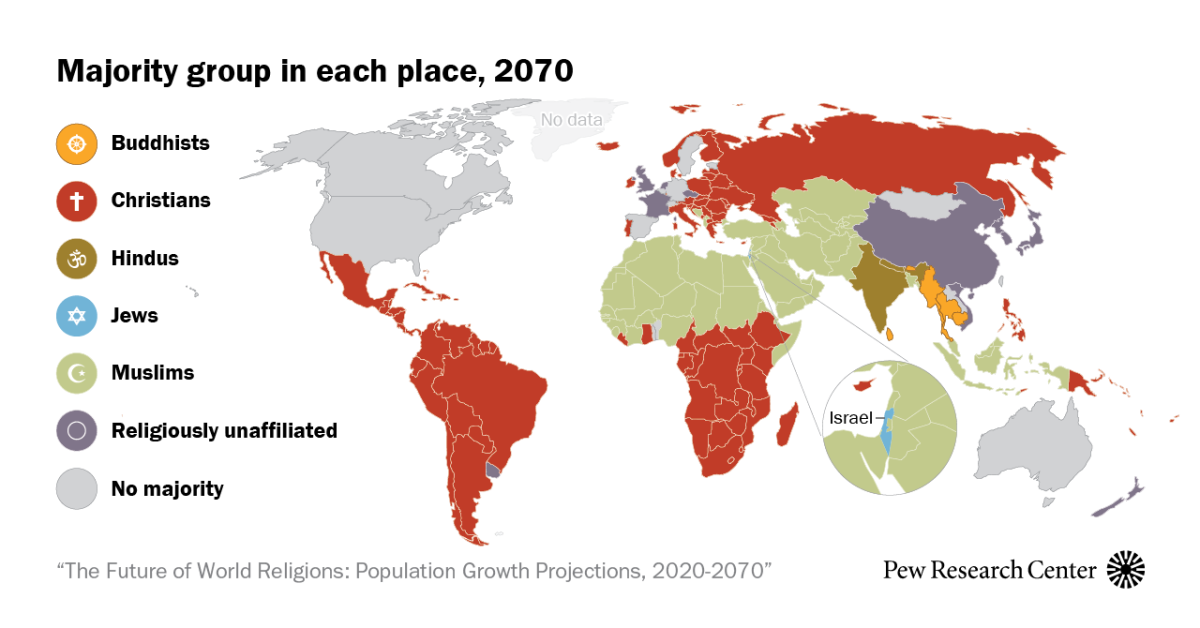
About this research This Pew Research Center study tries to answer two broad questions: First, how do the world’s major religious groups differ in their age profiles, fertility, migration patterns, and rates of attracting and losing followers? Second, how will these differences shape the future of religion around the world? We project future changes in the size and geographic distribution of seven religious groups – Christians, Muslims, Hindus, Buddhists, Jews, followers of all other religions and religiously unaffiliated people – between 2020 and 2070. The projections cover 201 countries and territories, which collectively account for 99.98% of the world’s population. The results are not intended to predict all the ways the world could change. There are many events that could affect religious group populations (including wars, natural disasters, epidemics, and changes in economic or social circumstances) that are not analyzed here. Why we did this This research is part of the Pew-Templeton Global Religious Futures project, which analyzes religious change and its impact on societies around the world. It builds on our recently published work measuring the world’s recent religious makeup. How we did this Many countries make demographic projections to try to forecast how their populations may change. The most common projection method – used by researchers for more than a century – starts by estimating the size of a country’s population in groups (“cohorts”) divided by age and sex, such as the number of girls ages 0 to 4, 5 to 9, 10 to 14, etc. Each cohort is then projected into the future, modeling how its size will change every five years with the addition of expected births (based on fertility rates) and the subtraction of expected deaths (based on mortality rates). Demographers also often attempt to forecast future levels of immigration and emigration. Our projections use an advanced version of this method. We pulled data from national censuses and surveys around the world to estimate the size and age distribution of each religious group in the baseline year, 2020. We incorporated data on differences in fertility rates between religious groups and on past patterns of movement into and out of each group, known as “religious switching.” Our projections also drew on data from the United Nations’ 2024 revision of its World Population Prospects, global migration flow estimates from University of Hong Kong professor Guy Abel, and the Center’s previous research on the religious composition of the world’s migrants. Read more in the methodology. Here is the complete list of sources used for each country and territory. Our projection model was developed in collaboration with researchers in the Center for Advanced Studies of Population and Religion (CASPAR) at Krakow University of Economics. You can explore the findings using our data explorer and sortable table. The custom software developed for these projections, which includes our input data, is available online. For centuries, Christianity has been the world’s largest religion. That may soon change. Muslims are expected to outnumber Christians by 2035, according to new projections from Pew Research Center. Both religious groups are growing in size, but Muslims are growing faster. By 2070, if recent trends continue, there will be more than 3.6 billion Muslims and just under 3 billion Christians worldwide. The world’s total population is projected to increase by 29% between 2020 and 2070. Muslims and Christians are the only religious groups analyzed here that are expected to keep pace, with Christians growing by 30% and Muslims by 80%. As a result, the size of many religious groups will change relative to the world’s overall population. Muslims will make up a larger percentage of the global population in 2070 (36%) than they did in 2020 (26%). Christians, meanwhile, will hold fairly steady at 29%. Although Hindus are growing in absolute number, they are projected to decline as a percentage of the global population. Jews are expected to follow a similar pattern.1 Meanwhile, Buddhists are expected to shrink both in number and as a portion of the world’s population in the coming decades. All other religions combined (including Baha’is, Daoists, Jains, Sikhs, adherents of folk religions and many other groups) are expected to experience a modest increase in number. However, they will slip below 2% of the global population by 2070.2 And people who have no religious affiliation – sometimes called religious “nones” – are projected to drop substantially as a share of the world population, from 24% in 2020 to 17% in 2070.3 Interested in projections for a specific religious group? Jump to sections of this study on: Christians | Muslims | Unaffiliated people | Hindus | Buddhists | Jews | Other religions What’s behind these changes? The future size of religious groups is heavily influenced by demographic trends in the countries and regions in which each group is concentrated. In the 21st century, most of the world’s population growth is expected to occur in Africa, particularly in countries south of the Sahara Desert. By 2070, more than a quarter of all people worldwide will live in sub-Saharan Africa. Since the vast majority of people who currently live there are either Christians or Muslims, the region’s high fertility and rising life expectancy will boost the global numbers of both faiths. By comparison, the populations of other major geographic regions are expected to grow more modestly, or even to shrink. For example, between 2020 and 2070, the number of people living in Europe will decline, and their share of the world’s population is projected to drop from 10% to 6%. Fertility differences have big effects on populations. Globally, Muslims tend to have more children than other major religious groups. During the 2020-2025 period, the total fertility rate for Muslims was 3.1 children per woman.4 By comparison, the rate for non-Muslims was 2.0 children per woman. The current age profile of the people in each religious group also plays a role in the projections. In younger populations, a larger share of people have yet to complete their childbearing years. On average, Muslims around the world are younger than any other religious group in this study. As of 2020, the median age of Muslims (24) was nearly a decade lower than the median age of non-Muslims (33). If recent trends continue, by 2070: More than half of the world’s Christians will live in sub-Saharan Africa. An African country, the Democratic Republic of the Congo, will surpass the United States as the country with the greatest number of Christians. The United States will no longer have a Christian majority, though Christians will remain the biggest religious group in the country. Pakistan will have the largest Muslim population, followed by India, Nigeria and Indonesia (which currently has the most Muslims). Hindus will increase the most in absolute number in India, but they will grow faster in countries outside India, including the U.S. The overall populations of China, Japan and South Korea will shrink, and their Buddhist populations will drop by more than half. Most countries will have more religiously unaffiliated people than they do now. But the increase will be entirely offset by population decline in China, where most religious “nones” currently live. 62% of all Jews will live in Israel, up from 46% in 2020. These findings are part of a broader Pew Research Center project examining how the size of seven religious groups will change globally between 2020 and 2070 if recent demographic trends continue. Our projections take into account the differences between religious groups’ age profiles, fertility rates, and patterns of religious switching and migration. (Religious switching and migration are assumed to continue at the same levels that have been recently observed.) We also incorporate mortality rates, applying the same rate to each religious group within a country. Read the methodology for more details about these projections and their limitations. The rest of this analysis explores: How each region’s religious populations will change How religious populations will change within countries How the religious majorities in countries will change Key factors behind change in the size of religious groups Evaluating earlier projections about the future of religion How each region’s religious populations will change In the coming decades, religious groups will grow and contract at different speeds, reshaping the religious makeup of the world’s six major regions. Muslims are projected to grow as a percentage of the population in all six regions, while Christians will decline in all but one (the Asia-Pacific region). Still, Christians will continue to make up about half or more of the population in most regions. If recent trends continue: Religiously unaffiliated people will rise from a quarter of all Europeans in 2020 to about a third in 2070. Over the same period, the share of the region’s population that is Muslim is expected to roughly double, from 6% to 13%. Muslims will surpass religiously unaffiliated people as the largest group in Asia and the Pacific, and Hindus will become the second-largest group. Christians will continue to make up a larger percentage of the population in Latin America and the Caribbean than in any other region, despite dropping from 85% in 2020 to 77% in 2070. Muslims will grow in number faster than Christians in sub-Saharan Africa and will make up a larger percentage of the regional population in 2070 (36%) than they did in 2020 (33%). The religious mix in the Middle East and North Africa will change little. Muslims are expected to make up 95% of the population in 2070, close to their share in 2020 (94%). North America will no longer have a Christian majority, as the portion of the population that is Christian is projected to fall from 63% to 46%. Religious change in the United States The United States is expected to follow roughly the same pattern of religious change as the overall North American region.5 By 2070, Christians are expected to decline to less than half of the U.S. population, while religiously unaffiliated people will rise to about 41%. And Jews – who were the country’s third-largest religious group in 2020 – will be outnumbered by both Muslims and Hindus in 2070 if recent demographic trends continue. The projected change among Christians and unaffiliated people will largely be driven by religious switching. Christians tend to lose more followers than they gain through switching in the U.S. In addition, unaffiliated Americans are younger, on average, than U.S. Christians. All else equal, a younger group will grow faster than an older group because the younger population contains more people of reproductive age and fewer people who are nearing the end of their natural lifespans. Looking for religious projections for a specific country? Search our data explorer for information. How religious populations will change within countries Around the world, many countries are expected to experience a substantial shift in their religious makeup between 2020 and 2070, defined in this study as an increase or decrease of at least 5 percentage points in any religious group’s share of the country’s overall population.6 The largest shifts are expected in: 61 countries and territories where the share of the total population that is Christian will decline substantially 37 places where the percentage of unaffiliated people will increase substantially 31 countries and territories where Muslims will grow substantially as a portion of the population If we compare expected changes at the global and country levels, two puzzles emerge: How can the Christian share of the world’s population stay stable if the general trend is toward declining Christian shares within many countries? How can the world experience a declining share of people who are religiously unaffiliated if many countries are expected to see a rising percentage of unaffiliated people in their populations? In both cases, change in a single region or handful of countries plays a large role in these apparent paradoxes. The greatest population growth in the coming decades is projected to occur in sub-Saharan African countries, where most people are Christian. Rapid growth among Christians in this region will offset the slower rate of growth – and in some cases, decline – of Christians elsewhere. Christian population declines will be especially pronounced in Europe, where the overall population is projected to shrink by 17% in the coming decades. European Christians are projected to experience more deaths than births and to continue to see larger numbers of people leaving the faith than converting to it. Meanwhile, the countries with the largest unaffiliated populations are projected to grow more slowly than the world’s overall population, or to shrink. Consider China, which was home to two-thirds of the world’s religious “nones” in 2020. China’s total population is expected to shrink dramatically by 2070. Consequently, even though about nine-in-ten people in China are expected to remain religiously unaffiliated during this period, the number of “nones” in China is projected to decrease by 361 million between 2020 and 2070.7 These losses will far outnumber the growth that is projected to occur among the unaffiliated population outside of China (+180 million people), causing the global unaffiliated population to decline in the coming decades. How the religious majorities in countries will change In most countries and territories, a single religious group accounts for at least 50% of the population. By 2070, this will still be the case, though a slightly smaller number of places will have religious majorities than in 2020 (185 vs. 194). Christians are expected to be the majority religion in most countries in 2070, as they were in 2020. However, the number of Christian-majority countries is expected to drop from 120 to 110 over this time span. If recent trends continue, the U.S., Canada and Germany are among the countries that will no longer have Christian majorities by 2070. While Muslims are projected to experience the greatest population growth in the decades ahead, the number of countries with Muslim majorities is expected to increase by just one – Ivory Coast – resulting in 54 Muslim-majority nations in 2070. Although the global population of religiously unaffiliated people is projected to decline, the number of countries where they form majorities is expected to rise by three – South Korea, France and the United Kingdom – to reach 13 countries in 2070. Mongolia and Laos, both of which had Buddhist majorities in 2020, are expected to see their Buddhist populations drop below 50% by the end of the projection period. The number of countries and territories in which none of the seven groups in this analysis forms a majority is expected to more than double, from seven in 2020 to 16 in 2070. Switzerland, Mongolia and Taiwan, among other places, will no longer have a majority religion.8 Key factors behind change in the size of religious groups The largest source of new members of major religions is not adults who convert to the faith, but babies who are born into the group. Globally, the three Abrahamic religions – Islam, Christianity and Judaism – are the only religious groups with total fertility rates above the level typically necessary for each generation to replace itself (2.1 children per woman).9 Muslims have the highest fertility rate, at 3.1 children per woman (as of 2020-2025), followed by Christians (2.5), while the Jewish fertility rate matches the global average (2.3). Collectively, women in the “other religions” group – an umbrella category composed of people who identify with religions other than the major groups in this study – have about 2.1 children per woman. The remaining groups have fertility rates too low to sustain their populations in the long term. By the Center’s estimates, Muslim women gave birth to more babies than women in any other religion during the 2020-2025 period. About 252 million babies were born to Muslim mothers, compared with 208 million babies born to Christian mothers. Muslims are the only major religious group expected to have growing numbers of births in the decades ahead. The other groups are projected either to have steady numbers of births or to experience gradual decline in the number of children born. These projections do not assume that fertility rates will remain constant. Rather, at the country level, fertility rates are assumed to follow the paths described by demographers in the United Nations Population Division.10 The UN anticipates gradual declines in fertility in countries that currently have very high fertility levels, as well as stability or modest increases in fertility in countries with very low rates. In the Center’s projections, the rank order of fertility rates among groups stays constant even as the average differences between groups grow smaller.11 In the 2065-2070 period, we project that rates will range from 2.2 children per Muslim woman to 1.5 children per religiously unaffiliated woman. The changing age profile of religious groups Younger populations, which include many people with their prime childbearing years still ahead, have greater potential for growth than do older populations, which include many people who are past their childbearing years. Comparing the median ages of people in various religious groups is a simple way to see how their age profiles differ. If everyone in the world had been lined up from youngest to oldest in 2020, the person in the middle – the median individual – would have been 31 years old. Muslims had the youngest median age in 2020, at 24, followed by Hindus (29) and Christians (31). Age gaps between religious groups are projected to persist. But the median age of each religious group is expected to increase in the coming decades as fertility rates decline and people live longer, on average. Religious switching For most religious groups, the Center projects that the net effect of people moving into and out of the group during their lifetimes will be modest. However, religious switching is projected to be especially consequential for two groups: unaffiliated people and Christians. Between 2020 and 2070, we expect that 117 million more people will become religiously unaffiliated than will switch from having no religion to identifying with one. The overwhelming majority of people who become unaffiliated will be former Christians. What is religious switching? Throughout this study, religious switching refers to a change between the religious group in which a person was raised (during their childhood) and their religious identity now (in adulthood). We use the term “switching” rather than “conversion” because many people have changed their religious identity by leaving their childhood religion and becoming religiously unaffiliated. In this study, our definition of switching includes changes between broad religious categories (such as from Buddhist to Christian, or from Hindu to religiously unaffiliated) but does not include changes within the same category (such as from Protestant to Catholic, both of which are Christian subgroups). The impact of religious switching versus births and deaths If we consider just the population change projected to have occurred between 2020 and 2025, we can get a sense of the relative influence of several factors. (While the 2020-2025 period is in the past, we use projections from our 2020 baseline to estimate this recent change.) Natural population change was the main cause of Muslim population growth as births outnumber deaths within the group. This is an example of natural increase. Natural increase also was the largest factor behind Christian population change, resulting in an increase of 98 million Christians over the 2020-2025 period. However, this gain was projected to be partially offset by a decline of 13 million Christians who left or “switched out” of the faith over the same period. The religiously unaffiliated population increased much more than any other group via religious switching (+15 million) during this period. “Nones” also saw some growth through natural increase (+10 million). But, in the long term, their demographic characteristics will limit their growth. Demographic challenges facing the unaffiliated population On average, religious “nones” have an older age profile and give birth to fewer children than do people who have a religious affiliation. In 2020, the median age of unaffiliated people around the world was 37, compared with 28 for religiously affiliated people. Unaffiliated people also tend to have about half as many children as religiously affiliated people. The total fertility rate for unaffiliated people in 2020-2025 was 1.3 children per woman, while people who identify with a religion had 2.5 children per woman. These demographic patterns are heavily influenced by Asian nations, including China and Japan. Collectively, the Asia-Pacific region was home to 78% of all “nones” in 2020. Outside of Asia, religiously unaffiliated people tend to be younger than their religiously affiliated counterparts. Migration and religious change Pew Research Center’s projections assume that the world’s population will remain on Earth. For this reason, migration is not projected to have much impact on religious groups at the global level.12 Because 96% of people live in the country in which they were born, migration also doesn’t have a huge effect on the religious composition of most countries. However, some countries do send and/or receive many international migrants. When those migrants have a different religious mix than the population of the country they move to, they can generate substantial religious change. Future migration patterns are difficult to anticipate. In our projections, we use a conservative set of estimates of recent migration flows from University of Hong Kong professor Guy Abel and the Center’s own estimates of the religious composition of migrants between each pair of countries. Based on this data, migration is expected to fuel some of the growth in the percentage of Europeans who are Muslim. Without migration, the Muslim share of Europe’s population would be expected to grow from 6% in 2020 to 9% in 2070. Factoring in migration, we project that Muslims will rise to 13% of the region’s population. Similarly, the share of North America’s residents who are Muslim is expected to be larger in 2070 as a result of continuing migration than it would be without migration (5% vs. 2%). In other cases, the net effect of migration is expected to be more modest. For example, by 2070 the share of people in the Middle East and North Africa who are Christian is expected to be 2.3% with migration, versus 2.0% if there were no migration. (Large numbers of non-Muslim migrants come to the region to work as migrant workers in Gulf Cooperation Council nations, although most eventually return to their country of origin rather than becoming permanent residents.) Evaluating earlier projections about the future of religion In 2012, Pew Research Center published estimates of the religious composition of the world’s population, as of 2010. Three years later, we published our first projections of the future growth of religious groups, starting from a 2010 baseline and going through 2050. How did these projections compare with the religious changes that took place worldwide between 2010 and 2020? Our projections correctly foretold both the direction and the scale of change among most religious groups in most countries.13 However, the religiously unaffiliated population grew faster than anticipated. We projected that unaffiliated people would rise in absolute numbers but begin to decline as a percentage of the world’s total population between 2010 and 2020. We now estimate – based on our latest analysis of recent census and survey data – that “nones” actually grew both in absolute numbers and in percentage terms, rising from 23% of all people around the world in 2010 to 24% a decade later. Our previous and new population projections assume that recently observed rates of religious switching will continue in the future. If rates of religious disaffiliation (i.e., people leaving religion to become unaffiliated) jump in countries where disaffiliation is already an established pattern, or if disaffiliation begins in countries where it has been rare in the recent past, our model will not capture these new dynamics. Our new projections for 2020-2070 may be conservative about the degree to which the ranks of the religiously unaffiliated will grow, especially if social scientists are correct that many countries are at different stages in a “secular transition.”14 Their hypothesis suggests that religious disaffiliation could become more widespread. On the other hand, it’s also possible that there could be a turn toward religion among “nones” in the future, a process of re-affiliation or religious revival among people who often hold some spiritual beliefs even if they don’t identify with any religious group. In the United States, the percentage of adults who are religiously unaffiliated has leveled off in recent years. After decades of decline in religious affiliation, belief and behavior, the U.S. appears to be in a period of relative stability in religion, and by some measures the youngest U.S. adults are more religious than their immediate predecessors. However, the data on religious switching that we’ve gathered from more than 100 countries does not at present show a pattern of more people joining than leaving religion. On the contrary, our recent surveys show that most religious switching has been by people who were raised in a religion and are now unaffiliated. Guide to other parts of this study This study on the Future of World Religions digs deeper into the factors driving demographic change, and how the population of each group and each geographic region is expected to change. Jump to other parts of this study on: Key factors shaping the global future of religions The future of the global Muslim population The future of the global Christian population The future of the religiously unaffiliated population around the world The future of the global Hindu population The future of the global Buddhist population The future of the global Jewish population The future of the global population of other religions The future of religion in the Asia-Pacific region The future of religion in Europe The future of religion in Latin America and the Caribbean The future of religion in the Middle East-North Africa region The future of religion in North America The future of religion in sub-Saharan Africa
The Future of World Religions: Population Growth Projections, 2020-2070
Full Article
Original Source
Read the full article at Pewresearch →KhanList aggregates and links to publicly available news content. We do not host full articles from third-party sources. Always verify important information with original sources.