
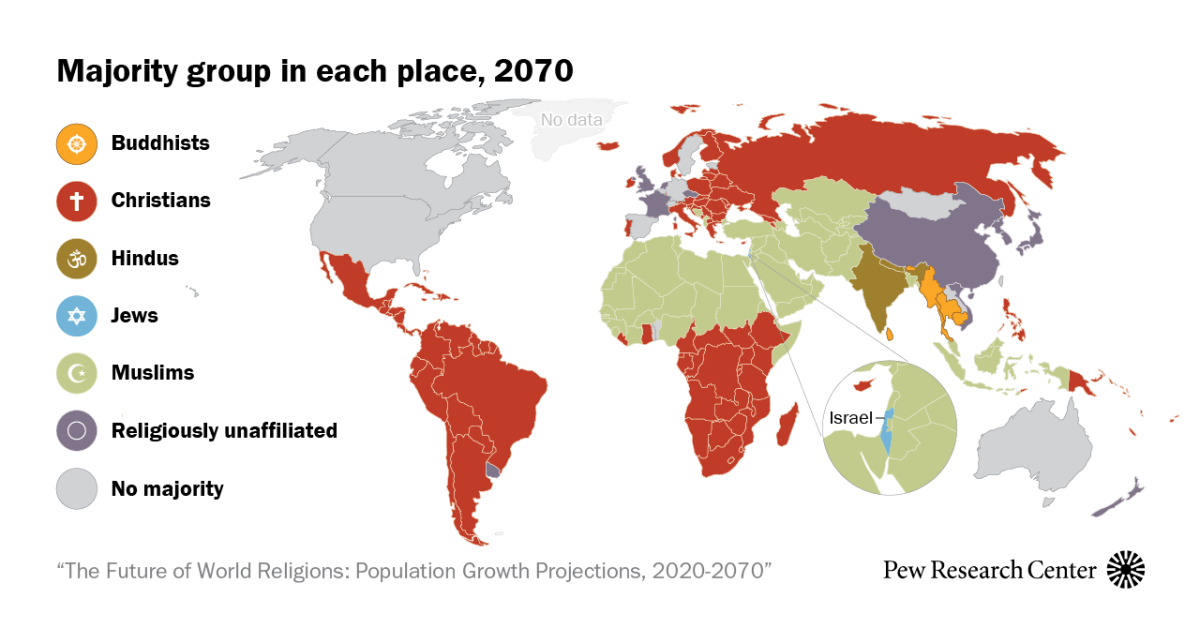
About this research This Pew Research Center study tries to answer two broad questions: First, how do the world’s major religious groups differ in their age profiles, fertility, migration patterns, and rates of attracting and losing followers? Second, how will these differences shape the future of religion around the world? We project future changes in the size and geographic distribution of seven religious groups – Christians, Muslims, Hindus, Buddhists, Jews, followers of all other religions and religiously unaffiliated people – between 2020 and 2070. The projections cover 201 countries and territories, which collectively account for 99.98% of the world’s population. The results are not intended to predict all the ways the world could change. There are many events that could affect religious group populations (including wars, natural disasters, epidemics, and changes in economic or social circumstances) that are not analyzed here. Why we did this This research is part of the Pew-Templeton Global Religious Futures project, which analyzes religious change and its impact on societies around the world. It builds on our recently published work measuring the world’s recent religious makeup. How we did this Many countries make demographic projections to try to forecast how their populations may change. The most common projection method – used by researchers for more than a century – starts by estimating the size of a country’s population in groups (“cohorts”) divided by age and sex, such as the number of girls ages 0 to 4, 5 to 9, 10 to 14, etc. Each cohort is then projected into the future, modeling how its size will change every five years with the addition of expected births (based on fertility rates) and the subtraction of expected deaths (based on mortality rates). Demographers also often attempt to forecast future levels of immigration and emigration. Our projections use an advanced version of this method. We pulled data from national censuses and surveys around the world to estimate the size and age distribution of each religious group in the baseline year, 2020. We incorporated data on differences in fertility rates between religious groups and on past patterns of movement into and out of each group, known as “religious switching.” Our projections also drew on data from the United Nations’ 2024 revision of its World Population Prospects, global migration flow estimates from University of Hong Kong professor Guy Abel, and the Center’s previous research on the religious composition of the world’s migrants. Read more in the methodology. Here is the complete list of sources used for each country and territory. Our projection model was developed in collaboration with researchers in the Center for Advanced Studies of Population and Religion (CASPAR) at Krakow University of Economics. You can explore the findings using our data explorer and sortable table. The custom software developed for these projections, which includes our input data, is available online. The global Buddhist population is on a downward trajectory. Between 2010 and 2020, the number of Buddhists around the world dropped by roughly 19 million. By Pew Research Center’s projections, the Buddhist population is expected to continue shrinking steadily through 2070. If current demographic trends continue, Buddhists will decline by an additional 74 million people, from 324 million in 2020 to 250 million in 2070. By the end of that period, they will make up 2.5% of the world’s total population, down from 4.1% in 2020. Most of the contraction is expected to occur in Asia and the Pacific, where 98% of all Buddhists lived in 2020. The number of Buddhists in the Asia-Pacific region is projected to decrease by 76 million due to a combination of religious disaffiliation and the older age profile and low fertility of Buddhists living there. Buddhists also are expected to decline as a proportion of the region’s overall population, from 7% to 5%. Three East Asian countries, in particular, are expected to drive the decline in the global Buddhist population: Japan, China and South Korea. The overall populations of these countries are shrinking, and Buddhists are expected to decline at an even faster pace. This pattern also holds for Thailand, which has more Buddhists than any other nation but is expected to have 14 million fewer Buddhists in 2070 than it did in 2020. Buddhist populations in other major geographic regions are projected to change little, or even to grow somewhat, but not enough to offset the declines in Asia and the Pacific. Challenges of measuring Buddhist identity The 2020 estimates for Buddhists in this analysis are based primarily on censuses and surveys that ask about religious identity, typically with the question “What is your religion, if any?” In several East Asian places, common translations of “religion” often refer to organized, hierarchical forms of religion, such as Christianity. Yet many people who do not affiliate with Buddhism still engage in Buddhist beliefs or practices. In places such as China, Japan, South Korea and Vietnam, Buddhism tends to be deeply embedded with local folk religions, and the lines between Buddhism and other religious traditions are blurry – both to practitioners of these traditions and to scholars who study them.For more on the characteristics of self-identified Buddhists, read our reports “Measuring Religion in China” and “Religion and Spirituality in East Asian Societies.” Our demographic projections point to several other changes in the Buddhist population in the decades ahead. By 2070, we project … Buddhists will remain the world’s fifth-largest religious group (out of the seven religious categories this study analyzes). The number of Buddhists living in China, Japan and South Korea will drop by more than half. Buddhists will no longer make up a majority of the population in Mongolia or Laos. These findings are part of a broader Pew Research Center study examining how the size of seven religious groups will change globally between 2020 and 2070 if recent demographic trends continue. Our projections take into account the differences between religious groups’ age profiles, fertility rates, and patterns of religious switching and migration. (Religious switching and migration are assumed to continue at the same levels that have been recently observed.) We also incorporate mortality rates, applying the same rate to each religious group within a country. Read the methodology for more details about these projections and their limitations. Read more about our projections for Buddhists: Which regions of the world will have the most Buddhists? Which countries will have the most Buddhists? Where will the Buddhist share of the population change the most? Countries where Buddhism will no longer be the majority religion Key factors driving change in the Buddhist population Which regions of the world will have the most Buddhists? As of 2020, the vast majority of the world’s Buddhists live in the Asia-Pacific region. This will still be the case in 2070, when 96% of all Buddhists are projected to live in Asia and the Pacific. The small share of the global Buddhist population living in other regions is expected to change modestly by 2070. For example, Europe is expected to hold 2% of the world’s Buddhists in 2070, compared with 1% in 2020. Projected change in the Buddhist population within regions Another way to analyze change is to look at populations within regions. Between 2020 and 2070, the share of the population in the Asia-Pacific region that is Buddhist is projected to decline from 7% to 5%. The absolute number of Buddhists there is expected to decrease by 76 million. Buddhists also are projected to decline slightly as a share of the population in North America, where the group is relatively old and has a low fertility rate. If current trends continue, Buddhists will make up 1.1% of the North American population in 2070, a slight decline from 1.3% in 2020. The number of Buddhists in that region is projected to decrease by 380,000. Meanwhile, the European Buddhist population is projected to grow in number by 2 million, largely through immigration. As a result, Buddhists will make up a slightly larger portion of the region’s population in 2070 (0.7%) than they did in 2020 (0.3%). Which countries will have the most Buddhists? As of 2020, Thailand has the world’s largest Buddhist population, with 68 million people. China (53 million); Myanmar, also known as Burma (47 million); Japan (47 million); and Vietnam (23 million) round out the top five. These five countries collectively hold 73% of the world’s Buddhists. The number of Buddhists in Thailand is projected to decline to 53 million by 2070, but the country still is expected to have the world’s largest Buddhist population. If current demographic trends continue, China’s Buddhist population will shrink by roughly half, from 53 million in 2020 to 26 million by 2070. China is projected to fall to third place in the rankings as a result. Laos will rise to rank ninth with 5 million Buddhists, while Malaysia will fall off the list of places with the 10 largest Buddhist populations. Refer to our sortable table to see how 201 countries and territories rank in the size of their Buddhist populations. In six countries, the portion of the population that is Buddhist is expected to change substantially (i.e., by at least 5 percentage points) by 2070. In all these places, the Buddhist share of the population is projected to decline, ranging from a 15-point drop in Laos to a 7-point decrease in Vietnam. The portion of Malaysia’s population that is Buddhist will shrink from 19% to 10% by 2070. Along the way, the country will fall off the list of the top 10 places with the most Buddhists. Countries where Buddhism will no longer be the majority religion Two countries that had a Buddhist majority in 2020 are projected to see their Buddhist populations drop below 50% by 2070: Mongolia and Laos. The other five countries that were majority-Buddhist in 2020 are expected to remain so in 2070. In Cambodia, Thailand and Myanmar, Buddhists are projected to make up 90% or more of the population. Buddhists in Bhutan and Sri Lanka, meanwhile, will live alongside relatively large Hindu populations in 2070. Buddhists are not projected to grow into a majority in any additional countries over the projection period. Key factors driving change in the Buddhist population Several dynamics determine whether a religious group grows or shrinks in size. Demographic factors – such as age structure, fertility and mortality – shape populations through births and deaths. International migration also plays a role, as does “religious switching,” or people moving into and out of religious groups (including disaffiliation from religion altogether). Buddhists are projected to decrease in number around the world between 2020 and 2070, with both religious switching and natural decrease playing large roles. (Natural decrease occurs when deaths outnumber births in a population.) Religious switching Based on recent surveys, we estimate that 83% of all people who were raised Buddhist still identify that way as adults. The only group analyzed in this study that has a lower global retention rate is the “other religions” umbrella category, at 78%. Buddhists’ retention rate is similar to the rate for Christians (85%), but lower than the rates of Hindus and Muslims (99% each). What is religious switching? Throughout this study, religious switching refers to a change between the religious group in which a person was raised (during their childhood) and their religious identity now (in adulthood). We use the term “switching” rather than “conversion” because many people have switched their religious identity by leaving their childhood religion and becoming religiously unaffiliated. In this study, our definition of switching includes changes between broad religious categories (such as from Buddhist to Christian, or from Hindu to religiously unaffiliated) but does not include changes within the same category (such as from Protestant to Catholic, both of which are Christian subgroups). Among people who were raised Buddhist, 17% no longer identify with the religion. This includes 15% who have disaffiliated from religion altogether and 2% who have “switched into” (or joined) another religion.53 Religious disaffiliation is particularly common among Buddhists in East Asia. Losses from religious switching will be especially pronounced in Asia and the Pacific, which is projected to see a decrease of nearly 7 million Buddhists through switching over the projection period. Natural population change The youthfulness of a population is an important factor in future growth. All else being equal, a population that begins with a relatively large percentage of people who are in – or soon will enter – their prime childbearing years will grow faster than a population that is older. Globally, Buddhists have a relatively old age profile (or “age structure”). For example, 22% of Buddhists worldwide are ages 60 and older, compared with 13% of non-Buddhists, according to our 2020 demographic estimates. An additional 21% of Buddhists are ages 45 to 59. The age profile of Buddhists varies little around the world. In most regions where data is available, Buddhists’ median age is 40 or older. North American Buddhists are slightly older than Buddhists living elsewhere, with a median age of 43. Refer to our accompanying data explorer to see how the age structure of Buddhists is projected to change over time. Buddhists also have a low total fertility rate of 1.6 children per woman, according to our demographic estimates for the 2020-2025 period. (The total fertility rate is the average number of children a hypothetical woman would have over her lifetime if she experienced the birth rates that were estimated for women of reproductive age during a particular period, such as 2020 to 2025.) Buddhists’ global fertility rate is lower than the rate for non-Buddhists (2.3) and below the replacement level, which is generally estimated at 2.1 children per woman in countries with low mortality rates for infants and children.54 Of the 23 countries and territories for which Buddhist fertility data is available, just three have Buddhist fertility rates above 2.1 children per woman: Mongolia (2.7), Cambodia (2.6) and Indonesia (2.3). Buddhist fertility rates are ultralow (i.e., below one child per woman) in Taiwan (0.9), New Zealand (0.8), South Korea (0.8), Singapore (0.8) and Hong Kong (0.7). Migration While migration doesn’t have much effect on the size of the global Buddhist population, it does impact regional populations.55 Nearly 3 million Buddhists are expected to move between regions by 2070. North America is expected to experience the largest net increase through migration, with roughly 1.3 million more Buddhists projected to move into the region than to leave between 2020 and 2070. Europe also is set to gain more than 1 million Buddhist immigrants, most of whom are expected to come from China, Thailand, Sri Lanka and Vietnam. The Asia-Pacific region, meanwhile, is projected to see the largest net loss, with far more Buddhists leaving (2.6 million) than entering (180,000) the region. RECOMMENDED CITATION:Hackett, Conrad, Marcin Stonawski, Yunping Tong, Stephanie Kramer, Rebecca Leppert and Jeff Diamant. 2026. “The Future of World Religions: Population Growth Projections, 2020-2070.” Pew Research Center. doi: 10.58094/qx43-nn81.
The Future of the Global Buddhist Population
Full Article
Original Source
Read the full article at Pewresearch →KhanList aggregates and links to publicly available news content. We do not host full articles from third-party sources. Always verify important information with original sources.