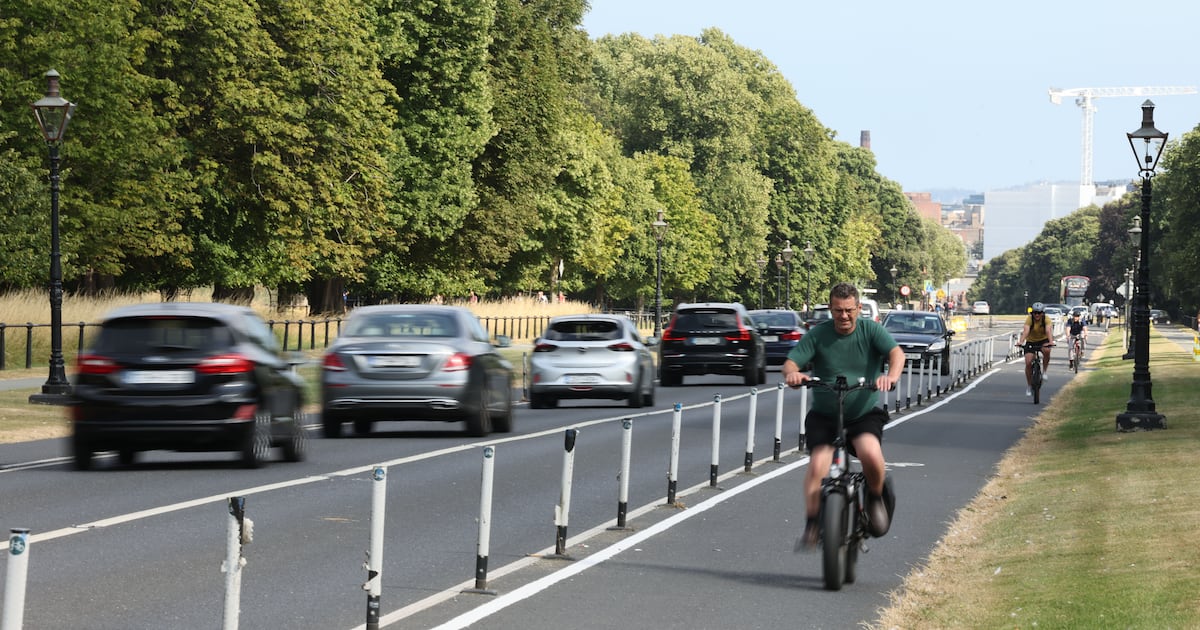
Dubliners, fond of superlatives to describe their city, might tell you that Phoenix Park is the biggest city park in Europe. A more restrained interlocutor will add a few modifiers, telling you it’s the biggest enclosed park in any European capital.The Office of Public Works (OPW), custodian of the park since 1860, goes further, telling us it is one of the largest enclosed public parks in any capital city in Europe – although if it changed Europe to the EU it might now dispense with that first caveat.At 1,752 acres it is certainly an impressive size, if that’s what you’re after in a park; bigger than London’s Hyde Park, Regent’s Park, St James’s Park, Greenwich Park and Kensington Gardens put together, although not as big as London’s Richmond Park (hence the now potentially redundant caveat).The element of enclosure is actually crucial to the park’s history and identity and largely explains how the OPW has been able to protect the huge swathe of green space so close to the city and surrounding suburbs from development.READ MOREThe wall enclosing the park was first built in 1662 to form a royal deer park and hunting grounds. The fallow deer remain one of the best-known features of the park to this day.The creation of the park was essentially a political project, designed to demonstrate the “splendour of government” following the restoration of the English monarchy and the return of King Charles the second to the throne in 1660, retired chief park superintendent John McCullen tells us in his Illustrated History of the Phoenix Park.The first record of the name “Phoenix” appears a few decades earlier, in state papers dating from 1619 where “His Majesty’s House at Kilmaynham called the Phoenix” refers to a Jacobean mansion built on a height on the southern side of the park, its name a corruption of the Irish fionn-uisce.Phoenix House was demolished the following century to make way for the Magazine Fort, the army gunpowder storage facility built in 1736 that still stands and has just opened following a restoration project.Renovated exterior walls at the Magazine Fort in Phoenix Park. Photograph: Alan Betson / The Irish Times Not long after the fort was built, the royal park was opened to the public by the Earl of Chesterfield in 1747. Not everyone was thrilled by this development. By the 1770s the Freeman’s Journal was lamenting the admission of every “Tag, Rag and Bobtail. The Sabbath is abused by permitting a hurling match to be played there every Sunday evening, which is productive of blasphemous speaking, riot, drunkenness, broken heads and dislocated bones, among ten thousand of the lower class; and meanwhile the deer are hunted by detached parties of these vagrants and their dogs.”By 1781 decorum had left the park almost entirely with whiskey being sold from between 200-300 tents, McCullen says.In the 1800s the Commissioners of Woods and Forests brought in London park designer Decimus Burton to produce a master plan for the lands. Much of how the park appears today, from its landscapes to its lodges, dates from this time.More socially acceptable sporting activities were also established in this period. Phoenix Cricket Club, the oldest cricket club in Ireland and one of the oldest in the world, formed in 1830 and the All Ireland Polo Club was founded in 1873 by Horace Rochfort, making it the oldest polo club in Europe.The zoo opened in 1831 followed by the Promenade Grounds, now the People’s Gardens, at the eastern end of the park in 1840 creating formal visitor attractions.In 1861, a year after the transfer of control to the OPW, the Wellington Monument was finally completed following an almost 50-year construction project. At 62m it remains the tallest structure in the park, almost twice the height of the 35m papal cross built more than a century later for the first papal visit in 1979.Deer in Phoenix Park. Photograph Nick Bradshaw / The Irish Times As well as the deer, the park is home to more than 40 species of birds, 351 species of plants, including the wonderfully named and rare Hairy Violet, and more than half of the mammal species recorded in Ireland.There are also a surprising number of houses – more than 40. Some are among the park’s most prominent landmarks, such as the President’s residence Áras an Uachtaráin, built in 1751 as the viceregal lodge, and the 1776 chief secretary’s lodge, now the US ambassador’s residence. Most are more modest, though still impressive, houses in the main and are primarily allocated to park staff.While formal sports grounds are well established in the park – in addition to the polo and cricket grounds, there are soccer pitches, and even hurling has been allowed back – the park is also a haven for less formal recreation with large numbers of walkers, runners and cyclists using it every day.The park is undeniably a magnificent resource, but it is not without its problems.The safety of those walkers, runners and cyclists is significantly compromised by the continuing dominance of cars.The park’s bylaws date from 1926 and are anachronistic, to put it mildly, referring to prohibitions on the use of charabancs – a horse-drawn forerunner to the minibus – and imposing a penalty “not exceeding five pounds” for breaches of the bylaws.The first management plan for the park was not produced until 1986, the same year Phoenix Park was designated a National Historic Park. Its primary purpose was to conserve the historic landscape of the park, but this was seen as unachievable without controls on traffic, which had surged over the decades.[ Subscriber Only Ireland ‘We rented houses at first but then said: Let’s just buy a caravan’Opens in new window ]The curbs on cars were modest. A small number of minor routes were closed, Chesterfield Avenue (the 4km main road through the park) was narrowed slightly, and the speed limit was reduced from 40mph to 30mph – 64km/h to 48km/h.It didn’t do much to reduce traffic volumes, which by the mid-1990s had reached 20,000 cars a day.The next concerted attempt to bring traffic under control was not until 2006, when the OPW put forward a plan to make all the gates of the park either exit or entry only, with the exception of the Parkgate Street, Castleknock and North Circular Road gates, and reduce the speed limit on part of Chesterfield Avenue to 30km/h.In the end, only the Chapelizod and Islandbridge gates were made one way, speed limits weren’t cut, but parking was removed from the east end of Chesterfield Avenue, from Parkgate Street to just before Dublin Zoo, and Military Road was turned into a cul-de-sac.A shuttle bus service was introduced on Chesterfield Avenue in 2008, but didn’t last and was discontinued two years later.The next significant plan for the park was the 2011 Conservation Management Plan. As the name suggests, this was more than just a car control plan. It referenced concerns over the statutory protections for the park, its landscapes and wildlife, and the “urgent need” to update the bylaws and the 1925 Phoenix Park Act. It also committed to bring the Magazine Fort back into sustainable use.Traffic in Phoenix Park is an issue. Photograph: Alan Betson / The Irish Times However, controlling the traffic levels remained a key concern, with the park at that stage catering for “an average 25,000 vehicles per day, the majority of which are merely passing through”, it said. “The extent of through traffic has a negative impact on the overall amenity value of the Park.”It said: “Specific measures need to be taken to redress the balance to ensure that the general public can enjoy the park as primarily a place of historic serene beauty, where passive recreational activities open to all enjoy the greatest possible priority. The achievement and realisation of this core objective must have central focus in all management policies.” It proposed prohibition or restriction of north-south through traffic and the closure of most roads to traffic at evenings and weekends. Chesterfield Avenue was closed at weekends periodically over a number of years, but the practice was eventually discontinued.In 2019, the OPW published a Visitor Experience Review which put forward proposals again to restore the Magazine Fort, and also to expand the Visitor Centre at Ashtown Castle. Some more “ambitious” proposals were also put forward such as driverless shuttle buses, a train station and a funicular which would run from the fort to connect with a new bridge proposed in the neighbouring Irish National War Memorial Gardens.The public were unenthusiastic about the funicular and it was dropped, but there were wide-ranging views about other transport facilities and the OPW undertook to conduct a separate mobility study.The following year, 2020, Covid-19 hit and presented the OPW with something of an opportunity. The hard shoulder on Chesterfield Avenue, which had become a long, unrelenting commuter car park, was turned into a cycle path and all gates, except the Casteknock Gate and Parkgate Street entrances, were shut.Ministerial orders saw those gate closures reversed with the easing of Covid restrictions, but the Chesterfield cycle paths remained.Margaret Gormley, chief park superintendent, at the Magazine Fort. Photograph: Alan Betson / The Irish Times In 2021 the Transport and Mobility Options Study was published. It recommended the closure of one park gate, the Cabra Gate, for a new bus route from Heuston Station to Broombridge Station, serving Dublin Zoo and the Visitor Centre. It also proposed a system of culs-de-sac and road closures to dissuade motorists from using the park as a through route.Speed limits would be reduced from 50km/h to 30km/h and pedestrian crossings would be introduced along the length of Chesterfield Avenue.In February 2022 the 30km/h speed limit was introduced, and a stretch of just under 1km of Upper Glen Road was made car-free. North Road was made one-way from the Cabra Gate to Dublin Zoo, with one lane of traffic in the centre of the road, flanked by parking spaces and a two-way cycle lane.But the bus plan was shelved when it emerged the Cabra Gate was too narrow, and although a bus route eventually began operating in the park in May 2023, this service (the 99) only operates from Parkgate Street to the Visitor Centre and back, replicating the old shuttle discontinued in 2010.The Magazine Fort is now open to tours and a design team has been appointed for the Visitor Centre project. However, the train station was seen as financially unviable by the Department of Transport. The bylaws remain unaltered 100 years on.Current chief park superintendent Margaret Gormley says she is committed to developing “sustainable transport” for the park and to the reduction in through traffic and its speeds.“It’s going in the right direction. We’ve closed roads, North Road became one-way, we haven’t got the whole loop of traffic around the park. We’ve increased the cycle lanes. We’ve done a number of measures to try and make the park safer,” she says“There are a lot more people cycling and walking, but we are always striving to improve. The OPW is ambitious for the Phoenix Park.”Monday: Kitty Holland on homelessness and housing at Phoenix Park
The future of Phoenix Park: How historic park is facing challenge of an expanding city
Full Article
Original Source
Read the full article at Irishtimes →KhanList aggregates and links to publicly available news content. We do not host full articles from third-party sources. Always verify important information with original sources.